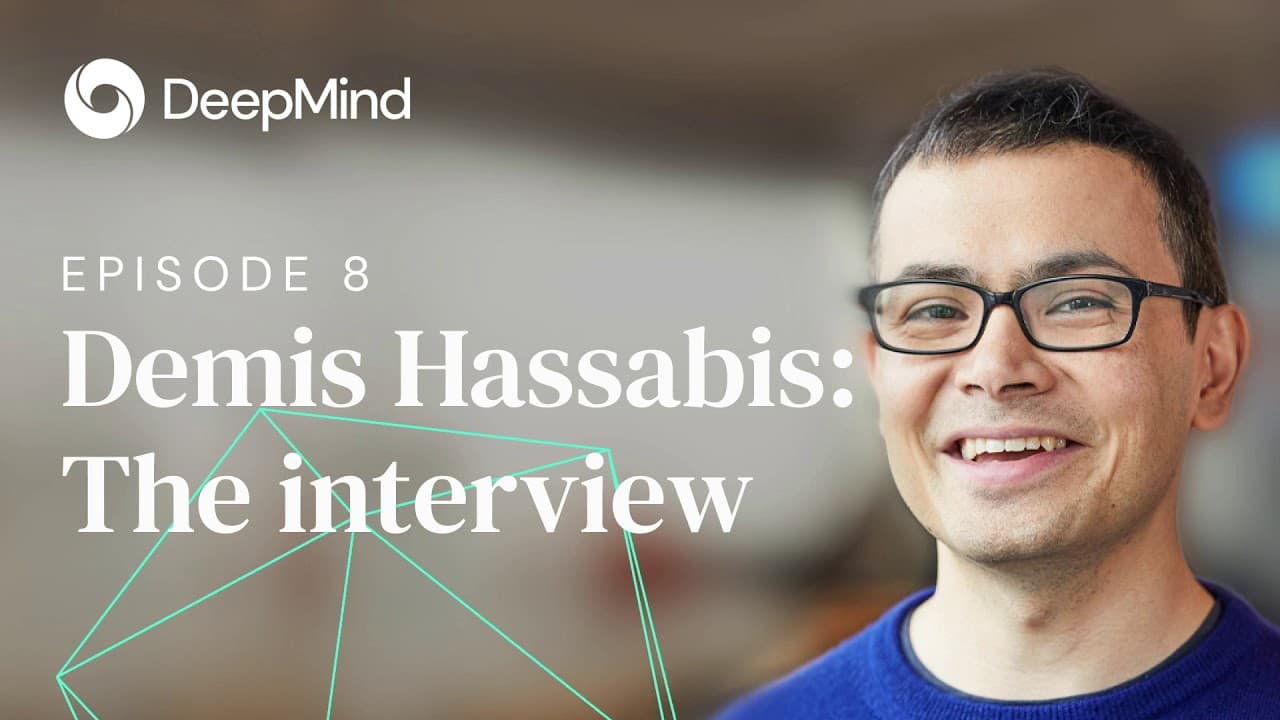
Demis Hassabis on Building DeepMind and AI
TL;DR
DeepMind combines neuroscience-inspired AI research with the focus, pace, and engineering capacity of a startup. Demis Hassabis argues that the brain should guide algorithm design and validation without being copied neuron by neuron, while games provide controlled environments for testing intelligence. His work on memory and imagination also shaped DeepMind’s efforts to give AI systems similar capabilities.
Transcript
Hannah: So here we are, the last episode in this series of the DeepMind podcast. My name is Hannah Fry. I am a mathematician, and someone who is deeply intrigued by artificial intelligence. Much like you, I imagine, since you made it this far. Now we’ve been toying with the big questions in this series. What is intelligence? How does an algorithm l... Read More
Key Insights
- • Hassabis’s career path was a deliberate preparation for AI research, combining chess, game design, computer science, and cognitive neuroscience to acquire the skills and experiences needed to create a company like DeepMind.
- • Games are useful environments for developing AI because they require intelligent use of limited assets and provide a practical vehicle for proving algorithms. Hassabis’s game-design experience also taught him creative visualization and the management of large engineering projects.
- • Imagination is a form of internal future simulation that supports planning and creativity. Hassabis used visualization when designing games, mentally exploring how players might experience changes before investing the effort required to program them.
- • The hippocampus is critical for both memory and vivid imagination, according to the PhD research Hassabis describes. This shared role suggested that the mind may use related processes for recalling past experiences and simulating possible situations.
- • Neuroscience provides inspiration for AI by suggesting useful algorithms, architectures, and representations. Hassabis considers the brain especially valuable because it demonstrates that intelligence is possible and offers scientific signposts when researchers are exploring unknown territory.
- • Neuroscience validates promising AI approaches when comparable mechanisms appear in the brain. Hassabis uses reinforcement learning as an example, arguing that its presence in a general intelligence supports continued engineering effort even when an initial implementation fails.
- • Brain-inspired AI should focus on systems-level algorithms and architectures rather than copying every neuronal implementation detail. Hassabis expects silicon-based computers and carbon-based minds to require different implementations because their strengths and weaknesses differ.
- • DeepMind combines startup speed and focus with academia’s blue-sky research and peer-reviewed scientific culture. Hassabis says this hybrid model enables long-term inquiry, strong publication output, and engineering-intensive achievements that would be difficult for a small academic laboratory.
Install to Summarize YouTube Videos and Get Transcripts
Explore YouTube Video Summarizer or Get YouTube Transcript Extractor
Questions & Answers
Q: How did Demis Hassabis prepare to create DeepMind?
Demis Hassabis says he worked backward from the goal of creating an AI research company and selected experiences that would give him the necessary skills. Chess taught him to use limited assets effectively, game design developed creative and engineering abilities, computer science supplied technical foundations, and cognitive neuroscience helped him investigate how brain mechanisms might inspire artificial intelligence algorithms.
Q: Why does DeepMind use games to test AI algorithms?
Games provide structured environments in which an AI system can demonstrate learning, planning, and effective use of available resources. Hassabis also viewed them as a logical development path because of his experience as a chess player and games designer. He says games became DeepMind’s main vehicle for proving its algorithms, linking his earlier work directly to the company’s research program.
Q: What did Demis Hassabis study during his PhD?
Hassabis studied cognitive neuroscience at UCL with Eleanor Maguire, focusing on how memory and imagination work in the brain. He was particularly interested in imagination as a way of mentally simulating the future for planning and creativity. The research concluded that the hippocampus, already known as critical for memory, is also necessary for vivid imagination.
Q: How are memory and imagination connected in the brain?
Hassabis describes memory and imagination as related functions centered on the hippocampus. Remembering reconstructs experiences that have already occurred, while imagination creates vivid simulations of possible situations. His PhD research found that people cannot imagine vividly without the hippocampus, supporting his idea that the mind may use a shared simulation process for recollection, planning, and creativity.
Q: How does neuroscience help researchers build artificial intelligence?
Neuroscience helps AI research in two ways, according to Hassabis. First, brain research can inspire new algorithms, architectures, or representations. Second, it can validate ideas developed through engineering or mathematics. If the brain uses a comparable mechanism, researchers gain evidence that the general approach could contribute to intelligence and may justify further engineering work when early attempts do not succeed.
Q: Should artificial intelligence copy the human brain exactly?
Hassabis argues that AI should not copy the brain exactly at the neuronal level. He favors a systems neuroscience approach that studies the algorithms and architectures used by the brain, then adapts those principles for computers. Silicon-based systems and carbon-based minds have different strengths and weaknesses, so their implementation details do not need to be identical even when their higher-level functions are related.
Q: How does DeepMind combine startup and academic research cultures?
DeepMind combines the focus, energy, pace, and organizational momentum of a startup with academia’s bright researchers, long-term questions, blue-sky thinking, and willingness to explore unknown areas. Hassabis believed these qualities were not mutually exclusive. He says the hybrid structure supported both peer-reviewed scientific output and engineering-intensive breakthroughs such as AlphaGo, which would have been difficult for a small academic laboratory.
Q: Why does DeepMind publish its artificial intelligence research?
DeepMind publishes its work because Hassabis views open scientific discourse and peer review as the proper way to conduct science. Publication allows other experts to scrutinize the research at a high level and gives its ideas broader exposure. He also argues that sharing findings helps the entire field advance more quickly than it would if every organization kept its ideas secret.
Summary & Key Takeaways
-
Demis Hassabis deliberately built a career spanning chess, game design, computer science, and cognitive neuroscience in preparation for creating an AI research company. Chess taught him to maximize limited assets, while designing games developed creative thinking, visualization skills, and experience managing major engineering projects. Games later became DeepMind’s principal testing vehicle for AI algorithms.
-
Hassabis studied memory and imagination because both are essential to human intelligence, planning, and creativity. His PhD research found that the hippocampus is critical not only for memory but also for vivid imagination. That connection influenced DeepMind’s continuing effort to incorporate memory and imagination abilities into artificial intelligence systems.
-
DeepMind was designed as a hybrid organization combining startup focus, energy, pace, and engineering with academia’s long-term questions, scientific talent, and exploratory thinking. Hassabis says this structure supported academic output and engineering-heavy breakthroughs such as AlphaGo. DeepMind also publishes its research for peer scrutiny and faster exchange of ideas across the field.
Read in Other Languages (beta)
Share This Summary 📚
Summarize YouTube Videos and Get Video Transcripts with 1-Click
Try YouTube Summary with ChatGPT & Claude or YouTube Transcript Generator
Explore More Summaries from Google DeepMind 📚

Summarize YouTube Videos and Get Video Transcripts with 1-Click
Try YouTube Summary with ChatGPT & Claude or YouTube Transcript Generator