How Do You Build and Deploy a Python API with Flask? | 🐙 Lunch & Learn Workshop
TL;DR
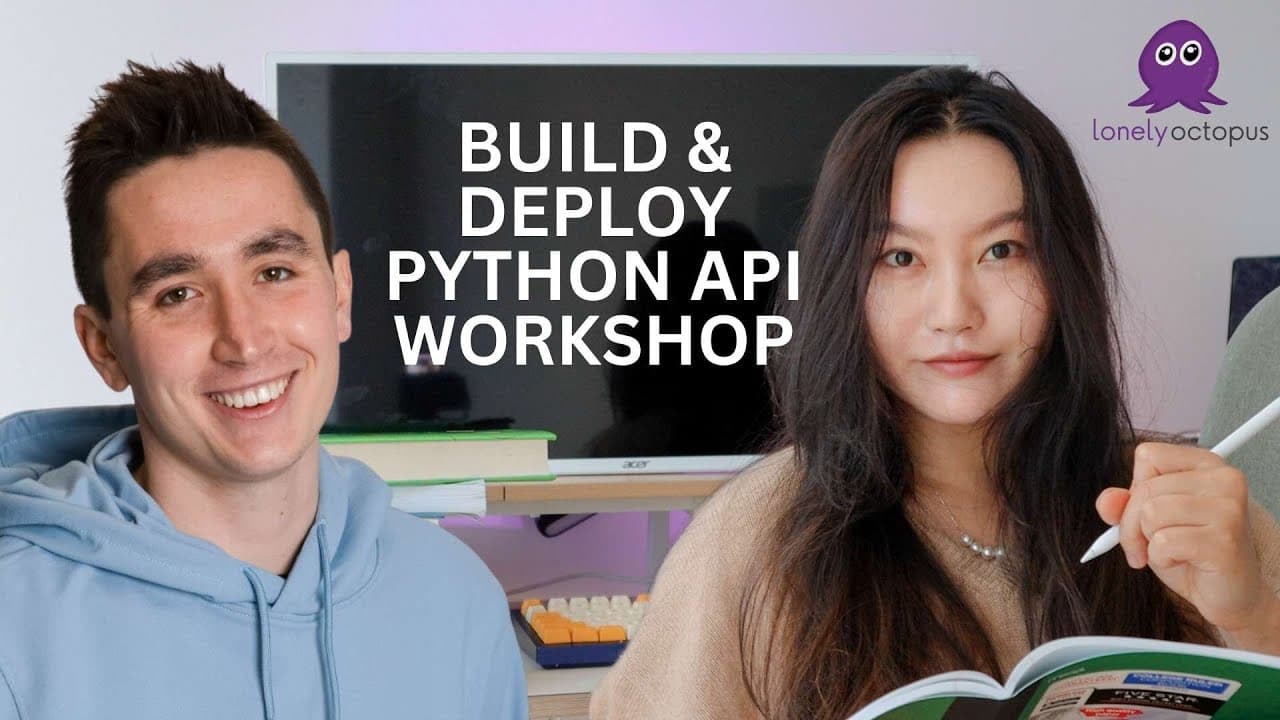
You can build and deploy a Python API by creating endpoints with Flask, documenting them with Swagger, and publishing the server through Render.com. Keith Galli demonstrates the process with starter code from GitHub, Flask-Restful, Gunicorn, and a book-review app example. Read on for the workshop’s tools, workflow, deployment approach, and explanation of why APIs make Python code more accessible.
Transcript
cool and we are live I think yes and we are live Hello friends how's it going oops I need to mute myself how's it going hi Tina hello my chat window seems to be very small right now let me try no what's up everyone this is Keith and we will say where are you guys all coming in from let us know where you guys coming in from yeah we're super excited ... Read More
Key Insights
- Keith Galli, an MIT graduate and tech YouTuber, leads a workshop on building and deploying Python APIs using Flask.
- The workshop demonstrates how to use Flask and Flask-Restful to create API endpoints with interactive documentation using Swagger.
- Participants are encouraged to clone a GitHub repository containing starter code to follow along with the workshop.
- The session covers the importance of APIs in enabling different software components to communicate, especially in backend and frontend integration.
- Keith highlights the use of libraries like Flask, Flask-Restful, and Gunicorn for setting up and running a Python API server.
- The workshop walks through deploying the API on Render.com, a platform that simplifies the deployment process.
- The session emphasizes the flexibility of APIs to encapsulate any Python code, making it accessible to other developers.
- Keith uses ChatGPT to generate API endpoint code, showcasing the utility of AI tools in software development.
Install to Summarize YouTube Videos and Get Transcripts
Explore YouTube Video Summarizer or Get YouTube Transcript Extractor
Questions & Answers
Q: How do you build and deploy a Python API with Flask?
Start with the workshop’s GitHub starter code, then use Flask and Flask-Restful to create API endpoints for the Python application. Add interactive documentation with Swagger, run the server with Gunicorn, and connect the GitHub repository to Render.com for deployment.
Q: What does Keith Galli build during the Python API workshop?
Keith Galli builds and deploys a full Python API using Flask and related libraries. The example application uses Python code for reviewing and rating books, demonstrating how an API can expose backend functionality to a more accessible frontend or other developers.
Q: What tools and libraries are used in the workshop?
The workshop uses Flask, Flask-Restful, Swagger, and Gunicorn to build, document, and run the Python API. It also uses GitHub for the starter repository and Render.com to deploy the resulting web service.
Q: How can participants follow along with the coding workshop?
Participants can clone or download the starter code from the GitHub repository linked in the pinned comments. Keith advises viewers who encounter problems to keep following the session, revisit the recorded video, and leave questions in the comments.
Q: What is Swagger used for in the Python API?
Swagger provides interactive documentation for the API endpoints created during the workshop. It presents available methods, required parameters, and example responses, with documentation generated from the code’s docstrings.
Q: How is the Flask API deployed on Render.com?
Keith connects the project’s GitHub repository to Render.com and deploys it as a web service. Render.com installs the dependencies and runs the server, making the API publicly accessible with limited configuration.
Q: Why does the workshop use an API for the book-review application?
The application begins with Python code for reviewing and rating books, but that code is not convenient for people who do not know how to run Python. An API makes the backend functionality accessible to a frontend or other software components without requiring each user to execute the original code.
Q: How does Keith Galli use ChatGPT while creating the API?
Keith uses ChatGPT to generate code for an API endpoint. He asks it to create an API class with specified parameters and docstrings, demonstrating how an AI tool can assist with part of the endpoint-development process.
Summary & Key Takeaways
-
Keith Galli leads a workshop on building and deploying Python APIs using Flask, focusing on backend and frontend integration.
-
Participants clone a GitHub repository with starter code and learn to set up API endpoints with interactive documentation using Swagger.
-
The workshop covers deploying the API on Render.com and emphasizes the flexibility of APIs in making Python code accessible to other developers.
Read in Other Languages (beta)
Share This Summary 📚
Summarize YouTube Videos and Get Video Transcripts with 1-Click
Try YouTube Summary with ChatGPT & Claude or YouTube Transcript Generator
Explore More Summaries from Tina Huang 📚




Summarize YouTube Videos and Get Video Transcripts with 1-Click
Try YouTube Summary with ChatGPT & Claude or YouTube Transcript Generator