How to Automate a Business in 30 Minutes a Day
TL;DR
Business automation requires three integrated systems: a conversion-focused website, an AI copywriter trained on proven brand content, and an AI clone supported by a repeatable video workflow. Together, these systems can generate traffic, answer prospects, create content, and publish videos with limited daily involvement, provided the owner first builds, tests, and delegates each process.
Transcript
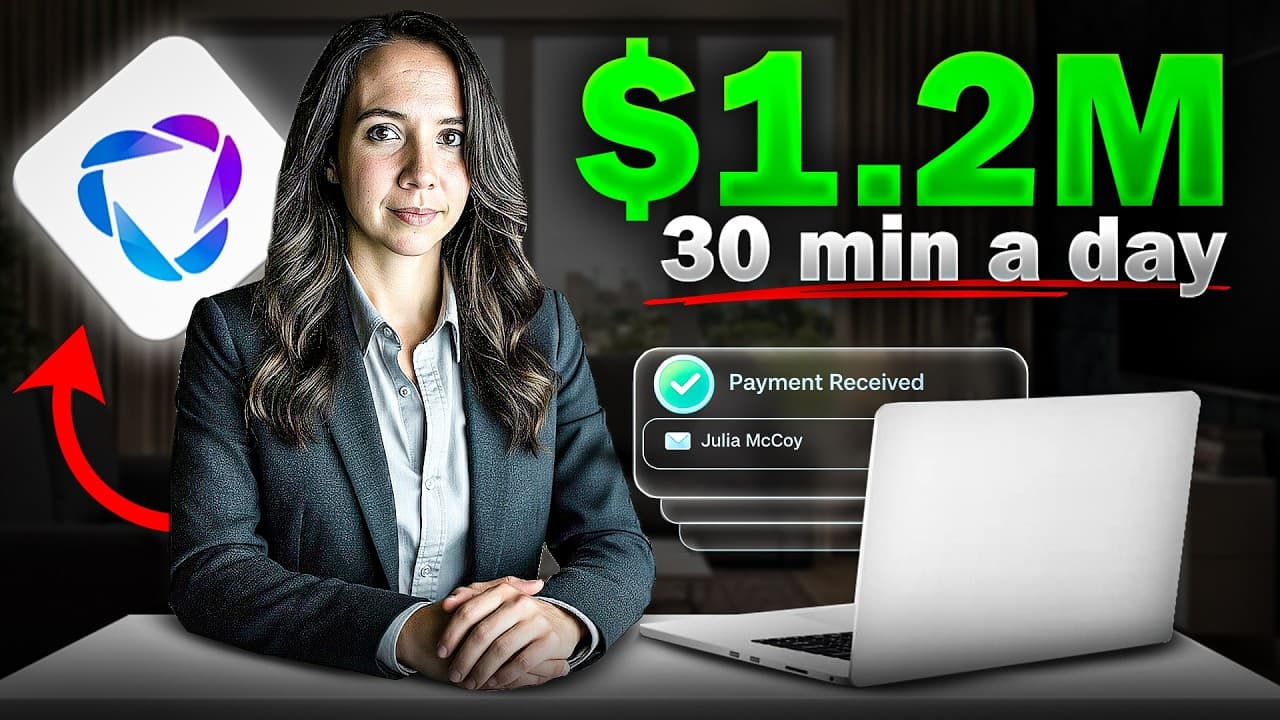
A year ago, I was working 90 hours a week. I had built a $1.2 million business in 11 months, and it was killing me. Literally, I went through a health crash so severe that I couldn't sit at a desk. I couldn't film. I couldn't write. I couldn't do any of the things that had built everything I'd created. And I thought, "This is it. Everything I built... Read More
Key Insights
- Effective automation is an integrated architecture, not a collection of disconnected subscriptions. A website, content system, chatbot, CRM, and publishing workflow must exchange useful information or the owner remains responsible for manually connecting every tool and task.
- A conversion-focused website is the foundation of the proposed business system. Its three to five money pages should quickly communicate the offer, present social proof at decision points, address a visitor’s specific pain, load quickly, work on mobile devices, and prompt meaningful action.
- Answer engine optimization is designed to make content visible in Google search and AI answer products mentioned in the transcript, including ChatGPT, Perplexity, and Google’s AI Overviews. Automated publishing allows a website to accumulate content, traffic, and authority without relying exclusively on social platforms.
- The First Movers blog costs $480 per month to operate with a writer. The writer uses ChatGPT for SEO research, Claude for writing, and independently publishes the articles, allowing the founder to remain outside the recurring production process.
- An AI chatbot is a continuously available sales resource when trained on services, pricing, frequently asked questions, and other business knowledge. Placed on high-intent pages, it can answer questions immediately, qualify prospects, book calls, and reduce the number of visitors who leave without acting.
- A useful AI copywriter is trained on the founder’s best existing material. Top-performing posts, successful emails, strong transcripts, signature frameworks, origin stories, explanations, opinions, and contrarian positions provide the knowledge required to reproduce a recognizable voice and established positioning.
- Delegation is the intended final stage of the AI writing workflow. The founder recommends mastering the system, documenting templates and a content calendar, then hiring a writer for $10 to $30 per hour for five to seven hours each week to operate it.
- The AI clone workflow combines HeyGen for a visual avatar, ElevenLabs for professional voice cloning, and ChatGPT and Claude for scripting. The stated tool foundation costs about $71 per month, while a production target of three weekly videos creates roughly 12 to 15 videos each month.
Install to Summarize YouTube Videos and Get Transcripts
Explore YouTube Video Summarizer or Get YouTube Transcript Extractor
Questions & Answers
Q: How can a business be automated to require less daily work?
A business can require less daily work by integrating three systems that handle conversion, writing, and video production. The proposed architecture starts with optimized website money pages, an automated answer-engine-focused blog, and an informed chatbot. It then adds an AI copywriter trained on the founder’s proven work and an AI clone supported by documented production, editing, publishing, and delegation processes.
Q: Why do disconnected AI tools fail to automate a business?
Disconnected AI tools fail because each application operates as an island and the business owner must manually transfer information between them. The transcript gives examples such as a chatbot that does not communicate with the CRM and an email platform that does not know who visited the website. Buying more subscriptions does not resolve this gap unless the tools become part of one connected architecture.
Q: How should a business optimize its website money pages?
A business should first identify the three to five pages that generate actual revenue by examining conversion data in its analytics. These pages commonly include core product or service pages, a pricing or offer page, and one or two high-intent landing pages. Each should feature a clear above-the-fold value proposition, strategically placed social proof, pain-specific calls to action, mobile optimization, and fast loading performance.
Q: What is answer engine optimization in this business system?
Answer engine optimization, or AEO, is presented as a content strategy that extends beyond ranking in traditional Google results. Its goal is to make website information discoverable through AI answer products such as ChatGPT, Perplexity, and Google’s AI Overviews. The proposed implementation uses consistent automated blog publishing to build authority and compounding traffic on a website the business owns.
Q: How do you train an AI copywriter to match your voice?
Training begins by collecting material that represents the founder’s strongest work, including top-performing social posts, successful emails, transcripts from strong videos or podcasts, signature frameworks, personal stories, explanations, opinions, and contrarian positions. This material becomes project knowledge. A comprehensive system prompt then defines the brand voice, content philosophy, audience, positioning, and writing style, while proven templates guide each content format.
Q: When should an AI content system be delegated to a writer?
An AI content system should be delegated after the founder has built it, learned how it behaves, and established repeatable templates and standards. The operator can then receive the trained copywriter, template library, and content calendar. The transcript suggests hiring a writer for $10 to $30 per hour for five to seven hours weekly, with the goal of removing the founder from recurring production.
Q: What tools and costs are used to create an AI video clone?
The clone system uses HeyGen to create the visual avatar and ElevenLabs to produce a professional voice clone. The stated creator prices are $29 per month for HeyGen and $22 per month for ElevenLabs, totaling about $51 for those two services. When ChatGPT and Claude are included for script development, the transcript places the starting monthly tool investment at about $71.
Q: How should an AI YouTube production workflow be started?
The workflow should start with a repeatable topic ideation process, script creation through the trained AI copywriter, avatar rendering in HeyGen, and defined editing and publishing steps. The recommendation is to begin with three videos per week, equivalent to approximately 12 to 15 videos monthly, instead of immediately publishing every day. A hired video editor can then manage the post-production workload.
Summary & Key Takeaways
-
The business reduced its founder’s workload from 90 hours per week to about 30 minutes per day after a severe health crash forced her away from production. Its growth continued because traffic, conversions, and content creation were supported by connected systems instead of depending entirely on the founder’s daily effort.
-
The website system combines three to five revenue-producing money pages, automated answer-engine-optimized articles, and an AI chatbot trained on business information. Clear value propositions, decision-point social proof, specific calls to action, mobile optimization, and fast page performance help turn owned website traffic into qualified leads and buyers.
-
The content system uses an AI copywriter trained on successful posts, emails, transcripts, frameworks, opinions, and brand guidelines. That system supplies scripts to an AI avatar and voice clone, while a documented production process and hired editor handle rendering, editing, and publishing approximately three YouTube videos each week.
Read in Other Languages (beta)
Share This Summary 📚
Summarize YouTube Videos and Get Video Transcripts with 1-Click
Try YouTube Summary with ChatGPT & Claude or YouTube Transcript Generator
Explore More Summaries from Julia McCoy 📚




Summarize YouTube Videos and Get Video Transcripts with 1-Click
Try YouTube Summary with ChatGPT & Claude or YouTube Transcript Generator