How did Figure melt retired Figure 02 robots into artifacts
TL;DR
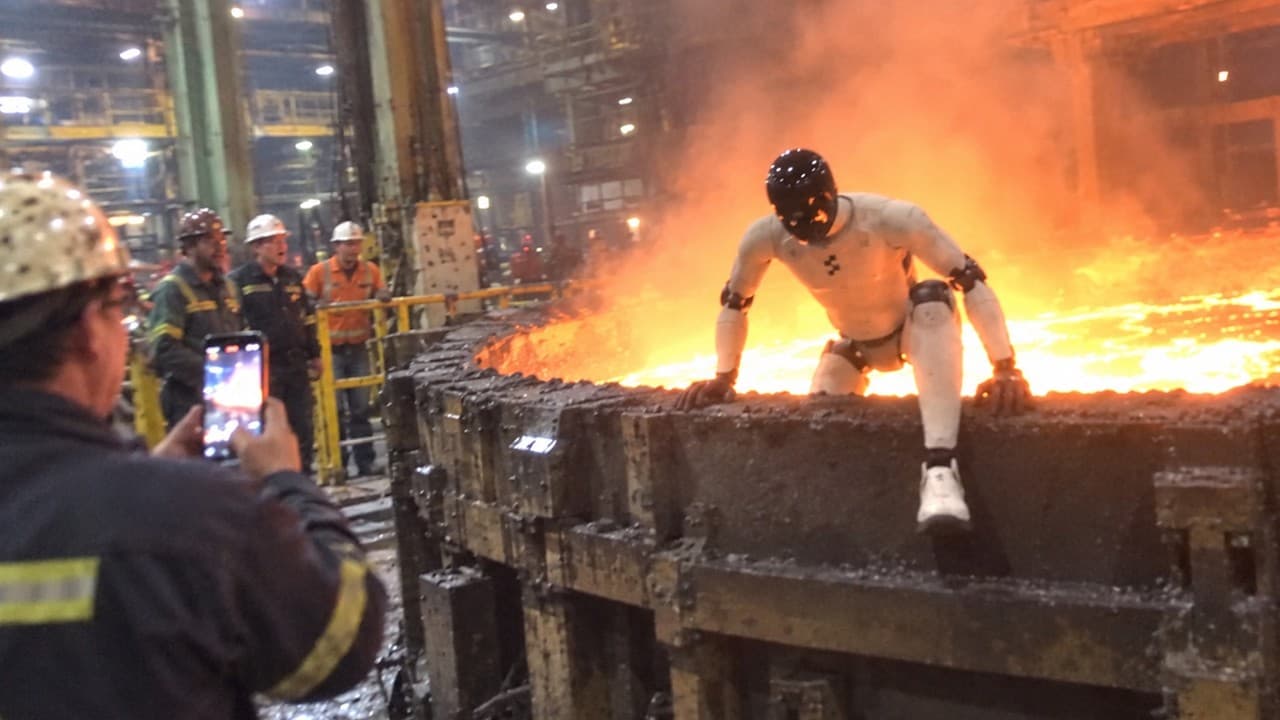
Figure melted almost the entire Figure 02 fleet by autonomously jumping them into a 75-ton furnace in Finland to create limited artifacts. The operation used trained AI policies, quick 20 minute melts, and a hazardous environment for electronics, while Clone and NASA pursue advanced robotics and space dexterity for future applications.
Transcript
Figure just melted its own robots. Almost the entire F-02 fleet, the same humanoids that worked at BMW and gave birth to Helix, got shipped to Finland. And then one by one, they jumped completely on their own into a 75tonon furnace full of molten steel. And the guy who told the company to do it was Arnold Schwarzenegger, the actual Terminator. That... Read More
Key Insights
- Figure 02 is retired and melted into metal artifacts rather to commemorate the fleet.
- The melt was performed in a 75 ton electric arc furnace located in Amatra, Finland.
- Arnold Schwarzenegger played a role in initiating the melt and linking it to a Terminator reference.
- Autonomous robot control was tested under extreme conditions with no on site rehearsal, relying on AI policies.
- The operation allowed a short 20 minute window per melt to ensure a workable shot at success.
- Clone Robotics is shifting from fast hand motion to simulation driven control for enterprise tasks with Torso 4.
- Atlas hands by Boston Dynamics emphasize a machine inspired design with a four finger hand and many joints.
- NASA’s Dextrous Robotics Team develops semi autonomous software to enable robots to operate safely alongside humans in space.
- China showcases a fully domestically architecture to control the robot from its AI computing and control functions.
Install to Summarize YouTube Videos and Get Transcripts
Explore YouTube Video Summarizer or Get YouTube Transcript Extractor
Questions & Answers
Q: How did Figure train the robots to jump autonomously into molten steel?
Figure trained the robots at its San Jose campus by setting up large airbags and having the robots jump from the second floor into a bucket of molten steel at a foundry. They used reference movements from real stunt performers and then simulated a brand new AI model so the robots could land accurately. This training enabled autonomous control during the melt without on site rehearsals.
Q: What was the role of Arnold Schwarzenegger in the melt operation?
Arnold Schwarzenegger endorsed the melt as a plan proposed by Figure’s CEO, and his involvement helped push the project forward. He appeared as part of the collaboration and informed the team to go ahead with melting the retired robots, connecting to the Terminator reference that framed the spectacle as a real world test of autonomous control under extreme conditions.
Q: Where did the actual melting take place and why was that location chosen?
The melting took place at a foundry in Amatra, Finland. The location was chosen because no metal foundry in the US or Mexico would accept the burden of melting a robot packed with lithium ion batteries into their expensive equipment, so the Finnish facility was the viable option for handling hazardous materials safely.
Q: How long did each furnace melt window last and why was timing critical?
Each melt window lasted about 20 minutes because after that the molten steel would cool and form a crust, making it harder to work with and potentially damaging to the artifact. The team had to complete the process within this tight window to produce usable metal bars for the commemorative artifacts.
Q: What makes Clone Robotics Torso 4 different from previous hands, and what is its target use?
Torso 4 represents a redesign focused on simulation, controllability, and an enterprise oriented product. While Clone previously emphasized fast hand movements, Torso 4 aims to automate stationary bimmanual tasks in a workplace setting, balancing human control with autonomous capability for practical applications.
Q: What is NASA’s strategy for robots in space exploration as described in the video?
NASA aims to build robots that can work safely alongside humans in extreme environments. The plan is to let machines take the hits so humans can focus on high level tasks. The Dextrous Robotics Team develops capabilities for lunar and Martian missions, including semi autonomous control, to reduce risk and increase efficiency in exploration.
Q: What is the significance of the Dextrous Robotics Team and IM Metro?
The Dextrous Robotics Team develops robots that can assist astronauts with dangerous tasks, like repairing stations or scouting terrain, which lowers risk for humans. IM Metro serves as a proving ground with mock habitats and simulation tools to test robot hardware and software for space environments, including challenges like radio delay.
Q: What did China unveil regarding humanoid robotic architecture and why is it important?
China unveiled what it calls the world’s first embodied AI robot with a fully domestically developed electronic architecture. This architecture covers the operating system, networking, software tools, computing chips, and control functions, representing a move toward internal control over core robotics software and hardware infrastructure.
Summary & Key Takeaways
-
A decommissioning show turned retired Figure 02 robots into metal artifacts after autonomous jumps into a molten steel furnace in Finland. The team faced a tight 24 hour window and a 20 minute melt per cycle, with electronics suffering under heat and EM fields. Arnold Schwarzenegger endorsed the melt, linking to a Terminator reference.
-
Clone Robotics revealed Torso 4 with a redesigned hand system aimed at workplace automation, shifting from fast hand movements to controllability and simulation. Atlas by Boston Dynamics received a different design approach focused on robustness and cost reduction. NASA’s Dextrous Robotics Team prepares semi autonomous systems for lunar and Martian operations.
-
NASA’s IM Metro provides a testing ground for semi autonomous robot software with Mars and Moon mission implications, including payload handling and hatch opening. China unveiled a humanoid with a fully domestically developed electronic architecture to strengthen its control over underlying robotics software infrastructure.
-
Overall, the video contrasts aggressive real world tests and artifact creation with gradual improvements in robot hands, autonomy, and space ready robotics, showing a field moving toward practical deployments and safer human-robot collaboration.
Read in Other Languages (beta)
Share This Summary 📚
Summarize YouTube Videos and Get Video Transcripts with 1-Click
Try YouTube Summary with ChatGPT & Claude or YouTube Transcript Generator
Explore More Summaries from AI Revolution 📚






Summarize YouTube Videos and Get Video Transcripts with 1-Click
Try YouTube Summary with ChatGPT & Claude or YouTube Transcript Generator