How to Manage AI Agents and Ship Software Faster
TL;DR
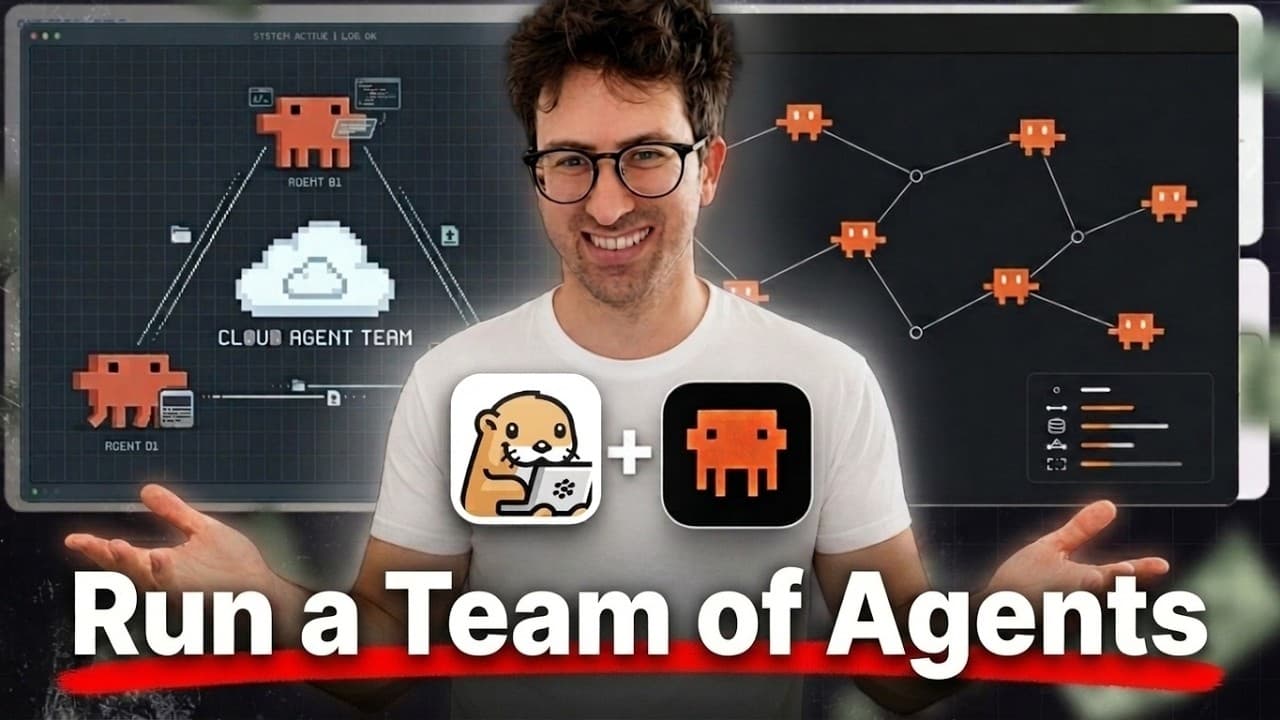
Run multiple AI agents in cloud environments, give each task clear context, review their work, and keep production credentials under human control. A cloud-based workflow can reduce local development conflicts, support five to ten simultaneous agents, and help an operator ship 22 to 40 pull requests per day, with much of the supervision possible from a phone.
Transcript
I don't think it's crazy to say that the people who know how to run teams of AI agents are going to be able to outperform everyone else in this AI age we're in. So, how do you actually run teams of AI agents? What does this mean? What's the stepbystep way to actually do this? And what are the tools you need to know like Devon AI to actually go and ... Read More
Key Insights
- Every knowledge worker is becoming a manager of agents, according to Carson's framework. Founders, individual contributors, investors, parents, and students can all benefit from learning how to assign work, monitor progress, evaluate results, and coordinate multiple AI agents effectively.
- Cloud development is the foundation for running agents in parallel. Separate cloud environments let an operator scale horizontally across five to ten agents without managing local code collisions, complicated work trees, or multiple development configurations on the same laptop.
- Human review is still necessary when agents produce software. Carson emphasizes checking work, testing the application, reviewing pull requests, and remaining explicit about production actions instead of assuming that an agent will always make a safe or correct decision.
- Production credentials should remain separated from AI agents. Carson stores production write keys in 1Password and supplies a key only during a clearly understood production-writing session, reducing the chance that an agent can independently perform a dangerous production action.
- Mobile access can keep agent work moving throughout the day. Carson estimates that roughly half of his work happens on his phone, where he uses a browser to check agent progress, discuss tasks, review pull requests, and decide whether completed changes should land.
- A high-throughput agent workflow can ship 22 to 40 pull requests per day. That output comes from running cloud agents concurrently, supervising their work as a manager, and avoiding the local development bottlenecks that make simultaneous coding tasks harder to coordinate.
- Technical understanding becomes more important as agent usage expands. Effective operators need to understand concepts such as PostgreSQL, development and production environments, migrations, authentication, and software architecture, even if agents help them acquire that knowledge through practical work.
- Agent-management practices will change every three to six months. Carson recommends gaining confidence through direct experimentation because models, tools, cloud harnesses, automations, and operating methods continue to evolve, making repeated hands-on practice more useful than treating one workflow as permanent.
Install to Summarize YouTube Videos and Get Transcripts
Explore YouTube Video Summarizer or Get YouTube Transcript Extractor
Questions & Answers
Q: How do you manage multiple AI coding agents effectively?
Manage AI coding agents like an engineering team: assign distinct tasks, provide enough context, monitor progress, test the resulting application, and review pull requests before changes reach production. Cloud environments help each agent work independently, while notifications provide visibility into activity. The human operator remains responsible for prioritization, quality control, coordination, and explicit approval of sensitive production actions.
Q: Why are cloud agents better for parallel software work?
Cloud agents can operate in separate virtual environments, allowing five to ten tasks to proceed simultaneously without competing for the same local setup. This avoids much of the friction associated with local databases, authentication, development servers, code collisions, and Git work trees. The operator can therefore scale horizontally and supervise multiple streams of software work from a desktop or phone.
Q: How can AI agents help a solo founder ship faster?
AI agents can let a solo founder delegate several software tasks at once instead of completing each task sequentially. Carson uses cloud agents, automations, testing, and pull-request review to scale his own output. His described workflow supports five to ten concurrent agents and 22 to 40 pull requests per day while he remains the company's only employee.
Q: How should production credentials be handled with AI agents?
Production write credentials should be stored separately from the agents and withheld by default. Carson keeps these keys in 1Password, then manually copies a required key into a session only when both he and the agent are clear about the intended production action. This approach preserves human control over dangerous writes and limits an agent's routine access to production systems.
Q: Can AI coding agents be managed from a phone?
AI coding agents can be supervised through a mobile browser when their working environment is cloud-based. Carson says roughly half of his work happens on his phone. He uses it to communicate with Devin, check the status of work, inspect pull requests, and decide whether changes should land, allowing agent tasks to continue even when he is away from his desk.
Q: What technical knowledge does an AI agent manager need?
An effective agent manager needs a growing understanding of software systems, including PostgreSQL, authentication, migrations, architecture, and the difference between development and production environments. Carson argues that technical skill does not disappear when agents write code. Instead, supervising more agents makes technical judgment increasingly important, and operators can develop that judgment through repeated hands-on work with agents.
Q: What tools support a high-volume AI agent workflow?
Carson's setup combines Devin for cloud-based agent work, Codex for local tasks, Slack for notifications, 1Password for secure production credentials, a browser for mobile access, and application screens for testing. He also uses Whisper Flow for voice input. The underlying principles are not specific to Devin, but depend on cloud execution, visibility, testing, and controlled production access.
Q: How often should an AI agent workflow be updated?
An AI agent workflow should be treated as temporary because Carson expects the field to change every three to six months. Models, harnesses, automation patterns, and operating practices can improve quickly. The recommended response is to experiment directly, keep using the tools, and refine the system through practice instead of assuming that one setup will remain the best approach indefinitely.
Summary & Key Takeaways
-
Ryan Carson argues that every knowledge worker should become a capable manager of AI agents. Drawing on 25 years as a founder and CEO, he describes how he now scales a one-person startup by delegating work to agents, checking their output, creating automations, and supervising tasks from both desktop and mobile devices.
-
Cloud environments are central to Carson's approach because they allow multiple agents to work simultaneously without competing for one local development setup. He contrasts this model with local development, where databases, authentication, development servers, branches, and work trees can create technical friction when several coding tasks need to proceed at the same time.
-
The broader playbook combines parallel cloud agents, human review, secure credential handling, production-monitoring automations, model routing, and public sharing on X. Carson reports running five to ten agents, shipping 22 to 40 pull requests daily, and doing roughly half his work from his phone while maintaining explicit control over production changes.
Read in Other Languages (beta)
Share This Summary 📚
Summarize YouTube Videos and Get Video Transcripts with 1-Click
Try YouTube Summary with ChatGPT & Claude or YouTube Transcript Generator
Explore More Summaries from Greg Isenberg 📚



Summarize YouTube Videos and Get Video Transcripts with 1-Click
Try YouTube Summary with ChatGPT & Claude or YouTube Transcript Generator