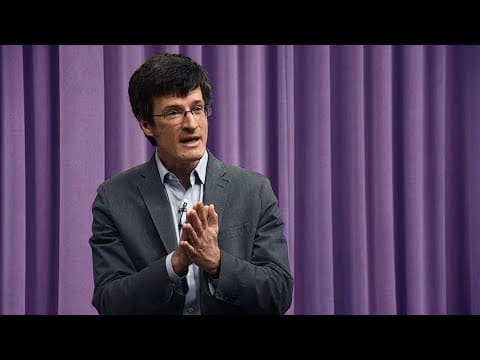
Adam Lashinsky: When Steve Jobs Returned to Apple

Transcript
Read and summarize the transcript of this video on Glasp Reader (beta).
Install to Summarize YouTube Videos and Get Transcripts
Explore YouTube Video Summarizer or Get YouTube Transcript Extractor
Summary
In this video, the speaker discusses the state of Apple when Steve Jobs returned to the company in 1997. He highlights the company's near insolvency, loss of money, and the $150 million investment made by Microsoft. The speaker also mentions the bloated nature of the company, which Jobs addressed by firing middle managers and simplifying the product line. Additionally, the speaker discusses Tim Cook's role in fixing Apple's factory system and the labor conditions in Chinese factories. Finally, the speaker emphasizes Jobs' efforts to eliminate divisionalization within the company and create a unified brand.
Questions & Answers
Q: What was the state of Apple when Steve Jobs returned in 1997?
Apple was a broken company, 90 days away from insolvency. It was losing money, fired its CEO, and received a $150 million investment from Microsoft, which was critical to ensure the value of the Macintosh.
Q: What steps did Steve Jobs take to address the company's issues?
Jobs fired around 4,000 middle managers and eliminated several products, focusing on simplification. He reduced Apple's product line to four computers and hired Tim Cook to improve the dysfunctional factory system, modeling it after Dell's successful approach.
Q: How did Tim Cook's actions in 1998 impact Apple's labor conditions in China?
Cook's decision to close Apple's factories and rely on contract manufacturers in China, such as Foxconn, resulted in the labor conditions we see today. This move allowed Apple to become more efficient, but it indirectly shifted manufacturing to regions with different labor standards.
Q: What was the most significant cultural change Jobs implemented upon his return?
Jobs wanted to unify the company and eliminate divisionalization. He wanted one Apple, one brand, and one way of communicating. He abolished the concept of General Manager and instead focused on building products and having himself orchestrate the entire process.
Q: Did Jobs' efforts to streamline the company involve cost cutting?
No, the streamlining process was not about cost cutting. In fact, Apple's advertising spending increased significantly in the following years, even during a recession. Jobs viewed this as a long-term investment in building the brand we know today.
Q: What was the impact of Jobs' decision to centralize advertising budgets?
Jobs consolidated the 16 advertising budgets into one. This allowed him to have direct control over allocating funds for advertising. The focus was on supporting products that deserved advertising and investing in the long-term success of the brand.
Takeaways
Steve Jobs returned to a broken Apple in 1997, which was on the brink of insolvency. He took significant steps to turn the company around, including simplifying the product line and eliminating divisionalization. Tim Cook's actions in 1998 had a lasting impact on Apple's factory system and labor conditions in China. Most importantly, Jobs aimed to create one unified company, brand, and way of communicating. This involved centralizing decision-making and making long-term investments in building the brand.
Read in Other Languages (beta)
Share This Summary 📚
Summarize YouTube Videos and Get Video Transcripts with 1-Click
Try YouTube Summary with ChatGPT & Claude or YouTube Transcript Generator
Explore More Summaries from Stanford eCorner 📚
![Elon Musk: Elon Musk's Vision for the Future [Entire Talk] thumbnail](/_next/image?url=https%3A%2F%2Fi.ytimg.com%2Fvi%2FSVk1hb0ZOrE%2Fhqdefault.jpg&w=750&q=75)



Summarize YouTube Videos and Get Video Transcripts with 1-Click
Try YouTube Summary with ChatGPT & Claude or YouTube Transcript Generator