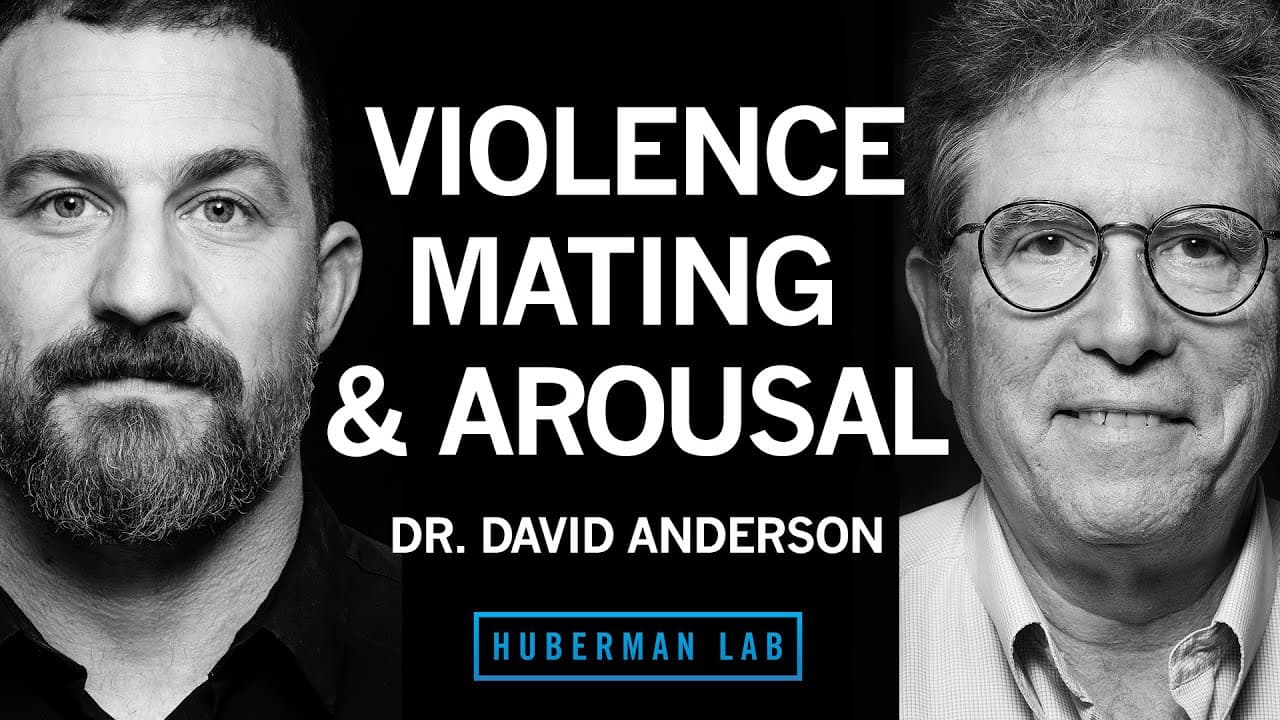
Dr. David Anderson: The Biology of Aggression, Mating, & Arousal | Huberman Lab Podcast #89
TL;DR
Dr. David Anderson explains that aggression, mating, arousal, and emotions arise from nervous-system states and brain-body connections that bias behavior and shape how surroundings are interpreted. Huberman Lab Podcast #89 examines rage, the overlap between aggression and sexual behavior, sex- and context-specific aggression, and peptides linked to anxiety and aggression. Read on for the episode’s key distinctions and research implications.
Transcript
- Welcome to the Huberman Lab Podcast, where we discuss science and science-based tools for everyday life. I'm Andrew Huberman, and I'm a professor of neurobiology and ophthalmology at Stanford School of Medicine. Today, my guest is Dr. David Anderson, Dr. Anderson is a professor of biology at the California Institute of Technology, often commonly ... Read More
Key Insights
- 🅰️ Aggression is a multifaceted behavior and varies between different types and contexts.
- 🧑🏭 Neurobiological factors, including neural circuits and hormones, contribute to aggression.
- 🖐️ Hormones like estrogen and progesterone play a role in aggression, but their exact mechanisms are still being explored.
- 🧠 The brain regions involved in aggression are complex and interconnected, and their activation can elicit different behaviors.
Install to Summarize YouTube Videos and Get Transcripts
Explore YouTube Video Summarizer or Get YouTube Transcript Extractor
Questions & Answers
Q: What is the biology behind aggression, mating, and arousal?
Dr. David Anderson describes these behaviors as products of nervous-system states involving the brain and its connections with the body. The discussion examines neural circuits underlying aggression and sexual behavior, including where those behaviors overlap and where their boundaries differ.
Q: Why do people become aggressive or enter a state of rage?
The episode presents aggression as behavior governed by biological mechanisms and internal nervous-system states. It also explores why aggression can sometimes intensify into rage, rather than treating every aggressive act as biologically identical.
Q: How are aggression and sexual behavior related?
Aggression and sexual behavior have both boundaries and areas of overlap in their underlying neural circuits and bodily states. The discussion uses different types of social encounters to examine how the same broad behavioral categories can operate differently depending on context.
Q: How does aggression differ across male and female encounters?
The episode distinguishes male-male, male-female, and female-female aggression. These categories help the speakers examine how neural circuits and states of mind and body may govern aggression differently across social contexts.
Q: What distinguishes emotions from broader nervous-system states?
Dr. Anderson describes emotions such as happiness, sadness, and anger as subcategories of broader states. Those states occur in the nervous system and in brain-body connections, influencing feelings, behavior, action or inaction, and interpretation of experience.
Q: How do brain-body connections influence behavior?
Brain-body connections help determine how a person feels about an internal state and bias that person toward action or inaction. They also strongly influence how experiences and surroundings are interpreted.
Q: What role can peptides play in anxiety and aggression?
The discussion highlights specific peptides, described as small proteins, that can govern whether people feel more or less anxious or aggressive. Dr. Anderson’s laboratory and other laboratories have made discoveries in this area, which the episode connects to the future of mental health treatments.
Q: What is Dr. David Anderson’s book about emotions called?
The book is titled “The Nature of the Beast: How Emotions Guide Us.” Andrew Huberman says it is grounded in scientific research and contrasts with common myths about emotions and biology.
Summary & Key Takeaways
-
Emotions are subcategories of states controlled by the nervous system and brain-body connections.
-
Aggression is a multifaceted behavior with different types and neural circuits.
-
Hormones like estrogen and progesterone play a role in aggression, although further research is needed.
Read in Other Languages (beta)
Share This Summary 📚
Summarize YouTube Videos and Get Video Transcripts with 1-Click
Try YouTube Summary with ChatGPT & Claude or YouTube Transcript Generator
Explore More Summaries from Andrew Huberman 📚





Summarize YouTube Videos and Get Video Transcripts with 1-Click
Try YouTube Summary with ChatGPT & Claude or YouTube Transcript Generator