How Does Consciousness Shape the Nature of Reality?
TL;DR
Reality is presented as a self-processing system in which physical states, consciousness, causation, and God are inseparable. Chris Langan’s CTMU describes the visible universe as a display that requires a processing domain, while consciousness operates through identity operators that receive, interpret, and return information. Because quantum behavior is probabilistic and reality is continually generated, the account also preserves a role for conscious participation and free will.
Transcript
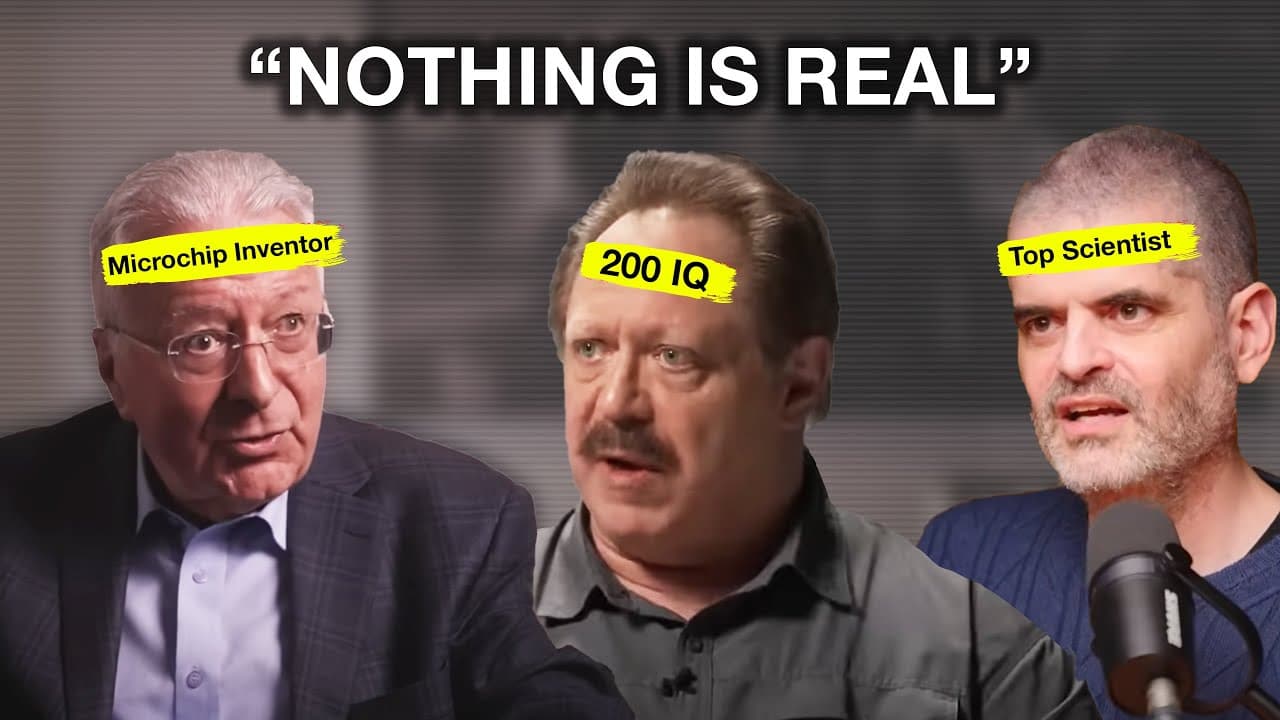
this video features three of the most brilliant minds alive federico Fagene Bernardo Castreup Chris Langan each of them has decoded reality in a completely different way but they all shake your understanding of reality by the end even the most obvious things might start to feel strange so please pay close attention you will persist after you die yo... Read More
Key Insights
- The CTMU is presented as a theory connecting consciousness, physics, God, and information within one self-processing reality. Rather than treating these subjects as separate, it seeks a mathematical structure from which the properties of reality and their relationships can be logically deduced.
- Reality is described as possessing an identity because the word itself identifies everything that exists. Langan argues that examining this identity reveals properties associated with God, including complete knowledge, power, universal presence, consciousness, and the capacity for personal relationships with human beings.
- God is described as greater than the physical universe rather than confined to visible matter. This position is characterized as panentheistic because God distributes across the universe while also existing in a broader processing domain that the observable world cannot contain by itself.
- The simulation analogy divides reality into a display and a processor. The display contains observable objects and static states, while the processor produces change between states. Langan argues that a complete account of reality and causation must unite these two ordinarily separated aspects.
- Causation is presented as requiring more than a collection of physical states. Static states do not contain the process that changes them, so the CTMU attributes processing functionality to God, who encompasses both the displayed universe and the activity that continually transforms it.
- Identity operators are described as the basic units needed to connect display and processing. An identity operator receives input from the external world, recognizes or accepts it through syntax, processes that input, and returns the result to the world as an external state.
- Consciousness is described as existing at different levels throughout reality. A table is called generically conscious, but its awareness is simpler and dependent on more complex consciousness, while human consciousness represents a more developed form of information recognition, processing, and interaction.
- Free will is defended through the claim that reality is generative rather than a permanently fixed array. Quantum fields contain probabilistic fluctuations, physical forces do not fully determine every outcome, and conscious states are continually recreated instead of merely unfolding from an entirely predetermined structure.
Install to Summarize YouTube Videos and Get Transcripts
Explore YouTube Video Summarizer or Get YouTube Transcript Extractor
Questions & Answers
Q: What is the cognitive-theoretic model of the universe?
The cognitive-theoretic model of the universe, or CTMU, is presented as a framework that connects consciousness, physics, information, and God within one self-processing reality. It begins with the identity of reality and attempts to deduce the properties required for reality to exist and operate. The resulting structure treats the universe as both a displayed collection of states and a process that continually transforms those states.
Q: How does the CTMU argue that God exists?
The CTMU argument begins by treating reality as an identifiable whole whose necessary properties can be examined. Langan claims that these properties correspond to those attributed to God, including knowledge, power, presence everywhere, and consciousness. God is therefore presented not as an optional concept added to reality, but as the central identity and principle required for reality to process itself and remain operational.
Q: Is God the same as the physical universe in the CTMU?
God is not described as merely identical to or confined within the physical universe. Langan characterizes the position as panentheistic: God distributes across the visible universe but also exceeds it. The physical world is compared to a display, while another domain performs the processing that changes displayed states. God encompasses both the observable display and the processing activity behind it.
Q: How does the simulation analogy explain reality?
The simulation analogy divides reality into two connected aspects: a display and a processor. The display contains the objects, events, and states people experience, while the processor accounts for their transformation. A state is static by definition and cannot independently explain how it changes. The analogy therefore suggests that understanding causation requires a framework that combines visible conditions with the processes generating their transitions.
Q: What are identity operators in the CTMU?
Identity operators are described as basic units that combine recognition, information processing, and outward expression. An identity operator receives input from the external world, accepts or recognizes that input through syntax, processes it, and returns a result as an external state. Langan uses these operators to explain how the identity of reality can include both static displays and the active processes that transform them.
Q: Does the CTMU claim that ordinary objects are conscious?
The CTMU account presented in the transcript says that even an ordinary object such as a table is generically conscious. This does not mean that a table possesses human-level thought or awareness. Consciousness is said to exist in levels, with simple physical objects expressing a basic form that depends on more complex consciousness, while humans possess more developed capacities for recognition, processing, and interaction.
Q: How does quantum mechanics relate to consciousness in this account?
Quantum mechanics is connected to consciousness through probability and the claim that physical forces do not completely determine what happens. The Heisenberg uncertainty principle is cited as an example of probabilistic quantum rules. Because outcomes are not portrayed as fully fixed, consciousness is assigned an active role in processing and participating in reality rather than functioning only as a passive observer of predetermined events.
Q: Why does Chris Langan believe humans have free will?
Langan argues that free will is possible because reality is generative rather than a fixed manifold or permanently completed array. Quantum fields contain fluctuations and superpositions, while physical forces are described as underdetermining outcomes. States, including human states, are continually recreated. Within this framework, choices can participate in reality’s ongoing generation instead of merely following an unchangeable sequence established in advance.
Summary & Key Takeaways
-
The compilation brings together ideas attributed to Chris Langan, Federico Faggin, and Bernardo Kastrup, although the supplied transcript focuses on Langan. His cognitive-theoretic model of the universe treats reality as an interconnected, self-aware system that includes consciousness, physics, information processing, and God within a single explanatory structure.
-
Langan compares reality to a simulation containing a visible display and an underlying processor. Objects and events appear as static states within the display, while change requires processing that states cannot provide independently. God is described as encompassing both domains and supplying the functionality through which causation and continuing transformation become possible.
-
Consciousness is described through identity operators that accept information, recognize it through syntax, process it, and return it as an external state. Different entities possess different levels of consciousness, with humans exhibiting greater complexity than ordinary objects. Quantum probability and continuous generation are then used to support conscious participation and free will.
Read in Other Languages (beta)
Share This Summary 📚
Summarize YouTube Videos and Get Video Transcripts with 1-Click
Try YouTube Summary with ChatGPT & Claude or YouTube Transcript Generator
Explore More Summaries from Be Inspired 📚
Summarize YouTube Videos and Get Video Transcripts with 1-Click
Try YouTube Summary with ChatGPT & Claude or YouTube Transcript Generator