Building a Marsbase is a Horrible Idea: Let’s do it!
TL;DR
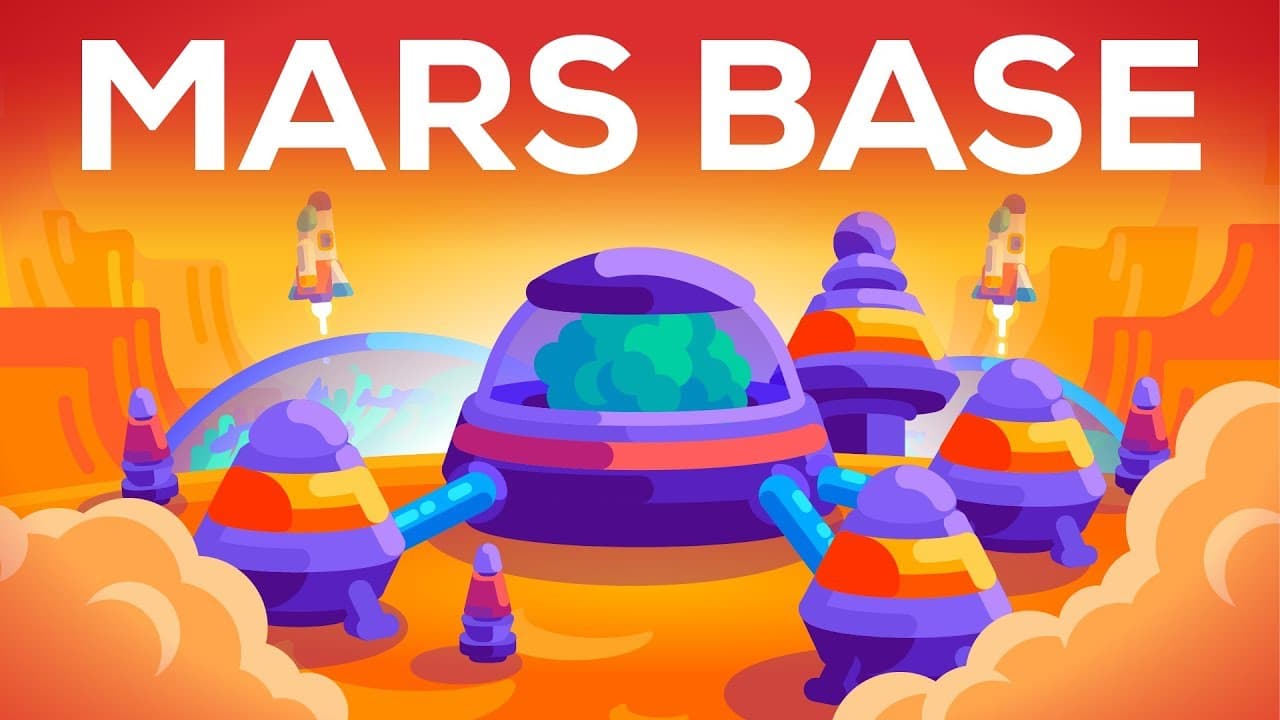
A semi-permanent Mars base is possible with existing technology, but its crew would face scarce energy, radiation, toxic dust, difficult food production, low gravity, and severe isolation. Solar power is only 40% as effective as on Earth, making nuclear technology a likely initial power source. Pressurized, shielded habitats, remote-controlled robots, aquaponics, frequent exercise, and psychological screening could make an outpost survivable. Read on to see how each solution addresses Mars’s hazards.
Transcript
From hostile deserts, to lonely islands and the highest mountains, wherever there is space to expand into humans do so. So, it's hardly surprising that we're already making preparations to set foot on Mars, and to create the first permanent colony outside of Earth -- maybe even terraform another planet and turn it into a second blue home. But wait,... Read More
Key Insights
- 🇲🇭 Mars colonization involves overcoming energy scarcity, radiation exposure, air production challenges, and toxic Mars dust.
- 😋 Solutions include nuclear power, shielding habitats, aquaponics for food production, and addressing gravity-related health issues.
- 🪡 Psychological resilience and intense screening are needed for Mars colonists due to isolation and challenging living conditions.
Install to Summarize YouTube Videos and Get Transcripts
Explore YouTube Video Summarizer or Get YouTube Transcript Extractor
Questions & Answers
Q: What are the main challenges of building a Mars base?
A Mars outpost must overcome limited energy, an unbreathable atmosphere, intense radiation, toxic dust, difficult food production, low gravity, and psychological strain. The first settlement would therefore be a semi-permanent outpost designed to prepare for a larger human presence.
Q: How could a Mars base generate enough energy?
Solar power is only 40% as effective on Mars as on Earth, and enormous dust storms can obscure sunlight for days. Wind and geothermal power are described as unfeasible, so nuclear technology might initially power a small outpost for its first few years.
Q: How would astronauts breathe inside a Mars habitat?
Mars’s atmosphere is only 1% as dense as Earth’s and consists mostly of CO2. Habitats would need to be pressurized and filled with an artificial atmosphere of nitrogen and oxygen, with rounded shapes and highly reliable airtight airlocks.
Q: How could a Mars base protect its crew from radiation?
A person on Mars’s surface would receive 50 times the radiation experienced on Earth, and three years there would exceed NASA astronauts’ career dose limits. Habitats could be covered with thick frozen CO2 and a meter of dirt, while remote-controlled robots perform routine outdoor work.
Q: Why is Mars dust dangerous to astronauts and equipment?
Mars dust is extremely fine, dry, and electrostatically charged, allowing it to enter machinery, cling to spacesuits, and reach the crew’s lungs. The soil also contains highly toxic perchlorate salts, so spacesuits could remain attached outside the habitat instead of entering it.
Q: How could settlers grow food on Mars?
Martian soil is alkaline, lacks vital nitrogen compounds, and must be decontaminated before plants can grow in it. Settlers could fertilize it with recycled biological waste or use aquaponics to raise fish and plants together, improving both diet and morale.
Q: How would Mars’s low gravity affect the crew?
Mars has only 38% of Earth’s surface gravity, which could cause muscle wasting, bone loss, and cardiovascular problems. Until rotating living spaces become possible, crew members would need extensive exercise to slow physical degradation.
Q: What psychological challenges would Mars colonists face?
Crew members would spend years indoors in tight, mostly windowless spaces, repeating routines with the same people and receiving little outside contact. They would undergo intense psychological screening for resilience and would probably rotate every few years.
Summary & Key Takeaways
-
Mars colonization involves creating semi-permanent outposts due to extreme conditions.
-
Challenges include energy scarcity, radiation exposure, air production, and dealing with toxic Mars dust.
-
Solutions involve nuclear power, shielding habitats, aquaponics for food, and addressing low gravity effects.
Read in Other Languages (beta)
Share This Summary 📚
Summarize YouTube Videos and Get Video Transcripts with 1-Click
Try YouTube Summary with ChatGPT & Claude or YouTube Transcript Generator
Explore More Summaries from Kurzgesagt – In a Nutshell 📚
Summarize YouTube Videos and Get Video Transcripts with 1-Click
Try YouTube Summary with ChatGPT & Claude or YouTube Transcript Generator