Schmid factor and resolved shear stress in BCC crystal
TL;DR
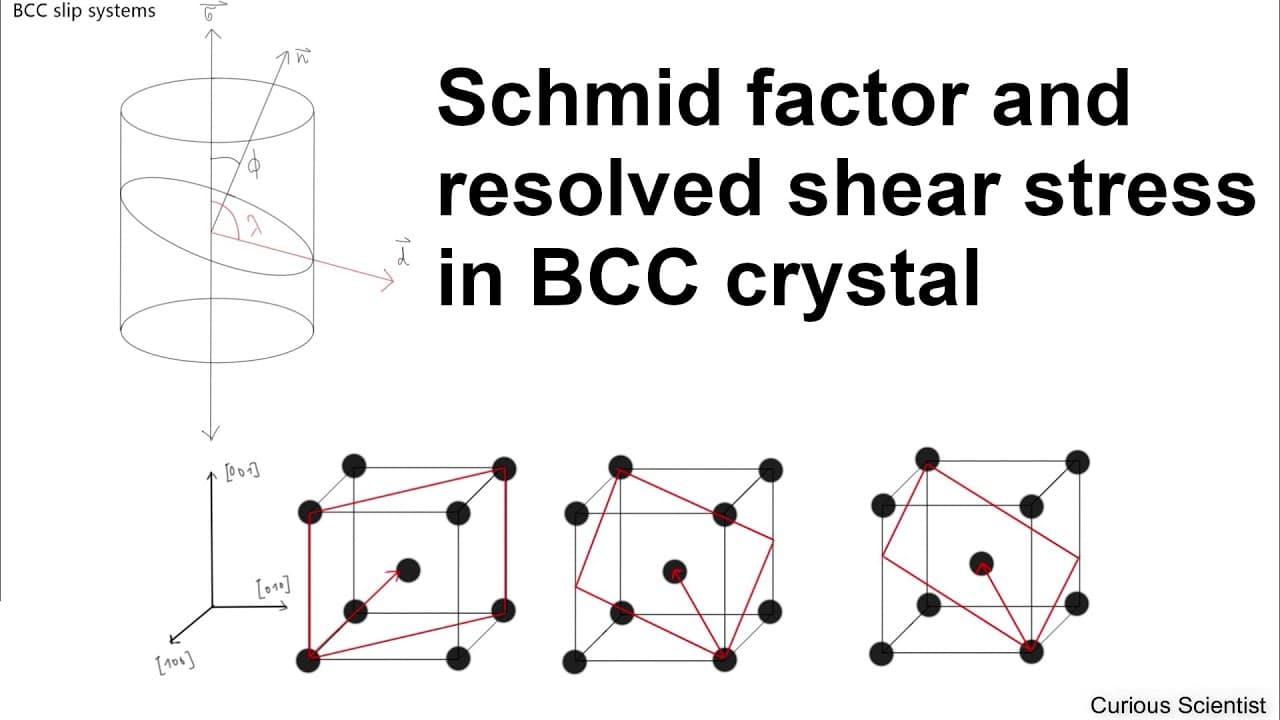
The video explains slip systems and resolved shear stress in body-centered cubic (BCC) crystals.
Transcript
welcome everyone in this video I show you how the slip systems look like in a body centered cubic crystal I will show you how you can get the Schmidt vector which I have previously shown for face centered cubic crystal and I will do a simple calculation just to do some practice so as you can see I have already made some figures so here in the top l... Read More
Key Insights
- 💋 BCC crystals exhibit slip systems comprising three groups with unique orientations, facilitating multiple deformation pathways.
- ❓ The relationship between external stress and the resolved shear stress highlights the geometry's critical role in material behavior.
- 😥 Adjusting the stress and the slip direction allows for different shear stress outcomes, influencing yield points.
- 💋 Understanding the distinctions between BCC and FCC slip systems aids in material selection for specific engineering applications based on strength and ductility preferences.
- 🔮 The calculation of resolved shear stress remains consistent, regardless of the crystal structure, simplifying the analysis for various materials.
- 💋 The interaction between thermally activated slip systems and their geometrical orientations often limits the ductility of BCC materials compared to FCC.
- 🌍 The video concludes with practical examples emphasizing calculations' applicability to real-world materials behavior under stress.
Install to Summarize YouTube Videos and Get Transcripts
Explore YouTube Video Summarizer or Get YouTube Transcript Extractor
Questions & Answers
Q: What are slip systems, and why are they important in understanding crystal behavior?
Slip systems are the mechanisms by which crystalline materials deform under stress. They consist of slip planes and slip directions, determining how and where a material will yield. Understanding these systems is essential for predicting a material's mechanical properties, like ductility and strength, since they affect the material's response to external forces.
Q: How does the Schmidt factor influence resolved shear stress in BCC crystals?
The Schmidt factor quantifies the effectiveness of an applied stress in causing slip. In BCC crystals, it accounts for the angles between the external stress vector and the slip planes. A higher Schmidt factor indicates a higher resolved shear stress, meaning that the material is more likely to deform. This relationship is critical for understanding material performance under load.
Q: Why does BCC have more slip systems compared to FCC, and what are the implications?
BCC crystals have 48 slip systems split among three types, leading to greater potential slip pathways than FCC’s 12 system. However, BCC slip systems are thermally activated and are not aligned with close-packed directions, making them less ductile despite the higher number of slip options. This results in BCC materials being stronger yet less malleable than FCC.
Q: What is the role of external stress in slip system calculations, and how is it represented mathematically?
External stress plays a crucial role in determining how much shear stress is resolved along slip directions. Mathematically, external stress is represented as a vector (Sigma), and its relationship to resolved shear stress (tau) is captured by the equation tau = M * Sigma, where M is the Schmidt factor. This framework allows for a clear calculation of the effective stress influencing the slip.
Summary & Key Takeaways
-
The video introduces the concept of slip systems in body-centered cubic (BCC) crystals, detailing the relationship between external stress and slip direction using Schmidt vectors.
-
It explains the calculation of resolved shear stress (tau) based on external stress (Sigma), emphasizing the geometrical factors that influence the slip behavior in BCC structures compared to face-centered cubic (FCC) systems.
-
A thorough example calculation is provided to demonstrate how to derive the resolved shear stress using specific vector values, reinforcing the parallels between BCC and FCC slip systems in terms of calculation methods.
Read in Other Languages (beta)
Share This Summary 📚
Summarize YouTube Videos and Get Video Transcripts with 1-Click
Try YouTube Summary with ChatGPT & Claude or YouTube Transcript Generator
Explore More Summaries from Curious Scientist 📚


![Building a coil winder [Part 6] - A few improvements thumbnail](/_next/image?url=https%3A%2F%2Fi.ytimg.com%2Fvi%2F3eyxG_g2iUA%2Fhqdefault.jpg&w=750&q=75)



Summarize YouTube Videos and Get Video Transcripts with 1-Click
Try YouTube Summary with ChatGPT & Claude or YouTube Transcript Generator