How Does Agentic AI Plan, Adapt, and Act?
TL;DR
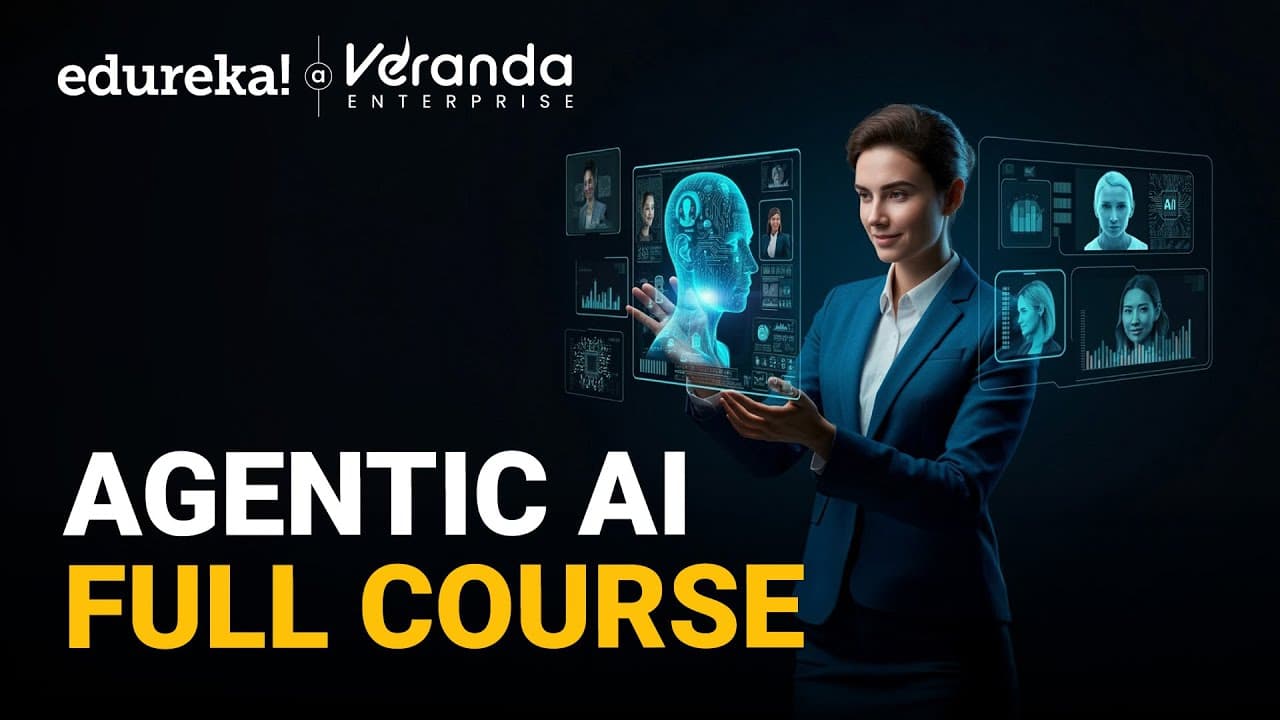
Agentic AI autonomously plans, decides, adapts, and takes actions to achieve defined objectives without continuous human guidance. It extends generative AI with decision-making, context awareness, memory, tools, and goal-oriented behavior, while technologies such as LangChain, retrieval-augmented generation, and LLMOps support its development, deployment, monitoring, and scaling.
Transcript
hey everyone welcome to this session on Agentic AI full course agentic AI is the next big leap in artificial intelligence it goes beyond just generating content and steps into the world of intelligent action-taking agents these agents just don't respond to prompts they plan reason and complete your task autonomously making them incredibly powerful ... Read More
Key Insights
- Agentic AI is artificial intelligence that autonomously executes actions to attain designated objectives. Unlike reactive systems that wait for inputs, it can plan ahead, take initiative, make decisions, and modify its behavior as conditions change without requiring continuous human guidance.
- Generative AI is primarily focused on producing outputs such as text and images from prompts. Agentic AI is goal-driven and self-directed, adding planning, context awareness, strategic decision-making, and action execution so a system can work toward an objective rather than only generate content.
- The decision-making process in agentic AI involves evaluating multiple options and selecting an appropriate course of action using current conditions and acquired knowledge. The system can then revise its strategy when unforeseen changes occur, making it suitable for dynamic and complex operating environments.
- LangChain is presented as a framework that helps agents connect tools and memory. These connections support systems that need to retain useful context, use external capabilities, and coordinate multiple components while performing tasks instead of relying solely on an isolated language model response.
- Retrieval-augmented generation is a method that allows a model to retrieve live data before producing an answer. It helps connect language-model generation with relevant information sources, giving agentic systems access to material beyond what is contained in the model's existing internal knowledge.
- LLMOps is the practice of deploying, monitoring, and scaling large language models in production. It provides the operational foundation needed to manage model-based applications after development, particularly when reliability, performance, and continued oversight matter in real-world agentic AI deployments.
- Agentic AI applications include autonomous vehicles, industrial and healthcare robots, virtual assistants, adaptive game opponents, trading systems, fraud detection, smart-city infrastructure, spacecraft, planetary rovers, personalized tutors, smart grids, surveillance systems, and autonomous drones. Each application combines decisions with actions directed toward specific objectives.
- The primary risks of agentic AI include misalignment with human goals, unclear accountability, limited decision transparency, unintended consequences, and failures in unpredictable environments. Responsible deployment therefore requires attention to safety, reliability, explainability, ethical behavior, and clearly defined objectives.
Install to Summarize YouTube Videos and Get Transcripts
Explore YouTube Video Summarizer or Get YouTube Transcript Extractor
Questions & Answers
Q: What is agentic AI and how does it work?
Agentic AI refers to artificial intelligence systems that autonomously perform actions to reach designated objectives. It works by examining current conditions, evaluating multiple options, choosing a course of action, and adapting its strategy when the environment changes. Unlike reactive AI, it can take initiative rather than waiting for a prompt, although its objectives and operating boundaries still require careful definition.
Q: How is agentic AI different from generative AI?
Generative AI concentrates on creating outputs such as text, images, or other content and relies heavily on prompts for direction. Agentic AI concentrates on achieving goals through autonomous action. It can plan, make strategic decisions, use context, initiate tasks, and adjust to changing conditions. The two approaches are complementary, but they address different functions within artificial intelligence systems.
Q: How is agentic AI different from reactive AI?
Reactive AI performs predefined tasks when it receives an input, as illustrated by spam filters and image classifiers. Agentic AI can operate proactively and independently toward a longer-term objective. It evaluates situations, determines what action to take, and revises its approach when circumstances change. This autonomy and adaptability distinguish it from systems limited to immediate, predefined responses.
Q: What technologies are used to build agentic AI systems?
The course identifies language models, transformers, deep learning, artificial neural networks, prompt engineering, and natural language processing as important foundations. It also presents LangChain for linking agents with tools and memory, retrieval-augmented generation for retrieving live data, and LLMOps for deploying, monitoring, and scaling language models in production environments.
Q: What is LangChain used for in agentic AI?
LangChain is used to connect an AI agent with tools and memory. These capabilities help an agent retain relevant context and access functions needed to complete tasks. Within the course, LangChain is treated as one of the main building blocks of agentic AI because autonomous systems often need more than text generation to plan and execute useful actions.
Q: What is retrieval-augmented generation in agentic AI?
Retrieval-augmented generation, also called RAG in the course, allows a model to pull in live data before generating a response. This gives an agent access to relevant information beyond its existing model knowledge. The approach is useful when an autonomous task requires current or externally stored material to support decisions, responses, or subsequent actions.
Q: Where can agentic AI be applied?
Agentic AI can support self-driving cars, delivery drones, logistics and rescue robots, surgical assistance, remote patient monitoring, virtual assistants, algorithmic trading, fraud detection, traffic management, smart grids, spacecraft, planetary rovers, personalized tutors, adaptive game opponents, surveillance systems, and defense drones. These applications rely on autonomous decisions, environmental adaptation, and goal-directed action.
Q: What are the main risks of agentic AI?
The main risks include objectives that conflict with human intentions, unintended consequences from poorly defined parameters, unclear responsibility when an autonomous system causes harm, and limited transparency around complex decisions. Reliability is another concern because agents may encounter unpredictable situations, including extreme weather or medical failures. Ethical deployment requires safety, accountability, transparency, and alignment with human goals.
Summary & Key Takeaways
-
Agentic AI differs from reactive and generative systems because it can pursue objectives proactively. It evaluates possible actions, selects a suitable course, responds to environmental changes, and operates with less continuous supervision. These capabilities make it useful for complex and dynamic tasks that require planning, adaptation, and strategic decision-making.
-
The course connects agentic systems to foundational technologies, including artificial intelligence, deep learning, artificial neural networks, transformers, large and small language models, prompt engineering, natural language processing, and KNN. It also introduces LangChain, retrieval-augmented generation, and LLMOps as building blocks for tools, memory, current information, deployment, monitoring, and scaling.
-
Applications discussed include autonomous vehicles, logistics robots, virtual assistants, healthcare systems, algorithmic trading, fraud detection, smart cities, space exploration, education, gaming, energy management, and defense. The course also emphasizes risks involving goal misalignment, accountability, limited transparency, unintended consequences, and reliability when autonomous systems operate in sensitive or unpredictable environments.
Read in Other Languages (beta)
Share This Summary 📚
Summarize YouTube Videos and Get Video Transcripts with 1-Click
Try YouTube Summary with ChatGPT & Claude or YouTube Transcript Generator
Explore More Summaries from edureka! 📚




Summarize YouTube Videos and Get Video Transcripts with 1-Click
Try YouTube Summary with ChatGPT & Claude or YouTube Transcript Generator