What is quantum consciousness in the brain?
TL;DR
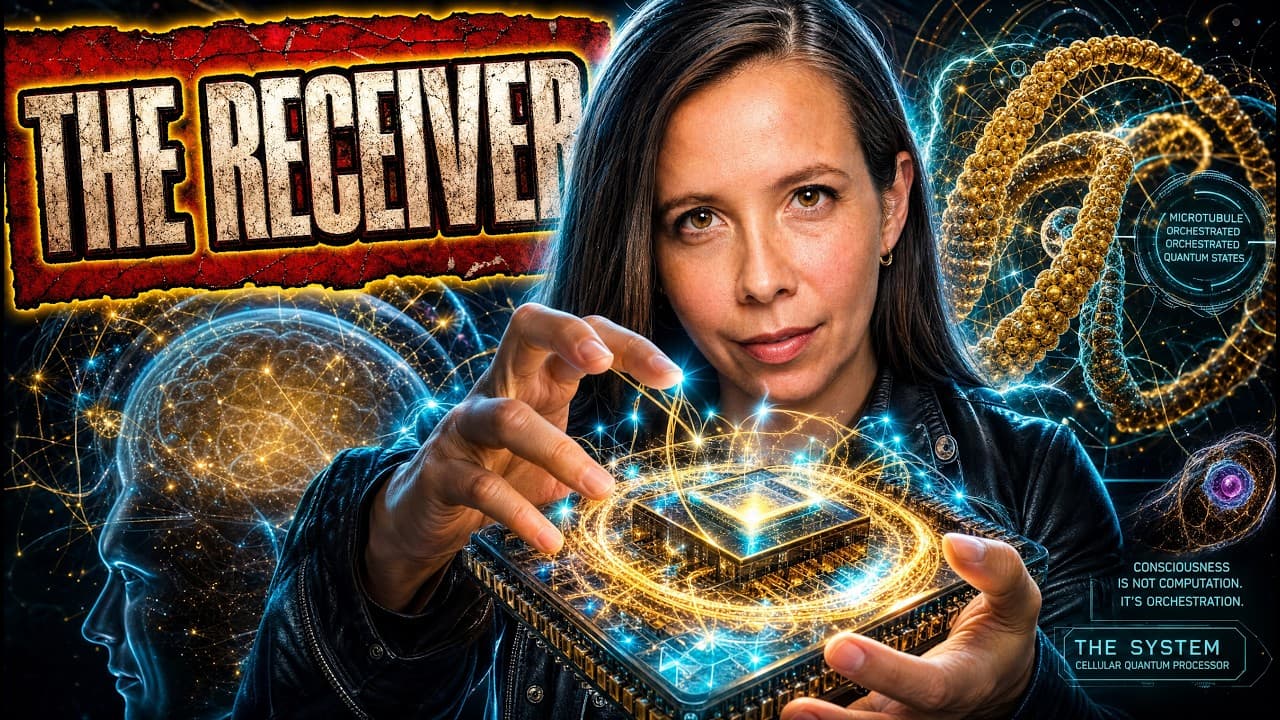
The video presents the first causal experimental evidence that quantum activity inside microtubules is directly linked to consciousness, challenging the warm wet noisy brain objection. It describes a Wellsley rat anesthesia study where stabilizing microtubules prolonged consciousness, implying quantum effects underpin conscious experience. The discussion expands to medicine, AI, and philosophy and anticipates mainstream acceptance by 2030.
Transcript
For 30 years, the scientific establishment dismissed Roger Penrose as a brilliant Nobel laureate who had lost the plot. His theory that human consciousness emerges from quantum computations inside your brain cells was called impossible, fringe, and physically absurd. Critics had a simple knockout argument. Quantum effects can't survive in the warm,... Read More
Key Insights
- Quantum activity in microtubules is directly tied to consciousness and can be demonstrated causally, not merely correlationally.
- Anesthesia effects may be explained by disruption of microtubule quantum states, and stabilizing microtubules can delay loss of consciousness in animals.
- The materialist brain model is challenged by evidence that consciousness is a fundamental aspect of reality linked to quantum processes.
- Penrose and Hameroff theory proposes orchestrated objective reduction as a mechanism for conscious moments tied to spacetime geometry.
- Recent independent papers report macroscopic quantum coherence related to conscious states in the human brain, supporting non classical explanations.
- Microtubules are described as living waveguides designed to protect quantum states from thermal noise in the brain environment.
- If consciousness is quantum, AI based on classical substrates may never achieve true consciousness, while quantum AI could change the landscape.
- The discussion connects science with philosophy and faith, suggesting a broader rethinking of mind, reality, and meaning.
Install to Summarize YouTube Videos and Get Transcripts
Explore YouTube Video Summarizer or Get YouTube Transcript Extractor
Questions & Answers
Q: How was causal evidence for quantum consciousness obtained in the Wellsley study?
The Wellsley study conducted an experiment on rats where one group received anesthesia and another group received anesthesia plus a microtubule stabilizing drug. The rats with stabilized microtubules stayed conscious significantly longer, retaining reflexes and writing-like behaviors beyond the point where control rats lost consciousness. This provided a direct causal link between microtubule quantum activity and consciousness, moving beyond simple correlations to demonstrate that quantum processes within microtubules can influence conscious states.
Q: Why does this challenge the warm, wet, noisy brain objection?
The warm, wet, noisy brain objection argues that quantum effects cannot survive in brain tissue due to thermal noise. The Wellsley findings claim microtubules are structurally and electrically designed to protect quantum states from thermal disruption, functioning as living waveguides. By showing that manipulating microtubules affects consciousness, the study argues that quantum effects can persist in the brain and play a causal role in conscious experience, countering the objection.
Q: What implications does this have for medicine and anesthesia?
If consciousness depends on quantum processes within microtubules, anesthesia might work by disrupting these quantum activities. The research suggests new therapeutic avenues where quantum-aware interventions could modulate states of consciousness. This could transform our understanding of anesthesia, coma, and disorders of consciousness, and potentially lead to strategies that can safely restore consciousness by targeting microtubule dynamics.
Q: What does this mean for AI and machine consciousness?
The video argues that classical AI substrates cannot achieve true consciousness if consciousness requires quantum effects. Quantum AI operating on quantum substrates might be needed to approach conscious experience. This shifts the debate from whether large language models are conscious to whether the underlying hardware can support quantum processes that generate subjective experience.
Q: How does the theory relate to the hard problem of consciousness?
The theory claims that consciousness is a fundamental feature of reality linked to the geometry of spacetime rather than a product of classical brain computation. It offers a framework where subjective experience is tied to objective quantum events, potentially softening the hard problem by reframing consciousness as an intrinsic aspect of physics rather than an emergent byproduct of neural networks.
Q: What future research directions does the video anticipate?
The video anticipates replication and expansion of findings, including direct in vivo measurements of quantum coherence during conscious states by 2030, and broader tests of quantum effects across medicine, AI, and philosophy. It also expects more studies confirming macroscopic quantum states in the living brain and exploring how microtubules can protect and harness quantum phenomena within biological systems.
Q: How does this view interact with faith and meaning traditions?
The perspective presented suggests that consciousness could be a fundamental aspect of reality, aligning with panpsychist ideas found in many wisdom traditions. It proposes that science and faith are increasingly converging, with quantum-based explanations offering a bridge between material explanation and spiritual interpretation, thus rethinking the relationship between mind, reality, and meaning without dismissing either domain.
Q: What is the expected timeline for mainstream acceptance according to the video?
The speaker forecasts that by 2030 quantum consciousness theories will move from fringe to mainstream in neuroscience, with direct in vivo measurements of quantum coherence in human brains by 2035 and a transformed textbook view of consciousness by 2040, indicating a gradual but significant shift in scientific consensus and educational framing.
Summary & Key Takeaways
-
An experimental result links microtubule quantum activity to conscious experience, challenging classical neuroscience assumptions.
-
The study uses anesthesia and microtubule stabilizers to demonstrate a causal relationship between quantum states and consciousness in rats.
-
The video argues that consciousness is a fundamental feature of reality and predicts broad implications for medicine, AI, and philosophy.
Read in Other Languages (beta)
Share This Summary 📚
Summarize YouTube Videos and Get Video Transcripts with 1-Click
Try YouTube Summary with ChatGPT & Claude or YouTube Transcript Generator
Explore More Summaries from Julia McCoy 📚






Summarize YouTube Videos and Get Video Transcripts with 1-Click
Try YouTube Summary with ChatGPT & Claude or YouTube Transcript Generator