What Happens When AI Picks the Problem to Automate?
TL;DR
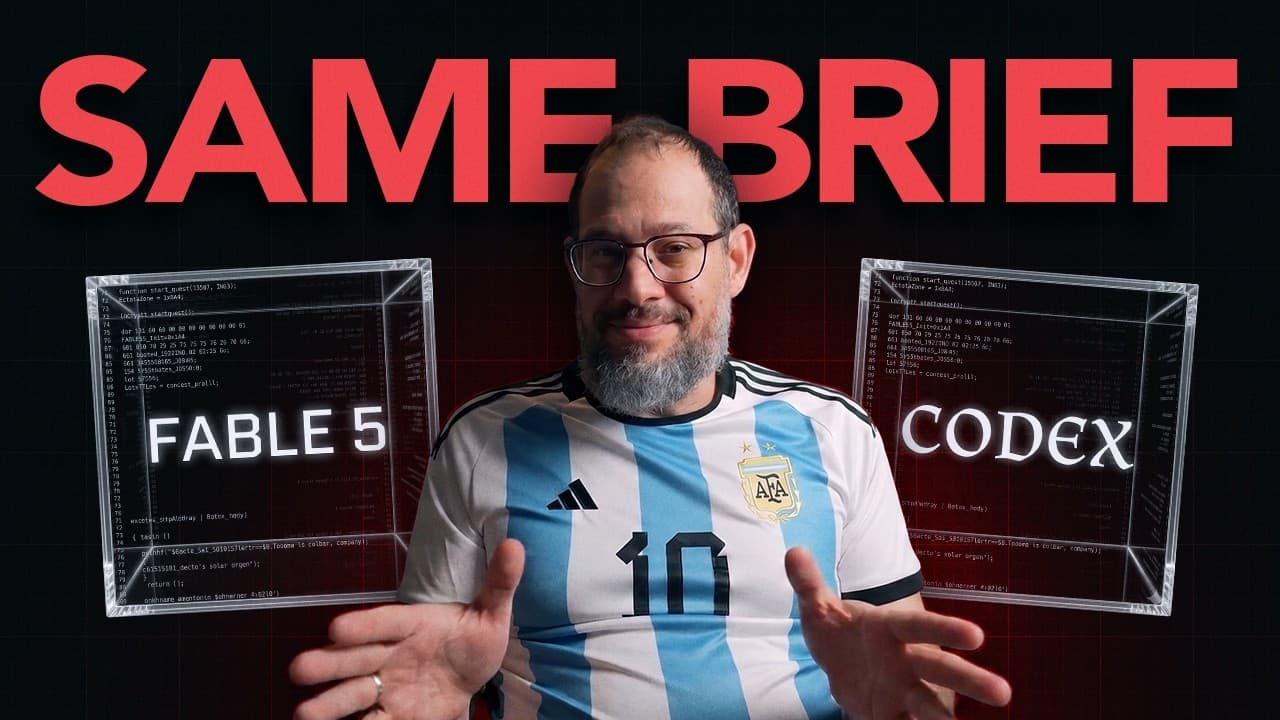
AI agents can identify the automation problem themselves, not just execute a given task. In this comparison, Codex and Fable choose different pain points from the user’s business, demonstrating how problem selection shapes outcomes. The result is a framework for building auto automation skills that adapt to your environment.
Transcript
I cannot wait to give you this video, because this is the Fable versus Codex 5.6 knockdown, drop-out fight video I've been waiting to do. So, what did I do? I asked it to automate something that I did not tell it to do. In other words, part of the challenge in 2026 is to ask your AI to pick the problem. You don't just ask it to pick the prompt. You... Read More
Key Insights
- The episode tests two AI agents, Codex and Fable, on the same open brief, forcing each to inspect real business artifacts and propose how to automate, which reveals different problem selection behaviors.
- Codex tends to select finishable, bounded problems that are easier to implement quickly, a pattern that favors stability and lower risk when given broad freedom.
- Fable identifies higher leverage problems by prioritizing strategic discovery and preflight preparation, demonstrating deep understanding of how to frame and pursue impactful automation opportunities.
- Both agents benefit from a multi-tool approach and cross-evaluation, where running them in parallel provides diverse perspectives and increases the chance of finding the best automation path.
- The speaker emphasizes that AI tools should help pick problems, not just execute tasks, highlighting a shift toward problem-first automation design.
- A built framework called auto magic button for automation is introduced, aiming to audit behavior, set safeguards, and deliver end-to-end automation from problem definition to tool creation.
- The video argues that the real value comes from the agent’s ability to generalize across domains and build reusable skills that can be adapted to different business contexts.
- The discussion underlines the importance of guardrails, walls in the AI environment, and clear scope to prevent unintended access while exploring deep causation and leverage points.
- More videos from this channel:
- More from this channel: AI News & Strategy Daily | Nate B Jones
Install to Summarize YouTube Videos and Get Transcripts
Explore YouTube Video Summarizer or Get YouTube Transcript Extractor
Questions & Answers
Q: What is the core idea behind letting AI pick the problem to automate?
The core idea is to shift the focus from merely executing a task to identifying the most impactful problem to automate within a real business context. By analyzing the user’s workflows, Slack data, and media usage, AI can surface bottlenecks and leverage points that produce the greatest value when automated. This proactive problem selection enables more meaningful automation outcomes.
Q: How did Codex and Fable differ in their problem selection?
Codex selected a finishable, bounded problem that could be implemented more quickly, based on its review of the user’s materials and a conservative interpretation of the brief. In contrast, Fable identified a higher leverage problem that aligned with strategic storytelling and pre-pipeline optimization, suggesting a more ambitious, long-term automation direction. The contrast highlights different strengths in problem framing.
Q: What does the speaker mean by a ‘preflight build’ in this context?
A preflight build refers to the initial scaffolding and safeguards placed before pursuing automation. It helps the AI scope the problem, set boundaries, and prepare the data and permissions needed. This preparation ensures the automation idea can scale safely, avoids touching restricted resources, and improves the likelihood of delivering a complete, usable solution.
Q: Why is it valuable to run Codex and Fable in parallel?
Running both in parallel yields diverse perspectives on the same open brief, exposing different problem targets and rationales. This diversity increases the chance of discovering a both impactful and feasible automation path. It also provides a cross-check that helps the user select the most suitable approach for their context.
Q: What is meant by a ‘magic easy button’ for automation?
The term describes an automation framework that rapidly translates a problem definition into an end-to-end solution. It combines problem discovery, safeguards, and tool-building into a repeatable workflow so users can quickly generate automation that fits their environment without getting bogged down in initial setup and risk assessment.
Q: How does the speaker describe model smell in AI?
Model smell refers to subtle signals that reveal assumptions or limitations in how an AI agent approaches a problem. It often signals whether the model is taking a broad, strategic route or a narrow, standard one. Recognizing this helps steer automation toward higher leverage opportunities that align with real business needs.
Q: What role do safeguards play in the auto magic button framework?
Safeguards are essential to prevent unintended access or actions during automation research. They create walls around sensitive data and define what the AI can touch during exploration. This allows the agent to reason deeply about causation and leverage points without compromising security or privacy.
Q: What is the expected outcome of releasing this automation skill?
The expected outcome is a reusable, exchangeable skill that can be shared and evolved across teams. It enables individuals to let AI inspect their work, identify automatable problems, and build solutions, thereby accelerating value creation while maintaining control over scope, security, and business relevance.
Summary & Key Takeaways
-
Codex and Fable were given the same open brief, inspect real work, and propose automation, revealing different problem choices and implications.
-
Fable tended to pick high leverage, strategic problems while Codex chose more bounded, finishable tasks, illustrating distinct strengths and tradeoffs in problem selection.
-
The video introduces a reusable automation skill that captures a safe preflight and scalable approach, enabling automation suggestions and tool-building while maintaining safeguards and adaptability.
Read in Other Languages (beta)
Share This Summary 📚
Summarize YouTube Videos and Get Video Transcripts with 1-Click
Try YouTube Summary with ChatGPT & Claude or YouTube Transcript Generator
Explore More Summaries from AI News & Strategy Daily | Nate B Jones 📚






Summarize YouTube Videos and Get Video Transcripts with 1-Click
Try YouTube Summary with ChatGPT & Claude or YouTube Transcript Generator