AI Syllabus for NTA UGC NET: Priority Topics to Study
TL;DR
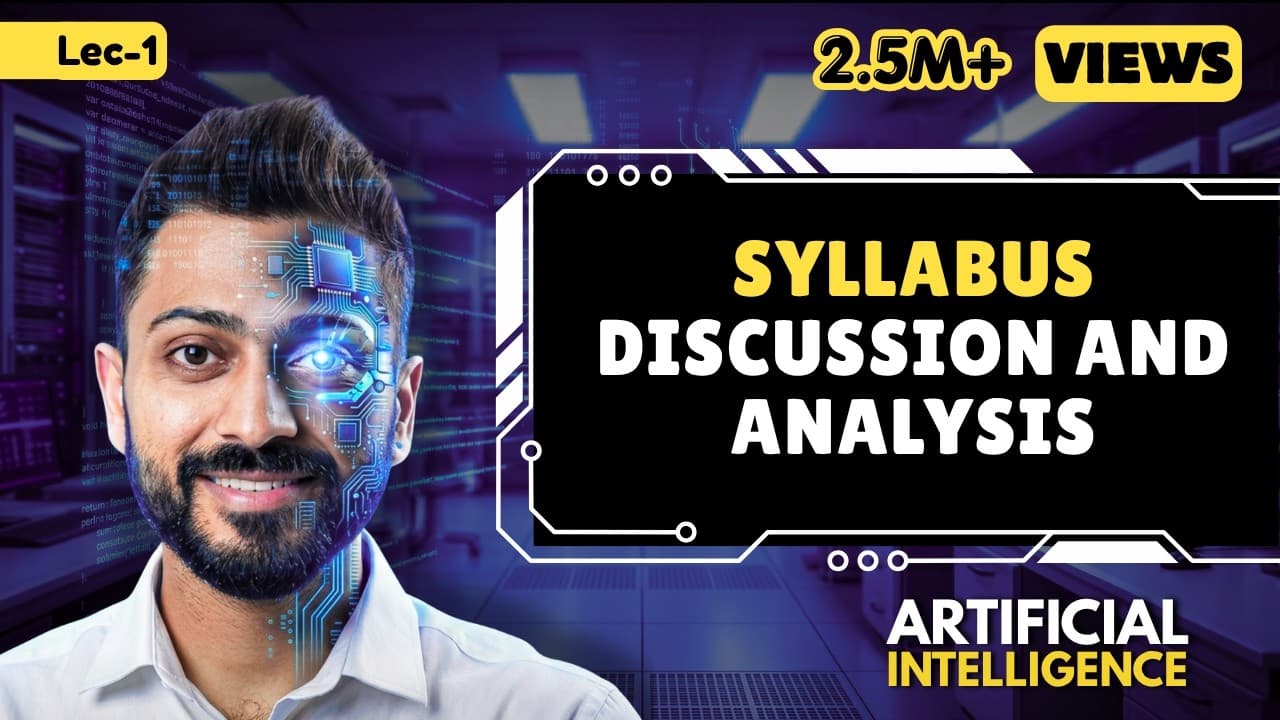
Approach to AI and fuzzy sets are the highest-priority topics for the NTA UGC NET Artificial Intelligence exam, since questions appear from them every year in the same patterns. Master heuristic search algorithms (A*, AO*, Best First), game playing (minmax, alpha-beta), and fuzzy set operations first, then cover neural networks and multi-agent topics.
Transcript
Hello friends welcome to gate smashers In today's video we are going to see Syllabus of artificial intelligence And we are discussing this specially for NTA and NET exam But even if you are preparing for your college or university level exam also Then the syllabus if Artificial intelligence is mostly same only But if we talk about NTA and NET exam ... Read More
Key Insights
- Approach to AI is the most important unit for the NTA UGC NET AI exam, earning three stars, because questions appear from it in every exam. It covers heuristic search (A*, AO*, Best First), game playing, and constraint satisfaction.
- Heuristic search algorithms A*, AO*, Best First, and Hill Climbing must be studied in detail, including how they work and the past questions asked on them, rather than only reading theory from above.
- Game playing questions focus mainly on the minmax algorithm along with alpha-beta cut off, making these the core algorithms to prepare within the approach to AI unit.
- Fuzzy sets rank as the second highest priority with three stars, since questions come every year in the same pattern, covering crisp versus fuzzy sets, alpha cut, and union, intersection, and minus operations.
- Neural networks receive two stars, meaning fewer questions are asked relative to top topics, and the unit covers artificial neural networks, genetic algorithms, single and multilayer feedforward, recurrent Hopfield networks, and supervised versus unsupervised machine learning.
- Multi-agent gets two stars because simple-level questions appear on types of agents, their properties, and how agents use current or past history to work.
- Newly introduced topics like genetic algorithm, machine learning, and big data are asked only at basic level, because competitive exams start new topics with simple questions and increase difficulty gradually over years.
- Smart work through strategy is essential alongside hard work; the recommended standard books are Rich and Knight and Indian author Soraj Kaushik, whose content is in easier language.
- Predicate logic earns two stars inside the single-starred knowledge representation unit because the logic concept overlaps with mathematics and AI, so it should not be skipped.
Install to Summarize YouTube Videos and Get Transcripts
Explore YouTube Video Summarizer or Get YouTube Transcript Extractor
Questions & Answers
Q: What are the most important topics in the AI syllabus for NTA UGC NET?
The two highest priority topics, each given three stars, are Approach to AI and Fuzzy sets. Approach to AI covers heuristic search (A*, AO*, Best First), game playing (minmax, alpha-beta cut off), and constraint satisfaction. Fuzzy sets cover crisp versus fuzzy sets, alpha cut, and union, intersection, and minus operations. Both appear every year in similar patterns, so they should never be left out.
Q: How to prepare for AI exam in less time?
Focus on high-probability topics identified through analysis of all past questions rather than studying every topic in equal depth. Prioritize the three-star topics (Approach to AI and Fuzzy sets), then two-star topics like neural networks and multi-agent. Combine hard work with smart work by following the star-based strategy, practicing the linked assignment questions, and studying newer topics only at basic level since they are asked simply.
Q: What algorithms should I study in heuristic search for the AI exam?
In heuristic search you should study A*, AO*, and Best First in detail, along with Hill Climbing. You should also know DFS and BFS techniques, which are also discussed in data structures. The video stresses knowing how each algorithm works and reviewing the questions that have appeared on them, because these are asked at more than basic level given they have been examined for many years.
Q: Which books are recommended for AI preparation for UGC NET?
The standard book recommended is Rich and Knight, by the authors Rich and Knight. There is also an Indian author option, Soraj Kaushik, whose book contains the same content but in easier language. Rich and Knight's content language may feel a bit tough, especially when preparing in less time, which can be demotivating, so easier-language alternatives are suggested for time-constrained students.
Q: Why are genetic algorithm and machine learning asked only at basic level?
Because in competitive exams newly introduced topics are never asked in detail or in deep at first. Questions are asked from the top, at basic level, and difficulty increases slowly over the years. The video gives the example of big data, added as a new topic in DBMS, where the December 2018 exam had very simple-level questions. Genetic algorithm and machine learning follow the same pattern.
Q: How many stars do neural networks and multi-agent get and why?
Both neural networks and multi-agent receive two stars. This does not mean skipping them; they remain important, but the rating reflects the fewer number of questions asked compared to three-star topics. Neural networks cover artificial neural networks, genetic algorithms, feedforward and recurrent Hopfield networks, and supervised and unsupervised machine learning. Multi-agent covers types of agents, their properties, and how they use current or past history.
Q: What should I focus on in knowledge representation and NLP?
Knowledge representation, planning, and NLP receive one star, meaning fewer questions, but they must still be covered. Within knowledge representation, study the approaches to represent knowledge and predicate logic, which gets two stars because logic overlaps with mathematics. Also cover reasoning, including statistical, forward, and backward reasoning. In NLP, focus on syntactic and semantic topics, the two main areas from which theory questions come.
Q: What is the purpose of the star rating system in this video?
The star system indicates priority based on the creator's analysis of all past AI questions. Three stars means the most important topics that appear every year, such as Approach to AI and Fuzzy sets. Two stars means important but with fewer questions asked, like neural networks and multi-agent. One star means fewer questions still requiring coverage. The ratings help students decide what to study first and how deep to go with limited time.
Summary & Key Takeaways
-
The video breaks down the Artificial Intelligence syllabus for the NTA UGC NET exam, using analysis of all past AI questions to assign star-based priority to topics so students preparing in limited time know exactly what to study and how deep to go.
-
Approach to AI (heuristic search, game playing, constraint satisfaction) and fuzzy sets receive three stars as the highest priority because questions appear every year in consistent patterns; neural networks and multi-agent get two stars, and knowledge representation, planning, and NLP get one star.
-
New topics such as genetic algorithm and machine learning are asked only at basic level because exams introduce them gradually. The creator recommends studying concepts deeply when time allows, following Rich and Knight or Soraj Kaushik books, and practicing linked assignment questions to learn real application.
Read in Other Languages (beta)
Share This Summary 📚
Summarize YouTube Videos and Get Video Transcripts with 1-Click
Try YouTube Summary with ChatGPT & Claude or YouTube Transcript Generator
Explore More Summaries from Gate Smashers 📚





Summarize YouTube Videos and Get Video Transcripts with 1-Click
Try YouTube Summary with ChatGPT & Claude or YouTube Transcript Generator