What Is Grammar in Theory of Computation?
TL;DR
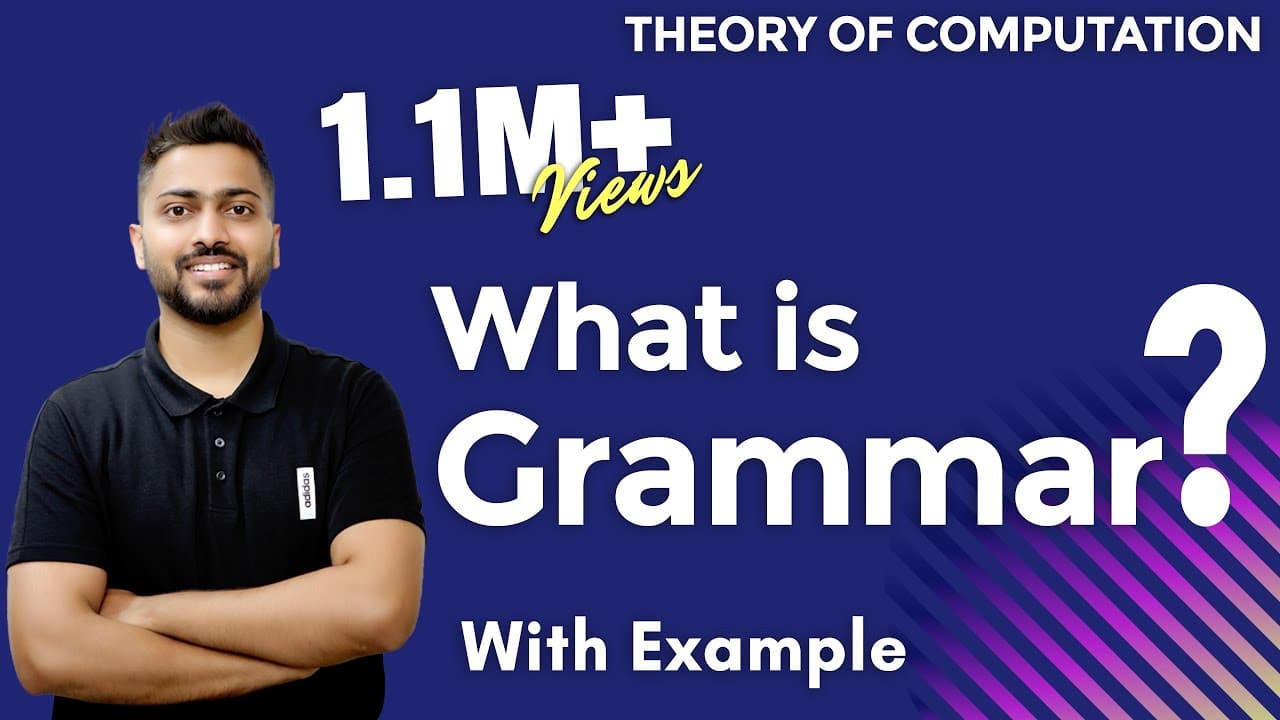
A grammar is a standard way to represent a language by defining rules that generate its valid strings. In Theory of Computation, a grammar is written as the quadruple G = (V, T, P, S), containing variables, terminals, production rules, and a start symbol. Applying productions from the start symbol determines which strings belong to the generated language.
Transcript
hello those so gates measures make us forget there is freedom explain carnage around what is grammar in TOC there are modularity osika important topic at Keuka TOC cosas manically a Darumaka concept of cahuachi a is Kilowog embark on a Cohiba competitive exams disk and the computer science Kapoor Shaad up there do you see you have a subsidy of the ... Read More
Key Insights
- A grammar is a standard method for representing a language. It supplies rules that generate acceptable strings, allowing a particular string to be tested by determining whether it can be derived from those rules.
- Language membership is determined by successful generation. If a grammar can derive a string through its production rules, the string belongs to the generated language; if the grammar cannot derive it, the string is not part of that language.
- A grammar G is defined as the quadruple G = (V, T, P, S). V represents variables, T represents terminals, P contains production rules, and S identifies the start symbol from which every derivation begins.
- Variables are symbols that can be replaced during a derivation. They are commonly written as capital letters, such as S, while terminals are commonly written as lowercase letters and remain in the completed generated string.
- Production rules are the mechanisms used to generate strings. Each rule specifies how a variable can be replaced, and repeatedly applying these rules transforms the start symbol into strings belonging to the grammar's language.
- The start symbol is the initial focus of every derivation. A grammar begins with this designated variable and applies production rules until the intended terminal string is generated or no suitable derivation can produce it.
- The rule S → aSb | ε generates strings with equal blocks of a and b symbols. It produces ε, ab, aabb, aaabbb, and more generally a^n b^n, where n is greater than or equal to zero.
- Different grammars can impose different equality constraints on strings. One example keeps all a symbols before all b symbols, while another set of productions permits varied ordering as long as the number of a symbols equals the number of b symbols.
Install to Summarize YouTube Videos and Get Transcripts
Explore YouTube Video Summarizer or Get YouTube Transcript Extractor
Questions & Answers
Q: What is grammar in Theory of Computation?
Grammar in Theory of Computation is a standard, rule-based way of representing a language. It describes how valid strings can be generated from an initial symbol by repeatedly applying production rules. A string belongs to the generated language when the grammar can derive it. If no permitted sequence of substitutions generates that string, it is not included in the language.
Q: What are the four components of a grammar?
A grammar is expressed as G = (V, T, P, S). V is the collection of variables that may be replaced during derivation. T is the collection of terminals that appear in completed strings. P is the set of production rules governing substitutions. S is the start symbol from which the process of generating a string begins.
Q: What are variables and terminals in a grammar?
Variables are replaceable symbols used while deriving a string, and the lecture commonly represents them with capital letters such as S. Terminals are the symbols retained in the generated string and are commonly represented with lowercase letters such as a and b. Production rules progressively replace variables until the derivation reaches a completed string made from terminals, or reaches ε.
Q: What is a production rule in formal grammar?
A production rule specifies how a variable may be replaced while generating a string. Rules form the active mechanism of a grammar because they control every permitted derivation from the start symbol. By selecting and repeatedly applying suitable productions, a grammar can generate individual strings. The full collection of strings obtainable through these rules constitutes the generated language.
Q: What is the start symbol in a grammar?
The start symbol is the designated variable from which a derivation begins. It is represented by S in the lecture's examples and is one of the four components of G = (V, T, P, S). Production rules are first applied to this symbol, then to any variables introduced later, until the grammar produces the desired terminal string.
Q: What language does S → aSb | ε generate?
The grammar S → aSb | ε generates strings of the form a^n b^n, where n is greater than or equal to zero. Choosing ε immediately produces the empty string. Applying S → aSb once and then ε produces ab. Repeating the recursive rule produces aabb, aaabbb, and further strings with equal numbers of a and b symbols.
Q: How does a grammar determine whether a string belongs to a language?
A grammar determines membership by attempting to derive the string from its start symbol using only the listed production rules. If a sequence of valid substitutions produces the target string, that string is part of the grammar's language. For example, S → aSb | ε derives aabb, but it does not derive the alternating string abab because its generated form places the a symbols before the b symbols.
Q: How can a grammar generate strings with equal numbers of a and b?
A grammar can preserve equality by using production rules that introduce one a and one b together. The rule S → aSb | ε does this while keeping every a before every b. The lecture also presents multiple productions, including combinations such as aSb, bSa, and recursive uses of S, to permit different symbol orders while maintaining equal totals of a and b.
Summary & Key Takeaways
-
Grammar provides a rule-based method for representing a language and generating its valid strings. Like English grammar, which distinguishes grammatically valid sentences from invalid arrangements of words, a Theory of Computation grammar determines whether particular symbol strings can be produced and therefore included in its associated language.
-
A grammar is defined by four components: variables, terminals, production rules, and a start symbol. Variables are commonly represented by capital letters, while terminals use lowercase letters. Production rules specify permitted substitutions, and derivation begins from the designated start symbol until a string containing terminals is obtained.
-
The production S → aSb | ε generates the language a^n b^n for n greater than or equal to zero. Each recursive substitution introduces one a and one b, while ε ends the derivation. Other rule sets can generate strings where the total number of a symbols equals the total number of b symbols.
Read in Other Languages (beta)
Share This Summary 📚
Summarize YouTube Videos and Get Video Transcripts with 1-Click
Try YouTube Summary with ChatGPT & Claude or YouTube Transcript Generator
Explore More Summaries from Gate Smashers 📚




Summarize YouTube Videos and Get Video Transcripts with 1-Click
Try YouTube Summary with ChatGPT & Claude or YouTube Transcript Generator