How to use Abacus AI personal agents across apps
TL;DR
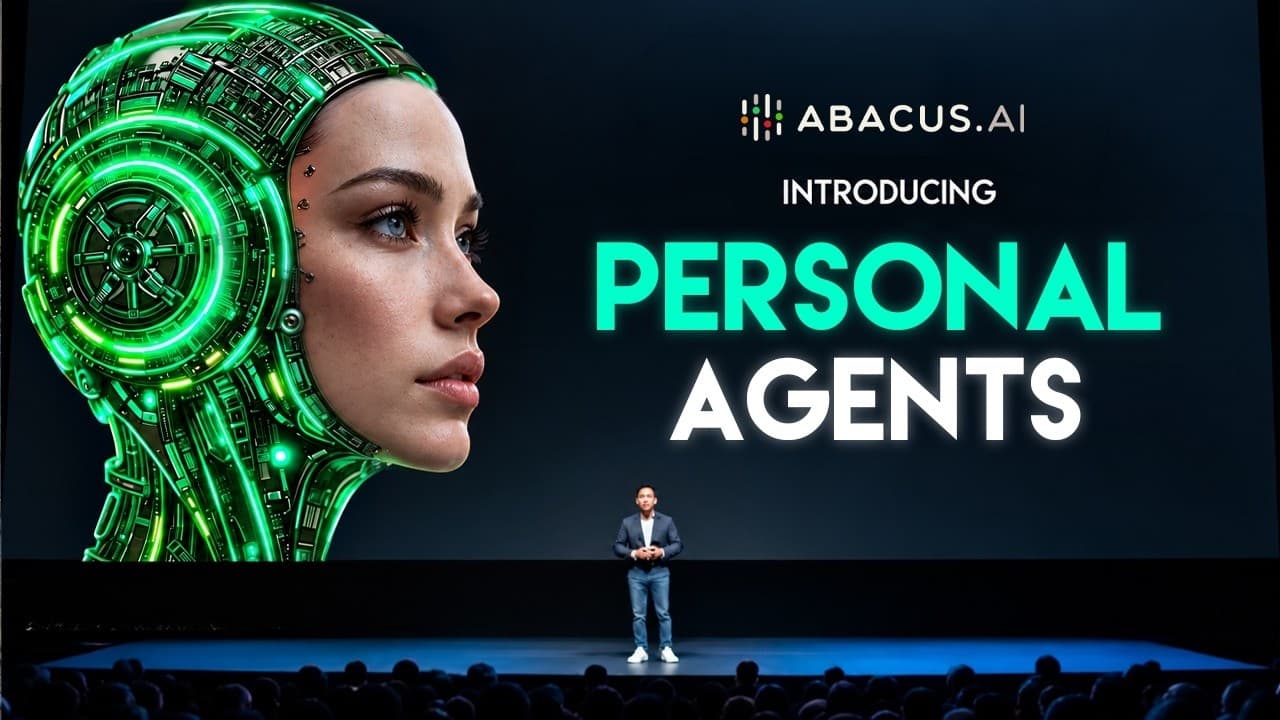
Abacus AI personal agents coordinate across messaging apps like WhatsApp and Telegram, allowing agents to investigate, fix, and deploy in response to live incidents with minimal human input. They remember user preferences, pass work between agents, and handle coordination across tools and teams, reducing traditional back-and-forth.
Transcript
[music] Abacus AI just shipped AI agents that talk to each other. Your agent sits in your WhatsApp like any other contact. Your co-worker's agent sits in their Telegram, and the two of them can pass work back and forth without either of you relaying a thing. In one of the demos, a live app breaks, and the person responsible gets it diagnosed, fixed... Read More
Key Insights
- Abacus AI enables agents that live inside messaging apps to talk to each other and pass work without human handoffs.
- The agents can investigate live failures, reproduce bugs, generate root cause analyses, and propose fixes via PDFs and Markdown delivered to chat.
- A pull request can be opened by an agent, and deployment occurs after human authorization, highlighting a controlled, end-to-end automation flow.
- Memory is built into agents so they remember user preferences and past decisions, reducing repetitive setup and improving personalization.
- Agents can connect across WhatsApp, Telegram, and Discord, and remember across these platforms for consistent behavior.
- A team setup can include multiple agents each representing different people, sharing a common goal and final spec across apps.
- Abacus integrates with a wide range of tools and services, including Gmail, calendars, project management, code repositories, and cloud file storage.
- The open-source variant and warnings about terms of service indicate both accessibility and compliance considerations for using such agents.
Install to Summarize YouTube Videos and Get Transcripts
Explore YouTube Video Summarizer or Get YouTube Transcript Extractor
Questions & Answers
Q: What is the basic idea behind Abacus AI personal agents across messaging apps
The basic idea is that personal agents live in familiar messaging apps like WhatsApp and Telegram, can talk to each other, and coordinate work across people and apps. They remember user preferences, handle routine tasks, and escalate decisions to humans only when needed, enabling a smoother, chat-based workflow for personal and team tasks.
Q: How do the agents handle a live production incident in the demonstration
In the demo, an agent investigates the incident by reading logs, reproducing the bug, and performing tests against the live app. It then writes a root cause analysis and creates a pull request to remove a problematic flag. The human approves the change via Telegram, and the system deploys after testing, completing the fix cycle.
Q: What role does memory play in Abacus personal agents
Memory allows agents to learn user preferences and past instructions, so they don’t have to be reminded repeatedly. This enables personalized planning, tailored trip suggestions, and consistent routines. The agents remember rules for tasks like vacation speed limits and local restaurant criteria to streamline future requests.
Q: How do agents coordinate across multiple people on different apps
Agents connected to different people on WhatsApp, Telegram, and Discord share a single agent or linked agents that pass information and constraints. They reconcile product goals, technical constraints, and desired outcomes to generate a shared spec or plan, avoiding manual meetings and consolidating input into a unified document.
Q: What kinds of tools and services can Abacus agents connect to
Agents can connect to Gmail, Google Calendar, Slack, Jira, GitHub, Confluence, Google Drive, One Drive, SharePoint, Teams, Outlook, Box, Figma, and more. When complex work arises, they escalate to the Abacus AI agent for specialized tasks, ensuring a balanced blend of automation and expert analysis.
Q: How is deployment controlled in the Abacus workflow
Deployment is controlled by human authorization. The agent can merge, build, deploy, and run tests, but the final deployment step requires a human to approve in the chat. This creates a balance between automation and governance to prevent unintended changes.
Q: What is the difference between personal agents and Abacus Claw or Muse
Personal agents are the connected, cross-app agents that work for individuals or teams and carry memory across apps. Abacus Claw is a cloud-hosted version focused on continuous assistants that manage conversations, while Muse is a WhatsApp integrated agent service. The three together form a broader ecosystem for AI-assisted work.
Q: What are potential caveats or risks mentioned in the video
Caveats include the possibility that linking personal accounts to agents may violate service terms, as WhatsApp and other platforms have policies about automation. The video notes the need to consider separate accounts to avoid conflicts and mentions prior restrictions by platform providers on general purpose AI bots.
Summary & Key Takeaways
-
Abacus AI introduces personal agents that live in familiar messaging apps and connect to additional services to automate work, while keeping humans in the loop for decisions.
-
The system demonstrates cross-app agent collaboration, incident investigation, code changes, and deployment through a seamless chat-based flow, with memory and template-based agents enhancing productivity.
-
Across individual and team use cases, shared agents coordinate tasks, keep context, and evolve with user feedback to improve planning and execution.
Read in Other Languages (beta)
Share This Summary 📚
Summarize YouTube Videos and Get Video Transcripts with 1-Click
Try YouTube Summary with ChatGPT & Claude or YouTube Transcript Generator
Explore More Summaries from AI Revolution 📚


Summarize YouTube Videos and Get Video Transcripts with 1-Click
Try YouTube Summary with ChatGPT & Claude or YouTube Transcript Generator