What AI Skills Do You Need to Master in 2026?
TL;DR
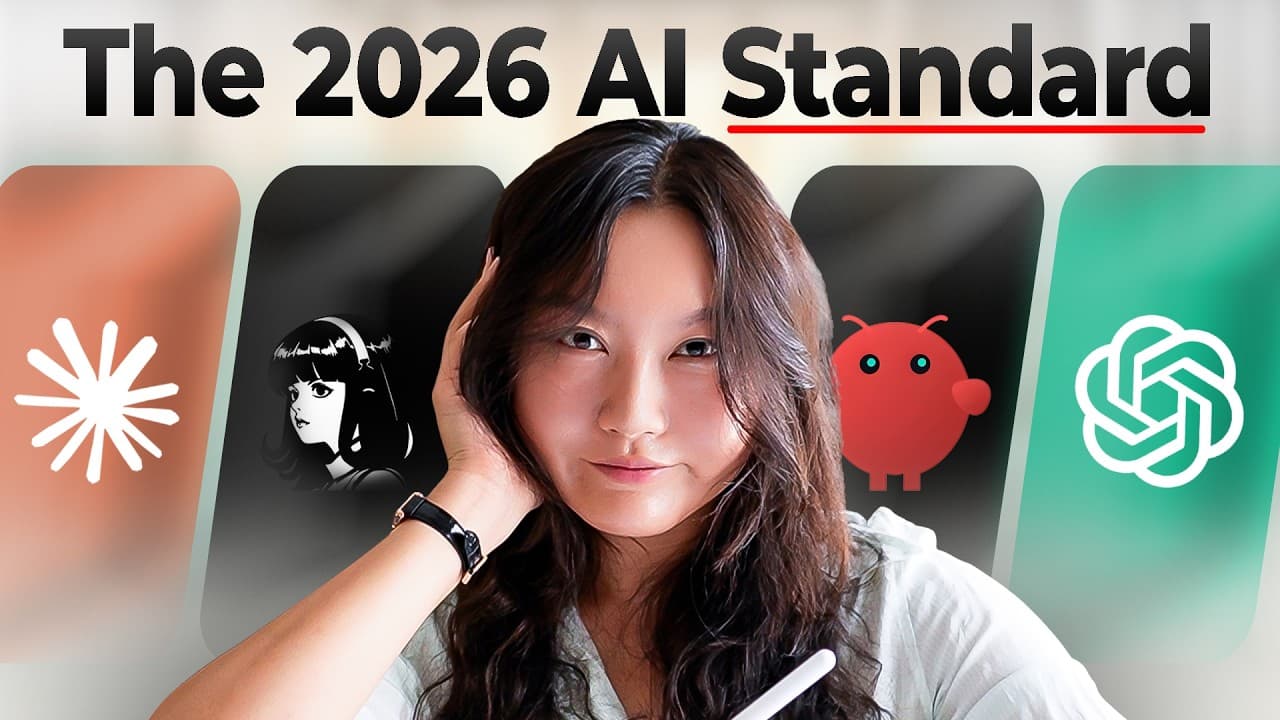
Start by improving your prompting, mastering a small core of useful AI tools, and deciding how AI exposure fits your investments and career. Then progress from single-response chatbots to AI agents, local automated workflows, and AI app building, choosing tools according to your technical ability, privacy needs, cost preferences, and desired capabilities.
Transcript
So, it's only been 5 months since I gave you my 2026 essential AI skills road map. But oh my goodness, things have changed so much since the beginning of this year. So, I feel like I got to give you an updated version. So, this video is it. The updated essential AI skills road map. And I'm going to structure like a progression from the most basic s... Read More
Key Insights
- Prompting is the foundation for interacting with every type of AI because it determines how users express requests, constraints, context, and goals. Strong prompting skills make both simple chatbot tasks and more complex agent workflows easier to direct, refine, and evaluate.
- An AI investment thesis is important because broad index funds can already create substantial exposure to companies that build, integrate, or invest in AI. The appropriate exposure should reflect a person's career, financial situation, existing AI dependence, and need to hedge against related risks.
- A small, mastered AI toolset is more sustainable than continually chasing new releases. One capable general chatbot can support questions, travel planning, image, audio, video, and animation generation, plus early app prototypes, particularly when paired with effective prompting.
- Specialized AI tools are most valuable when they match recurring needs. Research and news tools can support deeper investigation, learning tools can organize new material, and job-specific products can assist areas such as software development, marketing content, and search engine optimization.
- AI agents are software systems that pursue goals and complete tasks on a user's behalf. Unlike a basic chatbot exchange that returns one response to one request, an agent can interpret an overarching objective, identify necessary steps, and execute those steps.
- Local AI agents run on a user's own computer and enable personalized automations across connected information sources. Example workflows include producing daily digests from calendars, Gmail, investments, Slack, and Notion, or tracking AI news and helping prepare draft scripts.
- The choice of a local AI agent depends on technical skill and the preference for open or closed source AI. Some products target nontechnical users, while others assume coding ability, so selecting an appropriate entry point reduces unnecessary complexity.
- Open and closed source AI involve tradeoffs among capability, cost, and privacy. Closed source systems tend to be more capable, though the gap is closing, while self-hosted open source models can be inexpensive or free to run and keep sensitive data private.
Install to Summarize YouTube Videos and Get Transcripts
Explore YouTube Video Summarizer or Get YouTube Transcript Extractor
Questions & Answers
Q: What AI skills should everyone know in 2026?
The foundational skills are developing an AI-aware investment thesis, learning effective prompting, and mastering a small core of AI tools. Prompting supports every later interaction, while a general chatbot can cover questions, planning, media generation, and app prototyping. People can then add research, learning, coding, marketing, or SEO tools when those products match their actual work and recurring needs.
Q: Why should investors develop an AI investment thesis?
An AI investment thesis helps a person understand and intentionally manage their exposure to AI. Broad index funds may already include many companies that are AI businesses or have invested heavily in AI. The desired exposure should therefore be considered alongside career stability, professional dependence on AI, personal circumstances, investment beliefs, and any need to hedge against AI-related risks.
Q: How can someone avoid being overwhelmed by new AI tools?
The recommended approach is to stop chasing every new release and instead master a compact set of tools. A general chatbot is the strongest minimalist starting point because it can answer questions, plan travel, generate several types of media, and prototype apps. Additional specialized tools should be adopted selectively when they solve a clear research, learning, coding, marketing, or SEO problem.
Q: What is an AI agent and how does it differ from a chatbot?
An AI agent is a software system that uses AI to pursue goals and complete tasks for a user. A basic chatbot interaction often involves one specific request followed by one response. An agent can receive a broader objective, break it into smaller steps, and execute those steps, such as developing an office aesthetic, visualizing the decorated space, and locating relevant products.
Q: What is a local AI agent used for?
A local AI agent lives and runs on a specific computer, takes actions, and supports customized personal workflows. It can connect information from calendars, Gmail, investments, Slack, and Notion to create a daily digest in Apple Notes. Other examples include monitoring AI news, researching selected topics, assisting with script drafts, and maintaining a customized investment information dashboard.
Q: How should you choose a local AI agent?
Choose a local AI agent by considering two main factors: your technical ability and your preference for open or closed source AI. Some agent products are designed for nontechnical users, while others are better suited to people who can code. The source model decision should then reflect the relative importance of capability, cost, privacy, and running the system on your own machine.
Q: What are the tradeoffs between open and closed source AI?
The main tradeoffs concern capability, cost, and privacy. Closed source systems tend to be more capable and powerful, although the capability gap is closing. Open source models can be much cheaper or free to run. When users run them on their own machines, they can also keep sensitive information private instead of sending it to an external AI provider.
Q: How can AI agents improve personal and professional workflows?
AI agents can combine information, perform research, track changing topics, and prepare useful outputs without requiring a separate prompt for every step. Examples include assembling a personal daily digest, monitoring AI developments, researching topics, drafting material for YouTube scripts, and curating investment news. These workflows can save time and support higher-quality work, while the user still reviews and improves the results.
Summary & Key Takeaways
-
The basic level combines prompting, thoughtful AI exposure in investing, and mastery of a small toolset. A general chatbot can handle questions, planning, media generation, and app prototypes. Specialized research, learning, coding, marketing, or SEO tools can then be added when they address a recurring personal or professional need.
-
The intermediate level centers on AI agents, which accept overarching goals, divide them into steps, and execute tasks for users. Web-based agents provide an accessible starting point, while local agents run on a personal computer and support customized workflows involving calendars, email, investments, Slack, Notion, Apple Notes, news research, and drafting.
-
The choice of a local agent depends mainly on technical ability and preference for open or closed source AI. Closed source models tend to offer stronger capabilities, although the gap is narrowing. Self-hosted open source models can cost less and provide greater privacy, especially for workflows involving sensitive personal or financial information.
Read in Other Languages (beta)
Share This Summary 📚
Summarize YouTube Videos and Get Video Transcripts with 1-Click
Try YouTube Summary with ChatGPT & Claude or YouTube Transcript Generator
Explore More Summaries from Tina Huang 📚
Summarize YouTube Videos and Get Video Transcripts with 1-Click
Try YouTube Summary with ChatGPT & Claude or YouTube Transcript Generator