How to Use Molecular Models
TL;DR
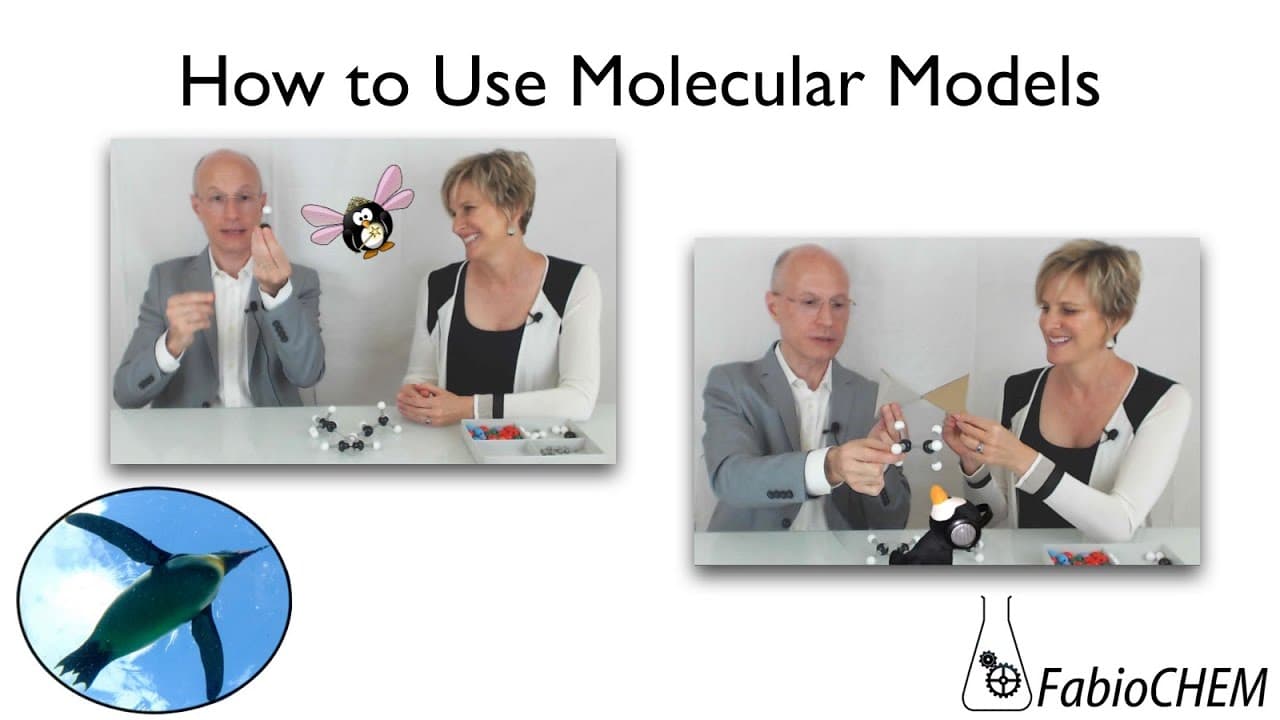
Learn about the different types of molecular models - ball and stick and wireframe models - and their advantages and limitations.
Transcript
Hello and welcome to the Penguin Prof Channel. And welcome back to the Fabio Playlist. If you have not yet met Fabio, you can click there or in the description box, and watch our introduction. And we also did a video where we introduced you to molecular model building, in so much as why you shouldn't be scared of it. And we promised you that we ... Read More
Key Insights
- 💄 Ball and stick models use balls to represent atoms and sticks to represent bonds, making them popular in introductory organic chemistry.
- 🫀 Wireframe models, based on Linus Pauling's theory, are more accurate but less intuitive, requiring the assembly of different pieces to represent atoms and bonds.
- 💋 Ball and stick models provide a simple visual representation of molecules, while wireframe models accurately depict bond angles.
- 💋 Wireframe models are useful for complex molecules, while ball and stick models are better for simple structures.
- 🧑🎓 Building molecular models helps students develop spatial reasoning skills necessary for understanding three-dimensional structures.
- 🫀 Wireframe models are labeled with SP-3 or SP-2 to indicate the type of carbon atom.
- 🔺 Ball and stick models have fixed bond angles of 109 degrees, while wireframe models have accurate bond angles.
Install to Summarize YouTube Videos and Get Transcripts
Explore YouTube Video Summarizer or Get YouTube Transcript Extractor
Questions & Answers
Q: What are the two types of molecular models discussed in the video?
The two types of molecular models discussed are ball and stick models and wireframe models.
Q: How are ball and stick models constructed?
Ball and stick models use balls to represent atoms and sticks to represent bonds. They are simple and popular for introductory organic chemistry.
Q: How do you build a ball and stick model of ethylene?
To build a ball and stick model of ethylene, you use normal sticks for carbon-hydrogen bonds and flexible sticks for the double bond. Join two CH3 units, insert them to make one bond, make the second bond, and bend it.
Q: What are the advantages of wireframe models over ball and stick models?
Wireframe models are more accurate and depict bond angles correctly. They are based on Linus Pauling's hydrogenation theory and require assembling different pieces to represent atoms and bonds.
Summary & Key Takeaways
-
There are two types of molecular models: ball and stick models, which use balls to represent atoms and sticks to represent bonds, and wireframe models, which are more accurate but less intuitive.
-
Ball and stick models are simple and popular in introductory organic chemistry. They are useful for visualizing and building simple molecules like methane and ethane.
-
Wireframe models, based on Linus Pauling's hydrogenation theory, are more accurate but less intuitive. They require assembling different pieces to represent atoms and bonds, and they accurately depict bond angles.
Read in Other Languages (beta)
Share This Summary 📚
Summarize YouTube Videos and Get Video Transcripts with 1-Click
Try YouTube Summary with ChatGPT & Claude or YouTube Transcript Generator
Explore More Summaries from ThePenguinProf 📚





Summarize YouTube Videos and Get Video Transcripts with 1-Click
Try YouTube Summary with ChatGPT & Claude or YouTube Transcript Generator