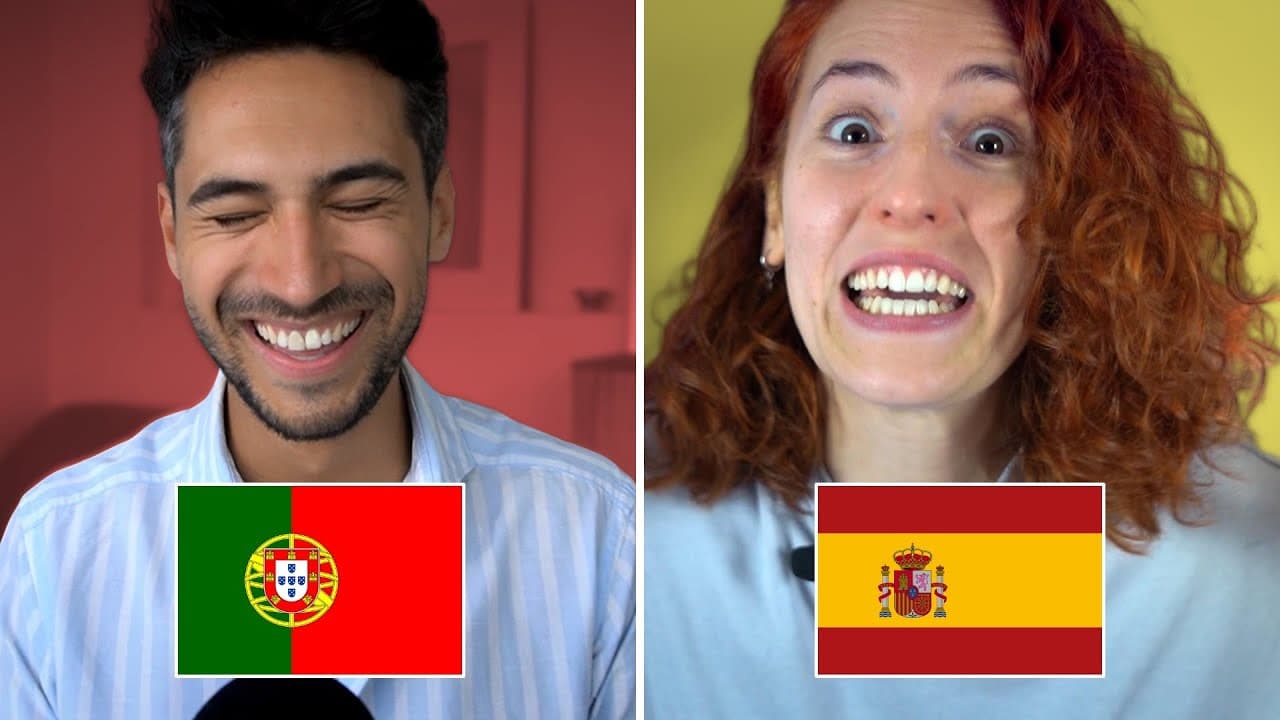
Português X Espanhol - Semelhanças e Diferenças // com @Linguriosa
TL;DR
Portuguese and Spanish are similar but differ in phonetics and grammar.
Transcript
Hello Leo, how are you? Hello Elena, ready to prepare this video about Portuguese and Spanish? Yes, and the truth is that I already have some ideas about what we can talk about. Wow excellent! So I'll just get a sheet… Fuck (folla)? Leo... if you're busy now, we can do it another time. No Elena, a sheet to write Sheet! I had thought of somethi... Read More
Key Insights
- Portuguese and Spanish are sister languages with approximately 90% lexical similarity, but they differ significantly in phonetics, with Portuguese having more complex sounds.
- Portuguese speakers generally understand Spanish better due to Spanish being more dominant globally and its simpler phonetic structure.
- The video features Elena from the Linguriosa channel discussing phonetic, grammatical, and vocabulary differences between Portuguese and Spanish.
- Portuguese has nine vowels, including nasal vowels and diphthongs, while Spanish has five vowels, with phonetic variations in certain regions.
- Spanish uses five definite articles, including the neutral 'lo,' while Portuguese uses four, with no equivalent for 'lo.'
- Pronoun placement differs between the languages, with Spanish placing them before verbs and Portuguese often placing them after with hyphens.
- False cognates exist between the languages, such as 'embarazada' meaning pregnant in Spanish but 'embarrassed' in Portuguese.
- Vocabulary transformation rules include changing endings like -ción to -ção in Portuguese and replacing consonants like Z with Ç.
Install to Summarize YouTube Videos and Get Transcripts
Explore YouTube Video Summarizer or Get YouTube Transcript Extractor
Questions & Answers
Q: What are the main phonetic differences between Portuguese and Spanish?
The main phonetic differences include the complexity of vowels in Portuguese, which has nine vowels and nasal variations, compared to Spanish's five vowels. Additionally, Portuguese uses nasal vowels and diphthongs, while Spanish maintains a simpler vowel structure. Consonant pronunciation also varies, with different sounds for letters like 'C,' 'S,' and 'R' between the languages.
Q: Why do Portuguese speakers generally understand Spanish better than vice versa?
Portuguese speakers tend to understand Spanish better due to the dominance of Spanish as a global language, leading to more exposure. Additionally, Spanish phonetics are simpler compared to the more complex phonetic system of Portuguese. This exposure and simplicity contribute to better comprehension by Portuguese speakers.
Q: How do the definite articles differ between Portuguese and Spanish?
In Portuguese, there are four definite articles: 'o,' 'a,' 'os,' and 'as,' corresponding to masculine, feminine, singular, and plural forms. In Spanish, there are five articles: 'el,' 'la,' 'los,' 'las,' and the neutral 'lo,' which is used to transform adjectives or adverbs into nouns, a feature not present in Portuguese.
Q: What are some examples of false cognates between Portuguese and Spanish?
False cognates include 'embarazada,' which means pregnant in Spanish but 'embarrassed' in Portuguese. Another example is 'exquisito,' meaning exquisite in Spanish, while 'esquisito' in Portuguese translates to 'raro' or rare. These differences can lead to misunderstandings if not properly understood.
Q: How do pronoun placements differ between Portuguese and Spanish?
In Spanish, pronouns are placed before the conjugated verb, such as 'lo vi' (I saw it). In Portuguese, pronouns typically follow the verb with a hyphen, like 'vi-o.' However, in certain contexts, such as negative sentences or following specific adverbs, Portuguese pronouns can precede the verb.
Q: What are some common vocabulary transformation rules between the languages?
Vocabulary transformation rules include changing Spanish word endings like -ción, -sión, and -zón to -ção, -são, and -zão in Portuguese. Additionally, consonants such as Z in Spanish words often change to Ç in Portuguese. These rules assist in converting words between the languages effectively.
Q: How do verb conjugations differ between Portuguese and Spanish?
While most verbs share similar meanings, differences arise in conjugation and usage. For example, Spanish uses 'he ido' for past actions with present relevance, whereas Portuguese uses a simple past form. Future tense constructions also differ, with Spanish using 'ir a + verb' and Portuguese using 'ir + verb.'
Q: What role does rhythm play in differentiating Portuguese and Spanish?
Rhythm plays a significant role, as Spanish is a syllabic rhythm language, where each syllable has a similar length. Portuguese, particularly European Portuguese, follows a stress rhythm, with stressed syllables at regular intervals and unstressed syllables compressed, leading to vowel reduction. Brazilian Portuguese, however, shares a syllabic rhythm with Spanish.
Summary & Key Takeaways
-
Portuguese and Spanish, both Romance languages, share a high lexical similarity but differ in phonetics and grammar. Portuguese has a more complex vowel system with nasal vowels and diphthongs, while Spanish vowels are simpler. The video explores these differences with insights from Elena of the Linguriosa channel.
-
Grammatical differences include article usage, pronoun placement, and verb conjugations. Spanish uses a neutral article 'lo,' while Portuguese does not. Pronouns in Spanish precede verbs, whereas in Portuguese, they often follow. Verb usage and conjugations also show notable differences.
-
Vocabulary differences include false cognates and transformation rules. Words like 'embarazada' and 'embarassed' have different meanings in each language. Transformation rules involve changes in word endings and consonants, aiding in language learning and comprehension.
Read in Other Languages (beta)
Share This Summary 📚
Summarize YouTube Videos and Get Video Transcripts with 1-Click
Try YouTube Summary with ChatGPT & Claude or YouTube Transcript Generator
Explore More Summaries from Portuguese With Leo 📚

Summarize YouTube Videos and Get Video Transcripts with 1-Click
Try YouTube Summary with ChatGPT & Claude or YouTube Transcript Generator