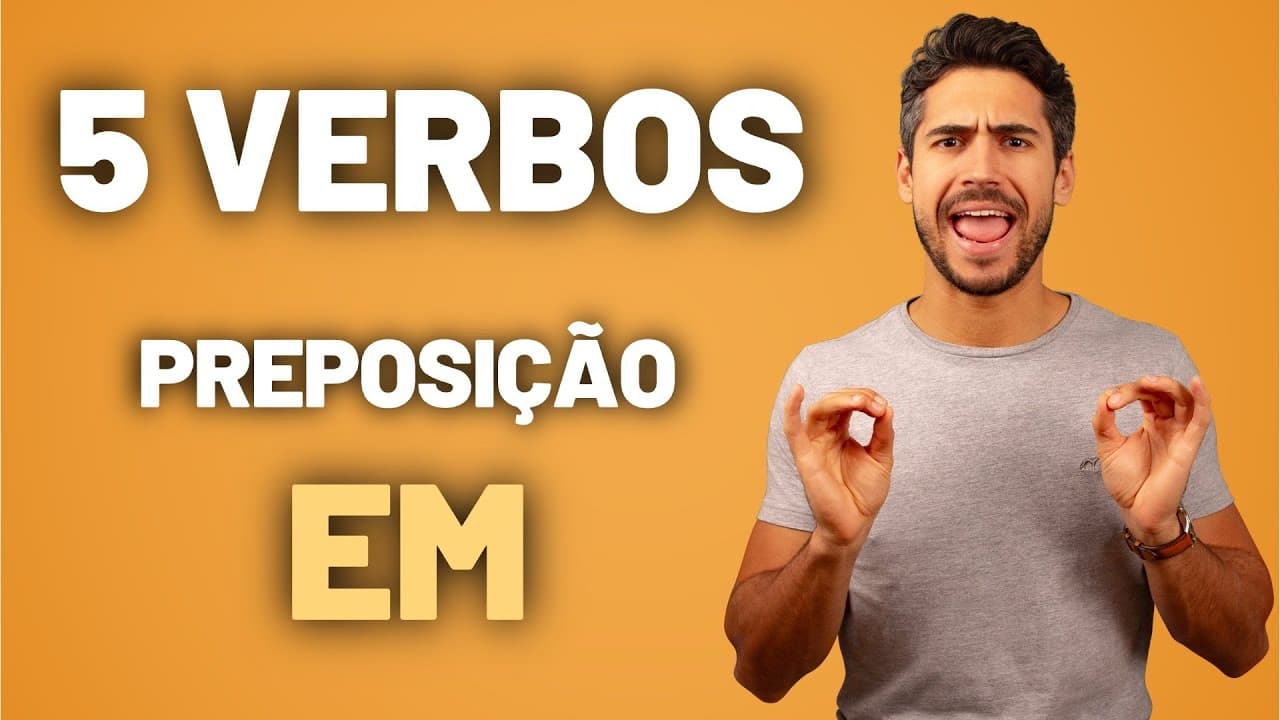
5 verbos com a preposição EM
TL;DR
Learn five Portuguese verbs that use 'em' preposition.
Transcript
Hello and welcome back to Portuguese With Leo! When learning a new language, one of the hardest things to understand are prepositions. Each language has its own rules regarding the use of prepositions, and these often seem somewhat arbitrary, making it very difficult to translate prepositions from one language to another. Today we are going to ... Read More
Key Insights
- Prepositions in different languages can be arbitrary, making translation challenging. Portuguese has specific rules for prepositions like 'em'.
- 'Acreditar' (to believe) in Portuguese always uses 'em', unlike English, which varies with context.
- 'Basear-se' (to base oneself) uses 'em' for both abstract and physical contexts in Portuguese.
- 'Confiar' (to trust) requires 'em' in Portuguese, unlike English where no preposition is used.
- 'Entrar' (to enter) uses 'em' in Portuguese, and interestingly, it contracts with both definite and indefinite articles.
- 'Pensar' (to think) in Portuguese always uses 'em', unlike English which uses 'about' or 'of'.
- Preposition 'em' in Portuguese contracts with articles and demonstratives, forming various combinations.
- Additional learning resources, including PDFs and exercises, are available to enhance understanding of Portuguese prepositions.
Install to Summarize YouTube Videos and Get Transcripts
Explore YouTube Video Summarizer or Get YouTube Transcript Extractor
Questions & Answers
Q: Why is the preposition 'em' significant in Portuguese?
The preposition 'em' is significant in Portuguese because it is frequently used with various verbs, and it contracts with definite and indefinite articles as well as pronouns. This makes it a crucial part of sentence construction, affecting meaning and grammatical correctness.
Q: How does 'acreditar' differ in Portuguese compared to English?
In Portuguese, 'acreditar' always uses the preposition 'em', regardless of context. In English, the verb 'to believe' can either use 'in' or no preposition, depending on the situation. This consistency in Portuguese simplifies its usage but requires learners to adjust from English norms.
Q: What is the rule for using 'em' with 'basear-se'?
'Basear-se', meaning 'to base oneself', always uses 'em' in Portuguese, unlike English where 'on' or 'in' might be used depending on context. This rule applies regardless of whether the basis is abstract or physical, simplifying the verb's usage in Portuguese.
Q: How does 'confiar' use 'em' differently than English?
In Portuguese, 'confiar' (to trust) always requires the preposition 'em', whereas in English, the verb 'to trust' typically does not use a preposition. This highlights a key difference in verb-preposition pairing between the two languages.
Q: What are the contraction rules for 'em' with articles?
In Portuguese, 'em' contracts with definite articles (o, a, os, as) to form 'no', 'na', 'nos', and 'nas'. It also contracts with indefinite articles (um, uma, uns, umas) to form 'num', 'numa', 'nuns', and 'numas'. These contractions are important for proper grammatical structure.
Q: How does 'entrar' utilize 'em' in Portuguese?
'Entrar' (to enter) in Portuguese always uses 'em', whether referring to entering a physical location or a figurative context. This verb also showcases the unique contractions of 'em' with articles, a feature not present in English.
Q: What is unique about 'pensar' and 'em' in Portuguese?
In Portuguese, 'pensar' (to think) consistently uses 'em', unlike English which uses 'about' or 'of'. This uniformity in prepositional use simplifies the verb's application in Portuguese, though it requires English speakers to adapt their understanding.
Q: What resources are available to learn more about Portuguese prepositions?
The video provides a free PDF summarizing the lesson, complete with example sentences, dialogues, and exercises. Additionally, there are links to courses, podcasts, and other resources on the 'Portuguese With Leo' website to further enhance understanding of Portuguese prepositions and language learning.
Summary & Key Takeaways
-
This lesson covers five Portuguese verbs that consistently use the preposition 'em'. Understanding these rules is crucial for learners, as prepositions often vary between languages.
-
The verbs discussed are 'acreditar', 'basear-se', 'confiar', 'entrar', and 'pensar'. Each has specific usage rules with 'em', differing from their English counterparts.
-
The video provides examples and explains the contraction of 'em' with articles and pronouns. Additional resources are offered to support further learning.
Read in Other Languages (beta)
Share This Summary 📚
Summarize YouTube Videos and Get Video Transcripts with 1-Click
Try YouTube Summary with ChatGPT & Claude or YouTube Transcript Generator
Explore More Summaries from Portuguese With Leo 📚






Summarize YouTube Videos and Get Video Transcripts with 1-Click
Try YouTube Summary with ChatGPT & Claude or YouTube Transcript Generator