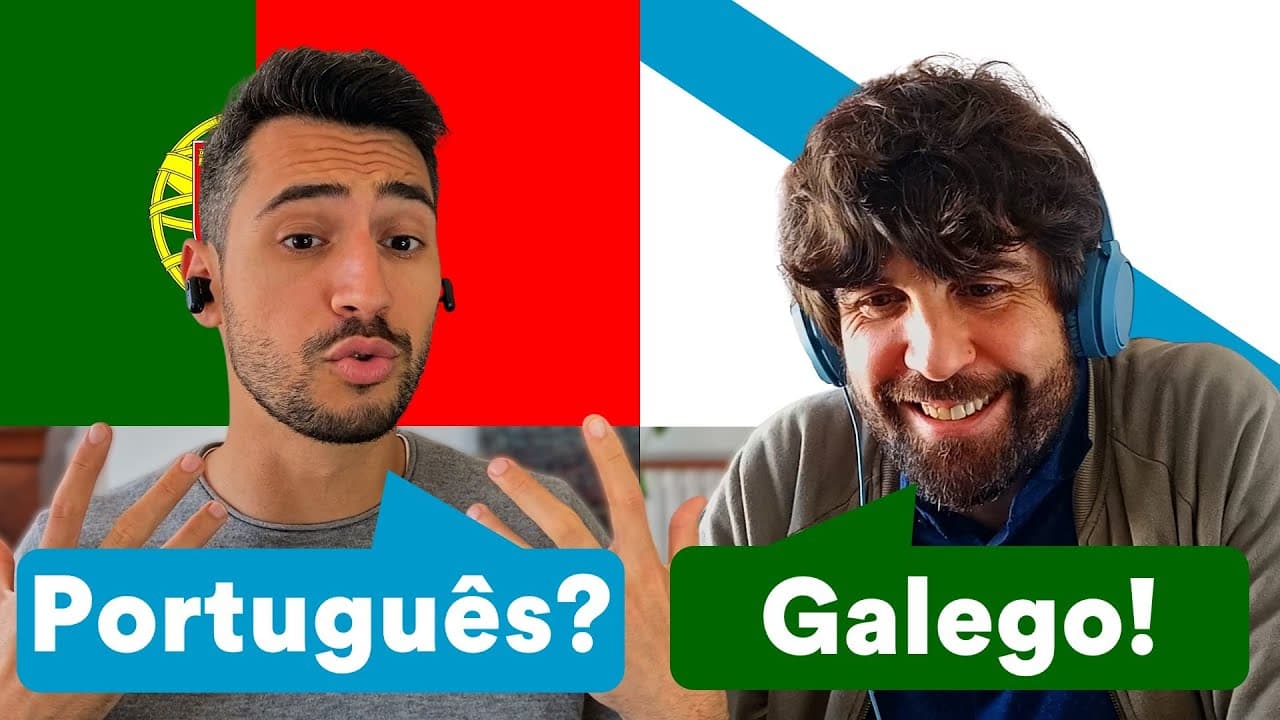
Can Portuguese Speakers Easily Learn Galician?
TL;DR
Portuguese speakers can understand Galician with minimal effort due to shared linguistic roots. Galician, influenced by both Portuguese and Spanish, requires slight adjustments in pronunciation and grammar for Portuguese speakers to master. The reintegrationist approach advocates viewing Galician as a variant of Portuguese, emphasizing their historical connection.
Transcript
Can a Portuguese-speaker speak Galician? Do we even need to try? In the past I made a video about these two sister languages with Mario from the olaxonmario channel, and for today's video I had the pleasure of interviewing the president of the Galician Language Association, Eduardo Maragoto. Eduardo will explain why, according to Reintegrationism... Read More
Key Insights
- Galician and Portuguese share a historical linguistic connection, making them mutually intelligible to some extent.
- Reintegrationism promotes the idea that Galician should be considered a variant of Portuguese, emphasizing their shared roots.
- Portuguese speakers need to adjust certain grammar and pronunciation aspects to speak Galician fluently.
- Galician retains some archaic Portuguese forms, such as 'dous' for 'two' and 'cousa' for 'thing'.
- Galician grammar differs slightly, with variations in pronouns and verb conjugations compared to Portuguese.
- Pronunciation adjustments include using a single 'r' sound and differentiating between 'b' and 'v'.
- Galician vowels are more open and pronounced as written, unlike the often reduced vowels in Portuguese.
- The nasal sounds in Galician, such as 'ão', are distinct and require adaptation for Portuguese speakers.
Install to Summarize YouTube Videos and Get Transcripts
Explore YouTube Video Summarizer or Get YouTube Transcript Extractor
Questions & Answers
Q: How can a Portuguese speaker learn Galician?
A Portuguese speaker can learn Galician by understanding its historical connection to Portuguese and making slight adjustments in grammar and pronunciation. Key changes include using certain archaic forms, adapting verb conjugations, and pronouncing vowels more openly. Familiarity with reintegrationism, which views Galician as a variant of Portuguese, also aids in learning.
Q: What is reintegrationism in the context of Galician language?
Reintegrationism is a linguistic approach that views Galician as a variant of Portuguese, emphasizing their shared historical roots. It advocates for strengthening the connection between Galician and the Portuguese-speaking world, promoting the use of Portuguese grammar and spelling in Galician to preserve its linguistic heritage and prevent further influence from Spanish.
Q: What are the main grammatical differences between Portuguese and Galician?
The main grammatical differences between Portuguese and Galician include variations in pronouns, verb conjugations, and the use of certain archaic forms. Galician uses 'vos' for formal address and retains older forms like 'dous' for 'two'. Additionally, Galician grammar is influenced by Spanish, with some convergence in verb regularization and other grammatical structures.
Q: How does Galician pronunciation differ from Portuguese?
Galician pronunciation differs from Portuguese in several ways. It uses a single 'r' sound similar to traditional Portuguese, distinguishes 'b' and 'v', and pronounces vowels as written, unlike the reduced vowels in Portuguese. Sibilants and nasal sounds also vary, requiring Portuguese speakers to adjust their pronunciation for effective communication in Galician.
Q: What role does Spanish play in the Galician language?
Spanish plays a significant role in the Galician language, influencing its grammar and vocabulary. Over time, Galician has converged with Spanish, particularly in verb regularization and pronunciation. However, the reintegrationist movement seeks to strengthen Galician's ties to Portuguese, emphasizing their shared linguistic heritage and reducing Spanish influence.
Q: What are some key pronunciation features of Galician?
Key pronunciation features of Galician include the use of a single 'r' sound, the distinction between 'b' and 'v', and the pronunciation of vowels as they are written. Sibilants and nasal sounds, such as 'ão', differ from Portuguese, and Galician retains some archaic forms like 'dous' for 'two'. These features require adaptation for Portuguese speakers.
Q: How does the reintegrationist view affect the learning of Galician?
The reintegrationist view facilitates the learning of Galician by emphasizing its historical connection to Portuguese. This perspective encourages Portuguese speakers to see Galician as a variant of their language, making it easier to learn by focusing on shared linguistic features. It promotes using Portuguese grammar and spelling to preserve Galician's linguistic heritage.
Q: What are the challenges for Portuguese speakers learning Galician?
Challenges for Portuguese speakers learning Galician include adapting to its unique pronunciation features, such as nasal sounds and vowel openness, and understanding grammatical differences like pronoun usage and verb conjugations. Additionally, the influence of Spanish on Galician requires learners to navigate between the two languages while focusing on the reintegrationist perspective.
Summary & Key Takeaways
-
Galician and Portuguese are closely related languages, sharing a historical connection that facilitates mutual understanding. Reintegrationism views Galician as a variant of Portuguese, emphasizing their linguistic ties. Portuguese speakers can learn Galician by making minor adjustments in pronunciation and grammar, recognizing the influence of both Portuguese and Spanish on Galician.
-
Galician grammar and pronunciation have unique features that differentiate it from Portuguese. Key differences include the use of 'vos' for formal address, specific verb conjugations, and the pronunciation of certain consonants and vowels. Understanding these distinctions helps Portuguese speakers communicate effectively in Galician.
-
The reintegrationist perspective highlights the historical unity of Galician and Portuguese, advocating for their convergence. By adopting this approach, Portuguese speakers can appreciate the shared cultural and linguistic heritage, making it easier to learn and speak Galician with minimal effort.
Read in Other Languages (beta)
Share This Summary 📚
Summarize YouTube Videos and Get Video Transcripts with 1-Click
Try YouTube Summary with ChatGPT & Claude or YouTube Transcript Generator
Explore More Summaries from Portuguese With Leo 📚

Summarize YouTube Videos and Get Video Transcripts with 1-Click
Try YouTube Summary with ChatGPT & Claude or YouTube Transcript Generator