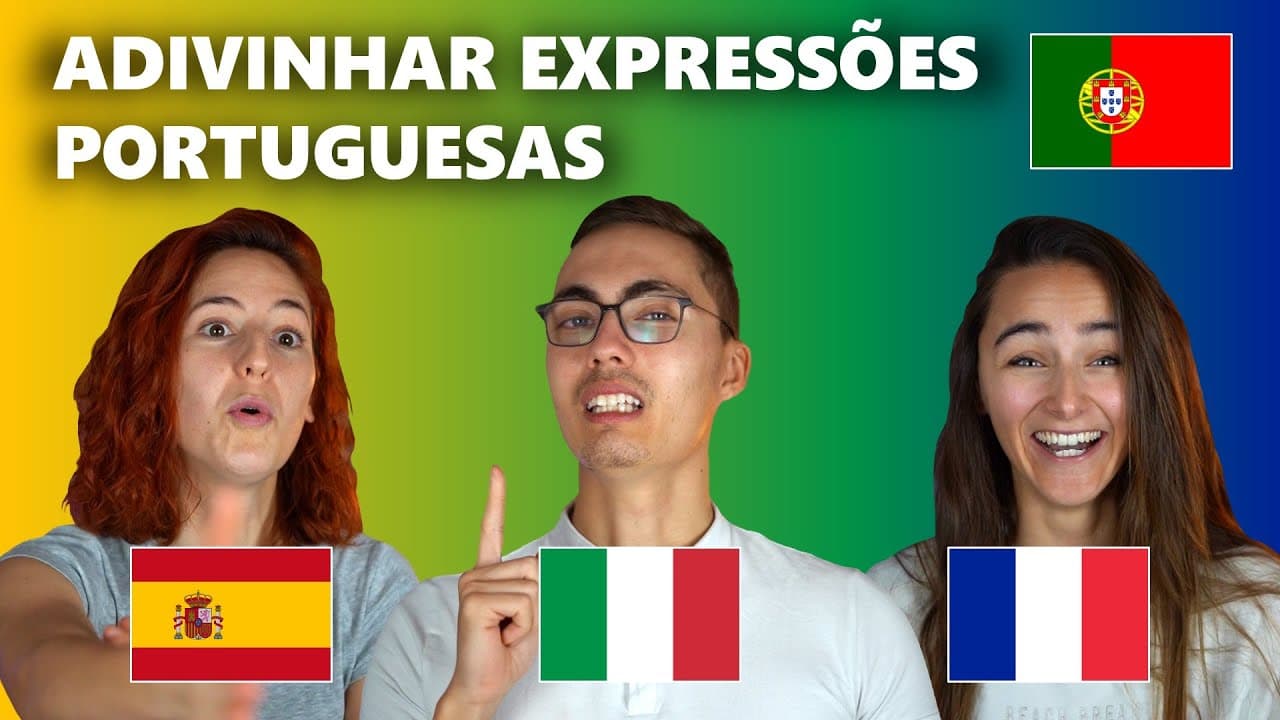
Qual o significado destas expressões PORTUGUESAS?
TL;DR
Exploring the meanings of unique Portuguese expressions.
Transcript
Hi everyone and welcome back to Portuguese With Leo! Today I bring you a different and very special video because I'm here with my friends Elena from the Youtube channel Linguriosa. Elisa from the channel French Mornings with Elisa. Davide from the channel Podcast Italiano. In today's video I'm going to give them 7 Portuguese expressions for them t... Read More
Key Insights
- The video features Leo and his friends from various language channels trying to decipher Portuguese expressions, highlighting cultural and linguistic differences.
- The expression 'ficar a ver navios' suggests missing an opportunity, similar to the French 'the train left without you.'
- The phrase 'ter dor de cotovelo' is associated with jealousy, not physical pain, despite its literal translation to 'elbow pain.'
- The expression 'não vai ser pera doce' implies that something will not be easy, akin to the French saying 'ça va pas être de la tarte.'
- The idiom 'ficar feito ao bife' indicates being in a difficult situation, comparable to 'being toast' in English.
- The phrase 'ficar em águas de bacalhau' means a project fell through, similar to the French 'tomber à l'eau.'
- The expression 'puxar a brasa à nossa sardinha' refers to acting in one's own interest, parallel to 'bringing water to your own mill.'
- The saying 'são muitos anos a virar frangos' signifies having a lot of experience in something, derived from the action of turning chickens.
Install to Summarize YouTube Videos and Get Transcripts
Explore YouTube Video Summarizer or Get YouTube Transcript Extractor
Questions & Answers
Q: What does 'ficar a ver navios' mean?
The expression 'ficar a ver navios' means to miss an opportunity or to be left behind while others move forward. It is similar to the French expression 'the train left without you,' indicating a situation where someone fails to act or take advantage of a situation.
Q: What is the meaning of 'ter dor de cotovelo'?
The phrase 'ter dor de cotovelo' translates literally to 'having elbow pain,' but it actually refers to feeling jealous. It does not relate to physical pain but rather to the emotional discomfort or envy one feels in certain situations.
Q: What does 'não vai ser pera doce' imply?
The expression 'não vai ser pera doce' implies that something is not going to be easy. It is similar to saying 'it won't be a piece of cake' in English, indicating that a task or situation will be challenging or difficult to handle.
Q: What is the significance of 'ficar feito ao bife'?
'Ficar feito ao bife' means to be in a difficult or hopeless situation, akin to the English phrase 'being toast.' It suggests that someone is in trouble or has encountered a problem that is hard to resolve.
Q: How is 'ficar em águas de bacalhau' used?
The expression 'ficar em águas de bacalhau' is used to describe a project or plan that has come to nothing or failed to materialize. It is similar to the French phrase 'tomber à l'eau,' meaning that something has fallen through or did not go as planned.
Q: What does 'puxar a brasa à nossa sardinha' mean?
The phrase 'puxar a brasa à nossa sardinha' means to act in one's own interest or to do something that benefits oneself at the expense of others. It is comparable to the English expression 'bringing water to your own mill,' indicating self-serving behavior.
Q: What is the meaning of 'são muitos anos a virar frangos'?
The expression 'são muitos anos a virar frangos' signifies having a lot of experience in something. It comes from the literal action of turning chickens, implying that someone has been doing the same task for many years and has become skilled or knowledgeable in it.
Q: What is the purpose of the video?
The purpose of the video is to explore and explain the meanings of various Portuguese expressions with the help of friends from different language backgrounds. It aims to highlight the cultural and linguistic differences and similarities between languages while engaging the audience in a fun and educational manner.
Summary & Key Takeaways
-
Leo, along with friends from different language backgrounds, explores the meanings of various Portuguese expressions, revealing linguistic nuances and cultural insights. Each participant attempts to guess the meanings based on their language knowledge.
-
The video covers expressions like 'ficar a ver navios' (missing an opportunity), 'ter dor de cotovelo' (jealousy), and 'não vai ser pera doce' (not easy), providing translations and equivalent expressions in other languages.
-
The session ends with a call to explore more content on their individual channels, encouraging viewers to engage with the expressions and share their country's equivalents. Leo invites support through Patreon for exclusive content.
Read in Other Languages (beta)
Share This Summary 📚
Summarize YouTube Videos and Get Video Transcripts with 1-Click
Try YouTube Summary with ChatGPT & Claude or YouTube Transcript Generator
Explore More Summaries from Portuguese With Leo 📚
Summarize YouTube Videos and Get Video Transcripts with 1-Click
Try YouTube Summary with ChatGPT & Claude or YouTube Transcript Generator