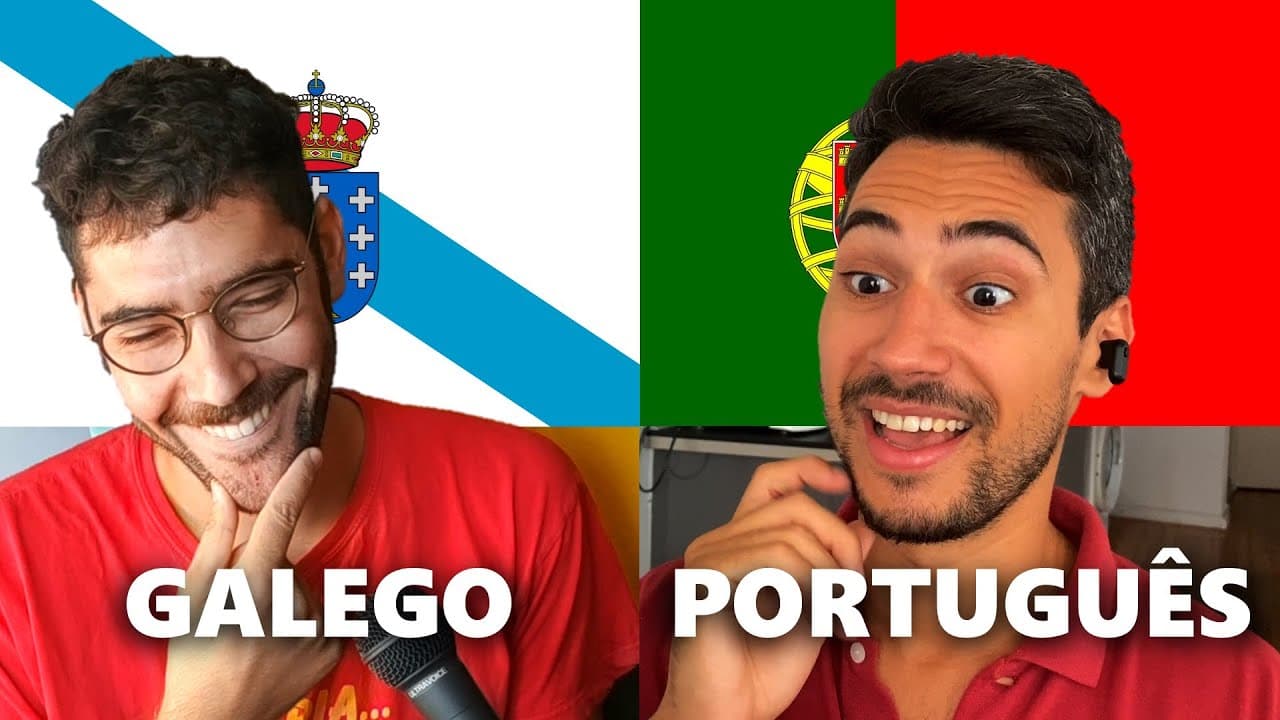
Português vs Galego com @olaxonmario
TL;DR
Exploring similarities and differences between Portuguese and Galician languages.
Transcript
I'm going to tell you a story that happened in my teenage years over a decade ago. Yes, I stopped being a teenager over ten years ago, time flies! It's a short story and it's going to be a little poorly told because I don't remember the details very well, but basically I was with my dad looking up something online, and by online I mean on Googl... Read More
Key Insights
- Portuguese and Galician were once the same language, known as Galician-Portuguese, which split in the 13th century.
- The Iberian Peninsula's linguistic history is deeply rooted in Latin, specifically Vulgar Latin, which influenced the development of Ibero-Romance languages.
- Galician and Portuguese share many similarities due to their common origin, but Galician has been influenced by Spanish over time.
- Galician reintegrationism is a movement aimed at reuniting written Galician with Portuguese, emphasizing historical and linguistic connections.
- Phonetic characteristics in Galician include seseo, where /θ/ is pronounced as /s/, and the use of X instead of J in words.
- The influence of Arabic on Portuguese is minimal, with only a few words of Arabic origin present in Galician.
- Formal and informal address in Galician uses 'vostede' and 'vostedes' for formal contexts, while 'ti' and 'vos' are used informally.
- Galician expressions and words often have unique meanings and usages, showcasing the cultural richness and linguistic diversity of the region.
Install to Summarize YouTube Videos and Get Transcripts
Explore YouTube Video Summarizer or Get YouTube Transcript Extractor
Questions & Answers
Q: Why are Portuguese and Galician so similar?
Portuguese and Galician are similar because they both originated from the same language, Galician-Portuguese, which was spoken in the northwest of the Iberian Peninsula. They only became distinct languages in the 13th century due to political changes, with Portuguese becoming the official language of Portugal and Galician being influenced by Spanish after Galicia's incorporation into the Kingdom of Castile.
Q: What is Galician reintegrationism?
Galician reintegrationism is a movement that seeks to reunite written Galician with written Portuguese, following historical, linguistic, and phonetic logic. It emerged strongly in the late 1970s as a response to the implementation of a new Galician norm that closely resembled Spanish, aiming to preserve Galician's unique linguistic identity and reconnect it with its Portuguese roots.
Q: How has Spanish influenced the Galician language?
Spanish has influenced Galician primarily through phonetics and vocabulary. Due to the linguistic pressure of Spanish as the dominant language, Galician speakers often mimic Spanish phonetics, such as the pronunciation of certain consonants. Additionally, many Galician speakers use Spanish words in daily conversation, although the Galician lexicon remains closely aligned with Portuguese.
Q: What are some phonetic characteristics of Galician?
Galician phonetics include the seseo phenomenon, where the /θ/ sound is pronounced as /s/, and the use of X instead of J in words. The letter LL is pronounced as /ɟ/, and the CH sound is /tʃ/. These characteristics reflect both the influence of Spanish and the preservation of certain phonetic traits distinct from Portuguese.
Q: How do formal and informal address differ in Galician?
In Galician, formal address uses 'vostede' for singular and 'vostedes' for plural situations, whereas informal address uses 'ti' for singular and 'vos' for plural situations. This clear distinction is maintained despite the linguistic influence of Spanish, which often uses 'usted' and 'ustedes' for formal address.
Q: Is there any Arabic influence on Galician?
The Arabic influence on Galician is minimal, with only a few words of Arabic origin present, such as 'almofada' (pillow) and 'arroz' (rice). These words likely entered Galician through Portuguese or Spanish. Unlike Portuguese, which has some phonetic variations attributed to Arabic influence, Galician's phonology remains largely unaffected by Arabic.
Q: What are some unique Galician expressions?
Unique Galician expressions include 'non ter ningunha malla preta' (to be immaculate), 'outra vaca no millo' (jumping on the bandwagon), and 'caer da burra' (having a reality check). These expressions reflect the cultural and linguistic richness of Galician, often using rural imagery to convey meanings that might not have direct equivalents in Portuguese or Spanish.
Q: How does the video encourage further exploration of the topic?
The video encourages further exploration by inviting viewers to watch the continuation of the conversation on Mario's YouTube channel, Olaxonmario. Additionally, it provides links to resources, courses, and podcasts on Portuguese and Galician language learning, fostering a deeper understanding of the linguistic and cultural connections between these two languages.
Summary & Key Takeaways
-
The video discusses the historical and linguistic connections between Portuguese and Galician, two languages that originated from the same root but diverged over time. It explores phonetic, lexical, and grammatical similarities and differences, illustrating the influence of Spanish on Galician.
-
Mario from the Olaxonmario YouTube channel joins the discussion, providing insights into Galician reintegrationism and sharing unique Galician expressions. The conversation highlights how political and historical factors shaped the evolution of these languages.
-
Viewers are encouraged to explore further by watching the continuation of the discussion on Mario's channel. The video serves as an educational resource for those interested in linguistics, language history, and the cultural ties between Portugal and Galicia.
Read in Other Languages (beta)
Share This Summary 📚
Summarize YouTube Videos and Get Video Transcripts with 1-Click
Try YouTube Summary with ChatGPT & Claude or YouTube Transcript Generator
Explore More Summaries from Portuguese With Leo 📚
Summarize YouTube Videos and Get Video Transcripts with 1-Click
Try YouTube Summary with ChatGPT & Claude or YouTube Transcript Generator