How Do Visual Riddles Test Your Brain Power?
TL;DR
Visual riddles test attention by hiding mistakes, repeated words, outlines, and familiar characters inside seemingly ordinary images. The seven challenges reward careful observation, flexible thinking, and resistance to assumptions, with faster correct answers presented as signs of a younger, more adaptable brain, while slower results are described as reflecting a more mature brain.
Transcript
hey you're gonna like this one seven riddles that will test your brain power our brain is a mysterious thing we know more about stars than about the things inside our heads but what we do know about the brain is that it gets less sharp and productive with age would you say never mind do you want to test your brain power and calculate its approximat... Read More
Key Insights
- The altered portraits contain upside-down eyes and lips, a mistake that becomes immediately disturbing when the photographs themselves are turned upside down. The explanation says the brain initially misses the alteration because it is not accustomed to seeing facial features positioned that way.
- The damaged T-shirt has eight holes: one neckline, two sleeve openings, one bottom opening, two holes in the front, and two corresponding holes in the back. The visible background indicates that the central damage passes through both sides of the shirt.
- The tree-naming challenge is actually an attention test because a bird is camouflaged on the tree. Naming the tree follows the apparent instruction, but spotting the concealed bird demonstrates that the viewer looked beyond the task's most obvious interpretation.
- The number puzzle hides a duplicated word rather than a numerical or color error. The word "spot" appears twice, illustrating the claim that the brain often supplies an expected interpretation instead of presenting every visible detail accurately.
- The hidden baby is formed by the tree's thin branches, which outline a fetus-like position. Its feet and toes appear on the right, its arms occupy the middle, and its head is located on the left side of the picture.
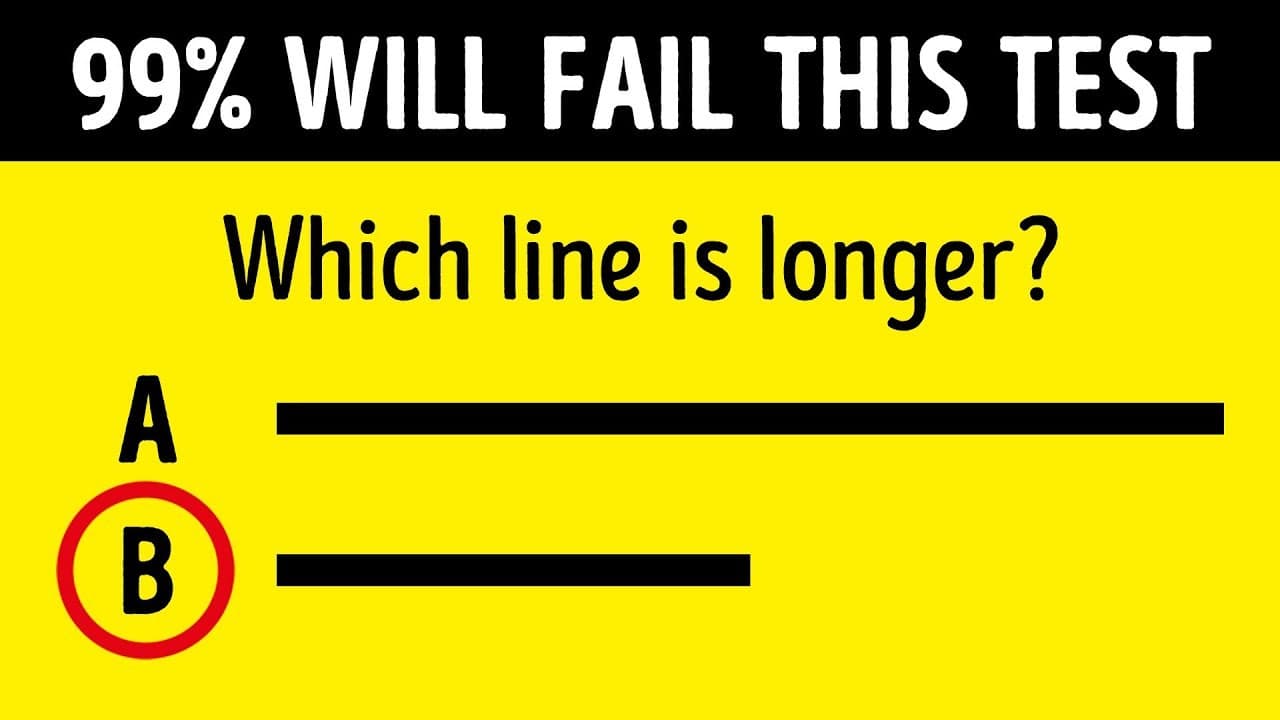
- The line comparison introduces conformity by describing a test with five people, four of whom were instructed to lie. The remaining subject could follow the group's incorrect response because the person did not want to stand out.
- The conformity example claims that approximately 75 percent of people may laugh when a group finds a joke funny, even if they do not understand or enjoy it. The example connects social agreement with answers that may conflict with personal perception.
- The scoring system treats speed as an indicator of mental flexibility: under five seconds for every correct answer represents a very young and flexible brain, under 20 seconds represents a quite young brain, and slower or incomplete performance represents a mature brain.
Install to Summarize YouTube Videos and Get Transcripts
Explore YouTube Video Summarizer or Get YouTube Transcript Extractor
Questions & Answers
Q: How many holes are in the T-shirt riddle?
The T-shirt has eight holes according to the riddle. Four are ordinary openings: the neckline, the two sleeves, and the opening at the bottom. Four more come from the visible damage in the middle. There are two holes in the front and two in the back because the background can be seen through them.
Q: What is wrong with the two photographs of women?
The eyes and lips of both women are upside down within the photographs. The mistake can be difficult to recognize while the entire pictures are inverted because the brain is not used to evaluating eyes and lips in that orientation. Turning the photographs upright makes the altered facial features look immediately strange and disturbing.
Q: What is hidden in the tree-naming riddle?
A camouflaged bird is hidden on the tree. Although the prompt asks viewers how they would name the tree, the actual challenge is to notice the bird rather than focus only on inventing a name. Spotting it shows that the viewer examined the picture beyond the most obvious meaning of the question.
Q: What is the mistake in the numbers and colors puzzle?
The mistake is not found in either the numbers or their colors. Instead, the word "spot" appears twice. The puzzle directs attention toward the visible numbers, making the repeated word easier to overlook. Its explanation says the brain often presents what it expects to see and may complete familiar patterns automatically.
Q: How can you find the hidden baby in the tree image?
Follow the thin branches of the tree and look for the outline of a baby in a fetal position. The baby's feet and toes are located on the right side of the image, the arms appear in the middle, and the head is on the left. These separated shapes combine into the concealed figure.
Q: What does the line comparison show about conformity?
The line comparison is connected to a conformity test involving five people. Four participants were instructed to give a false answer, leaving one real subject. Even though the correct comparison was simple, the subject could repeat the group's incorrect answer to avoid standing out, showing how social pressure may influence an obvious judgment.
Q: Where is Mike Wazowski hidden in the final puzzle?
Mike Wazowski is concealed among the figures in the final visual puzzle and is identified by his green appearance. The answer reveals that he still looks very different from the surrounding options despite sharing that color. The task tests whether viewers can locate a familiar character inside a visually distracting group before time expires.
Q: How are the brain-riddle results scored?
Taking more than 20 seconds for each question, or failing to complete all the tasks, is described as having a mature brain. Finishing in less than 20 seconds suggests a quite young brain that approaches tasks from different angles. Correctly answering every question within five seconds is presented as showing a very young, flexible brain.
Summary & Key Takeaways
-
Seven timed riddles challenge viewers to inspect photographs, count openings in a damaged shirt, find camouflaged figures, detect repeated words, compare lines, and recognize a disguised character. Each task provides up to 20 seconds, although viewers are encouraged to solve it as quickly as possible before the answer is revealed.
-
Several puzzles exploit the difference between what an image contains and what the brain expects to see. Upside-down facial features appear less disturbing in inverted photographs, repeated words escape notice, and concealed figures blend into trees. The challenges suggest that familiarity and expectation can influence how people interpret visual information.
-
The final scoring divides results by speed and completion. Answers taking more than 20 seconds, or unfinished tasks, are associated with a mature brain. Correct answers within 20 seconds suggest a young brain, while solving every question correctly within five seconds is presented as evidence of exceptional flexibility and attention.
Read in Other Languages (beta)
Share This Summary 📚
Summarize YouTube Videos and Get Video Transcripts with 1-Click
Try YouTube Summary with ChatGPT & Claude or YouTube Transcript Generator
Explore More Summaries from BRIGHT SIDE 📚





Summarize YouTube Videos and Get Video Transcripts with 1-Click
Try YouTube Summary with ChatGPT & Claude or YouTube Transcript Generator