How to Live Authentically According to Heidegger
TL;DR
Authenticity requires choosing according to your deepest beliefs, accepting the circumstances you did not choose, and remaining resolute despite obstacles. Heidegger’s approach asks you to resist automatic conformity, recognize your connection to a particular world and other people, and examine what existence means instead of treating yourself, relationships, nature, and work merely as tools for economic gain.
Transcript
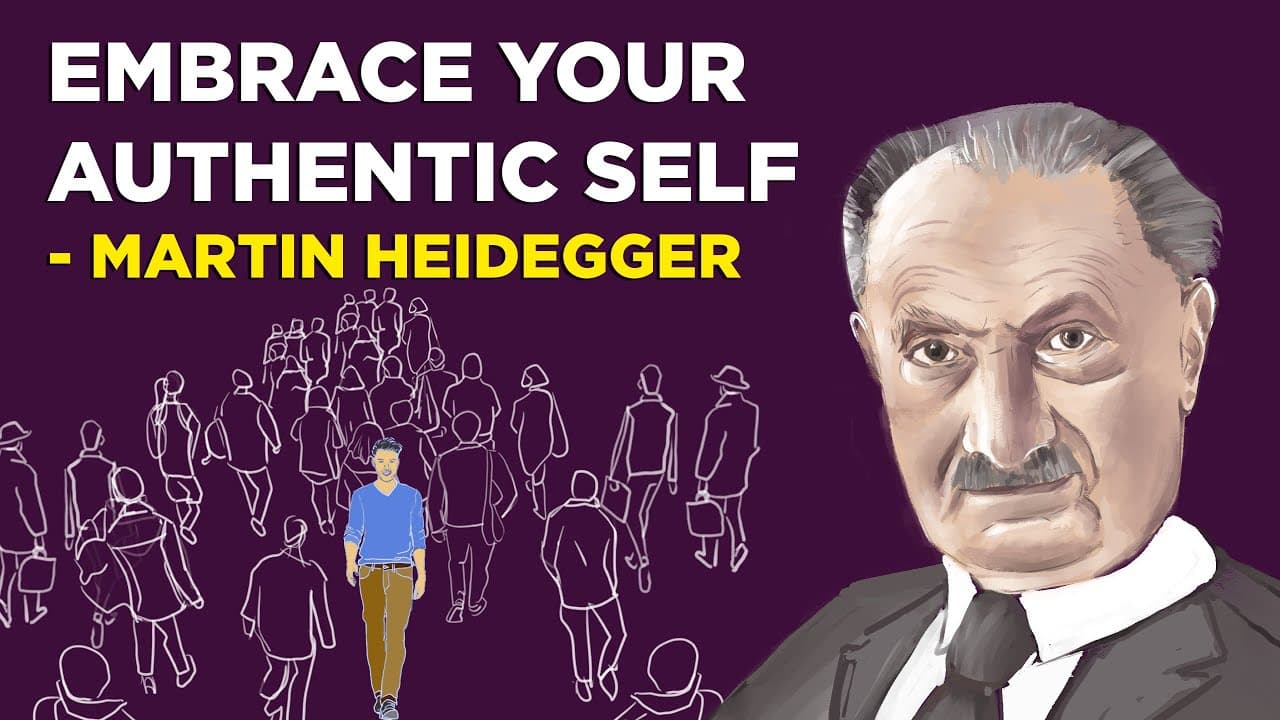
Imagine going about your day, doing what everyone else does without much thought. According to German philosopher Martin Heidegger, this way of living is called "being absorbed in the they" or "das Mann." The "they" in this instance is like a faceless crowd—it's the collective ideas, trends, and behaviors that everyone follows without really thinki... Read More
Key Insights
- “The they,” or das Mann, is the faceless collection of popular ideas, behaviors, and expectations that people often follow without reflection. Absorption in this collective mode can suppress individuality and produce a comfortable but disconnected form of life that Heidegger calls inauthentic.
- Dasein is Heidegger’s term for distinctively human existence, translated in the transcript as “there-being.” It emphasizes that humans possess self-awareness, reflect on their place in the world, make choices, and actively engage with their surroundings rather than merely being present like objects.
- Authenticity is an active commitment to shaping life according to personal beliefs, abilities, desires, and intuitions. It requires people to examine why they make choices instead of allowing fear, social expectations, popularity, or established behavioral norms to determine the boundaries of their lives.
- Instrumental thinking is the treatment of nature, work, relationships, and even oneself primarily as resources for economic goals. When every river, friendship, career, or person is evaluated as a product or opportunity, daily life becomes mechanized and deeper questions about existence are neglected.
- The call of conscience is a source of personal clarity rather than merely a moral command. Listening closely to conscience means identifying one’s strengths, interests, beliefs, and deepest desires, allowing them to inform choices instead of automatically accepting priorities imposed by society.
- A moment of vision is the clarity that arises when a person recognizes personal abilities and a meaningful calling. Resoluteness follows this recognition by sustaining commitment through difficulty, keeping a goal connected to identity, purpose, learning, and self-discovery rather than treating it as a temporary ambition.
- Facticity is the set of unchosen conditions that define a person’s situation, including upbringing, culture, social environment, history, advantages, and limitations. Authenticity requires acknowledging these influences honestly while refusing to assume that they completely determine one’s potential, values, or future path.
- Being-in-the-world is the view that people understand themselves through their relationships with contexts, cultures, historical events, social structures, and other people. Authenticity therefore does not require isolation from society, but a reflective engagement with the world in which one already exists.
Install to Summarize YouTube Videos and Get Transcripts
Explore YouTube Video Summarizer or Get YouTube Transcript Extractor
Questions & Answers
Q: What does Heidegger mean by living authentically?
Living authentically means actively shaping your life according to your own beliefs, abilities, desires, and intuitions. It requires recognizing when social expectations or popular behavior are making choices for you, then choosing more deliberately. Authenticity does not mean ignoring your background or relationships. It means understanding their influence without allowing them to define your identity, potential, or direction completely.
Q: What is “the they,” or das Mann, in Heidegger’s philosophy?
“The they,” or das Mann, is the faceless crowd represented by collective ideas, trends, expectations, and behaviors. A person absorbed in “the they” wears, believes, or does certain things simply because they are popular or socially expected. This mode feels normal, comfortable, and safe, but it can obscure individuality and create a sense of disconnection from one’s genuine beliefs and possibilities.
Q: How can someone choose freely instead of following society?
Free choice begins by examining whether fear, popularity, economic pressure, or other people’s expectations are defining your decisions. Heidegger’s approach encourages listening to conscience by attending to your deepest desires, beliefs, intuitions, strengths, and abilities. A choice becomes more authentic when it reflects what genuinely matters to you, rather than being an unconsidered repetition of collective values or accepted behavioral norms.
Q: What is resoluteness in Heidegger’s account of authenticity?
Resoluteness is a deep and sustained commitment to a possibility that expresses who you are. It means continuing to pursue a meaningful goal despite setbacks, practical difficulties, or uncertainty. Someone committed to becoming an artist, for example, might take part-time work while preserving time for art. Resoluteness values growth, learning, and self-discovery throughout the journey, not only success at a final milestone.
Q: What does facticity mean in Heidegger’s philosophy?
Facticity refers to the parts of life that are given rather than chosen, such as upbringing, culture, social environment, personal history, advantages, discrimination, and limited opportunities. Recognizing facticity means honestly understanding how these conditions shape perception and available choices. Authenticity involves accepting their reality while refusing to treat them as a complete definition of one’s essence, abilities, values, or future potential.
Q: How can people accept facticity without being controlled by it?
People can accept facticity by identifying how their history and social position influence their assumptions, opportunities, and decisions. A wealthy person might question the prestigious career expected by family and pursue personally meaningful work. Someone facing discrimination might acknowledge genuine barriers while continuing toward a valued goal. The balance lies in neither denying circumstances nor allowing those circumstances to dictate every possible choice.
Q: What does being-in-the-world mean for personal identity?
Being-in-the-world means that personal identity and understanding do not develop in complete isolation. People are already connected to particular cultures, historical periods, social structures, events, and other people. These contexts shape how individuals understand themselves and their possibilities. Authentic living therefore involves engaging reflectively with these connections, recognizing their influence while continuing to move toward a self-directed way of existing.
Q: Why does treating everything as a resource undermine authenticity?
Treating everything as a resource reduces nature, work, friendship, and people to instruments for money, status, energy, or personal advantage. This perspective can turn a river into nothing but a power source, a relationship into an exchange, and a job into mere income. It also instrumentalizes the self, mechanizes daily motivation, and distracts people from asking what existence and meaningful connection actually involve.
Summary & Key Takeaways
-
Heidegger describes ordinary conformity as absorption in “the they,” or das Mann. People become inauthentic when collective trends and expectations replace reflective choice. Because human existence, or Dasein, includes self-awareness and active engagement with the world, individuals can question inherited norms and shape lives guided by their own beliefs and priorities.
-
Authenticity begins with listening to conscience as a guide to personal abilities, desires, beliefs, and intuitions. A “moment of vision” provides clarity about one’s calling, while resoluteness turns that clarity into sustained commitment. Setbacks then become part of growth and self-discovery rather than reasons to surrender a meaningful goal.
-
Facticity includes the upbringing, culture, history, social environment, advantages, and limitations that people do not choose. Authentic living neither denies these conditions nor treats them as destiny. Being-in-the-world further means that identity develops through relationships with historical and social contexts, rather than through an isolated and completely independent self.
-
The five practices presented are free choice, resoluteness, recognition of facticity, acceptance of being-in-the-world, and being toward death. Together, they encourage individuals to question conformity, understand their circumstances, commit to meaningful possibilities, and actively shape their lives while remaining aware that existence is situated rather than detached from the world.
Read in Other Languages (beta)
Share This Summary 📚
Summarize YouTube Videos and Get Video Transcripts with 1-Click
Try YouTube Summary with ChatGPT & Claude or YouTube Transcript Generator
Explore More Summaries from Philosophies for Life 📚

Summarize YouTube Videos and Get Video Transcripts with 1-Click
Try YouTube Summary with ChatGPT & Claude or YouTube Transcript Generator