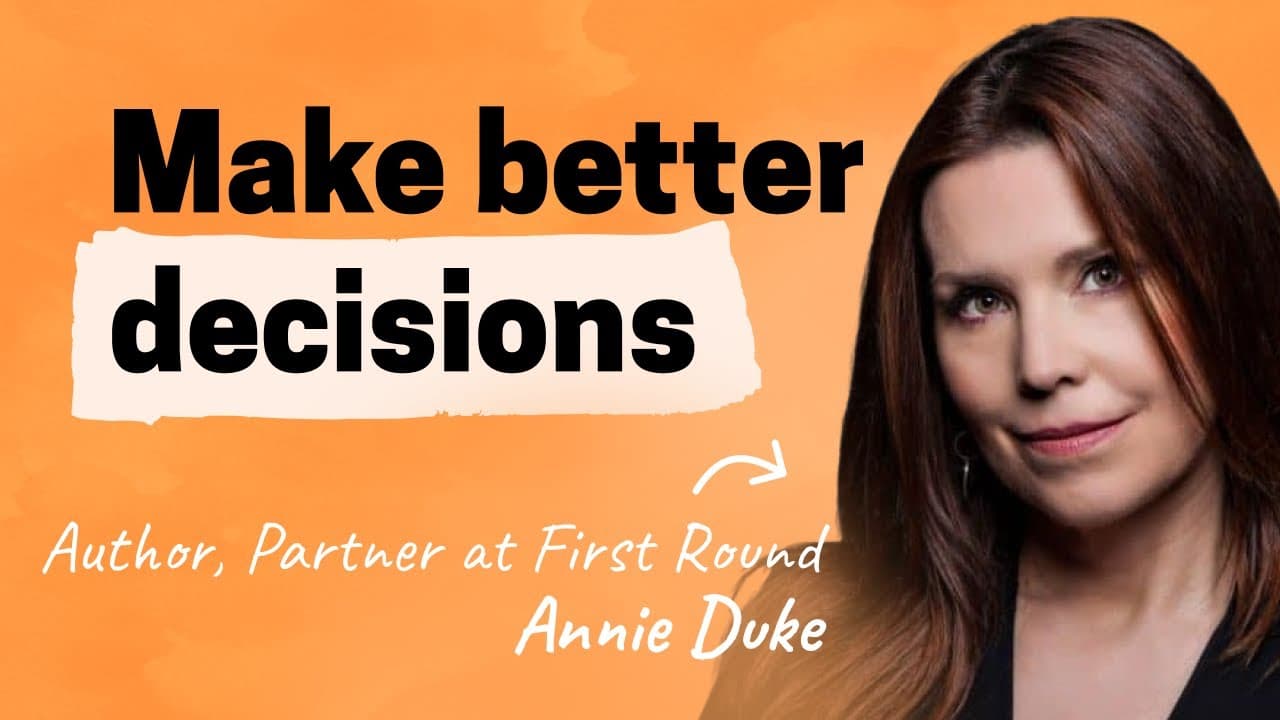
How to Make Better Decisions Under Uncertainty
TL;DR
Better decisions come from making assumptions explicit, identifying signals tied to desired outcomes, and committing in advance to actions when those signals appear. Meetings should separate discovery and decision from discussion, while pre-mortems should include kill criteria. Intellectual humility also matters because openly testing beliefs makes errors visible and creates opportunities to revise them.
Transcript
It's so incredibly necessary in improving decision quality to take what's implicit and make it explicit. It's not that intuition is crap, your intuition is sometimes right. If you don't make it explicit, then you don't get to find out when it's wrong. When you look at companies that have read your book, what do you find are the brainwashing... Read More
Key Insights
- Decision quality improves when implicit judgments become explicit. Intuition is sometimes correct, but an unstated intuition cannot be examined, tested, or compared with later evidence. Writing down assumptions creates a record that reveals where reasoning succeeded and where it needs correction.
- A meeting should be reserved for discussion rather than discovery or final decision-making. Separating these activities helps participants arrive with relevant information already surfaced and prevents the group conversation from automatically becoming the mechanism that determines the final choice.
- A pre-mortem is useful only when it includes kill criteria. Teams should identify signals that would indicate a plan is failing and commit beforehand to specific actions they will take if those signals appear, reducing the temptation to rationalize continued investment.
- A long-term outcome can be evaluated through shorter-term correlated signals. Duke rejects the idea that feedback must remain unavailable until the final result arrives. Decision makers can instead identify present indicators connected to the outcome they eventually want and monitor those indicators over time.
- Intellectual humility requires actively asking how a belief might be wrong. Daniel Kahneman acknowledged that some studies included in his work did not replicate, and he was willing to say that he wished the material on priming had not appeared in his book.
- Adversarial collaboration turns disagreement into a shared investigation. Kahneman sought out people who disagreed with him, then worked with them to determine what study might resolve the dispute instead of treating disagreement as a contest between opposing reputations.
- The relationship between money and happiness produced conflicting research findings. Kahneman and Angus Deaton reported that money had limited additional effect after basic needs were met, while Matthew Killingsworth later reported correlation across income levels, prompting a joint effort with Barb Mellers to examine the disagreement.
- A foundational parenting priority is ensuring that children deeply know they are loved. Duke argues that debates over breastfeeding, co-sleeping, sleep training, homeschooling, and school selection are less important than a child's confidence that a parent is committed to the child's survival and happiness.
Install to Summarize YouTube Videos and Get Transcripts
Explore YouTube Video Summarizer or Get YouTube Transcript Extractor
Questions & Answers
Q: How can I improve the quality of my decisions?
Decision quality improves when you make your assumptions, intuitions, and predictions explicit. Intuition is not automatically unreliable, but an intuition kept inside your head cannot be tested. Record what you believe, what signals you expect to observe, and what actions those signals should trigger. This creates evidence that later shows whether your reasoning was accurate or mistaken.
Q: What should happen during a decision-making meeting?
The meeting itself should focus on discussion. Discovery should occur before participants gather, and the final decision should be treated as a distinct activity rather than automatically produced by the conversation. Separating discovery, discussion, and decision makes each stage explicit and prevents a meeting from trying to perform three different functions at the same time.
Q: How should teams use a pre-mortem effectively?
A useful pre-mortem should be paired with kill criteria. The team identifies warning signals that could show a project or plan is failing, then commits in advance to actions it will take if those signals appear. Without that commitment, imagining failure may not change behavior because participants can reinterpret or dismiss warning signs after becoming invested.
Q: How can decision makers shorten a long feedback loop?
Decision makers can shorten an apparently long feedback loop by identifying present signals that correlate with the outcome they eventually want. Instead of waiting for the final result, they monitor those intermediate indicators. This approach does not guarantee the desired outcome, but it provides earlier information that can be used to evaluate assumptions and adjust actions.
Q: What did Annie Duke learn from Daniel Kahneman?
Duke emphasizes Kahneman's humility, curiosity, kindness, and willingness to change his mind. Despite his influence and intellect, he asked other people about their work and openly admitted gaps in his knowledge. He also acknowledged when studies did not replicate, including saying that he wished priming had not been included in his book.
Q: What is adversarial collaboration in research?
Adversarial collaboration is an approach in which people who strongly disagree work together on a study designed to resolve their dispute. Kahneman helped pioneer this practice. Rather than attacking one another's credibility, collaborators jointly define the disagreement, determine what evidence would clarify it, and conduct research capable of testing their competing views.
Q: What did the research discussed say about money and happiness?
Kahneman and Angus Deaton published a result in 2010 suggesting that money had limited additional influence on happiness beyond $75,000, when basic needs such as rent were met. A decade later, Matthew Killingsworth reported that money and happiness remained correlated across income levels. Kahneman, Killingsworth, and Barb Mellers then collaborated to investigate the disagreement.
Q: What parenting advice does Annie Duke consider most important?
Duke says the central priority is making sure children know deeply that their parents love them and would protect their survival and happiness. She considers this more important than disputes about breastfeeding, co-sleeping, attachment parenting, sleep training, homeschooling, private school, or other parenting styles. Those choices matter less than a child's secure knowledge of parental love.
Summary & Key Takeaways
-
Annie Duke argues that improving decision quality requires turning implicit intuition into explicit reasoning. Intuition can be correct, but unspoken judgments cannot be tested or corrected. Clear assumptions, observable signals, and predetermined responses allow individuals and organizations to evaluate their reasoning instead of judging decisions only by whatever outcome eventually occurs.
-
Meetings work better when discovery, discussion, and decision are separated. Duke says the meeting itself should focus only on discussion. Pre-mortems can help teams anticipate failure, but they become actionable only when paired with kill criteria that specify warning signals and the actions the team commits to take when those signals appear.
-
Daniel Kahneman modeled intellectual humility by acknowledging uncertainty, changing his mind, and openly discussing research that did not replicate. He also pursued adversarial collaboration, working with people who disagreed with him to design studies capable of resolving disputes. Duke presents this curiosity and willingness to be wrong as qualities worth emulating.
Read in Other Languages (beta)
Share This Summary 📚
Summarize YouTube Videos and Get Video Transcripts with 1-Click
Try YouTube Summary with ChatGPT & Claude or YouTube Transcript Generator
Explore More Summaries from Lenny's Podcast 📚


Summarize YouTube Videos and Get Video Transcripts with 1-Click
Try YouTube Summary with ChatGPT & Claude or YouTube Transcript Generator