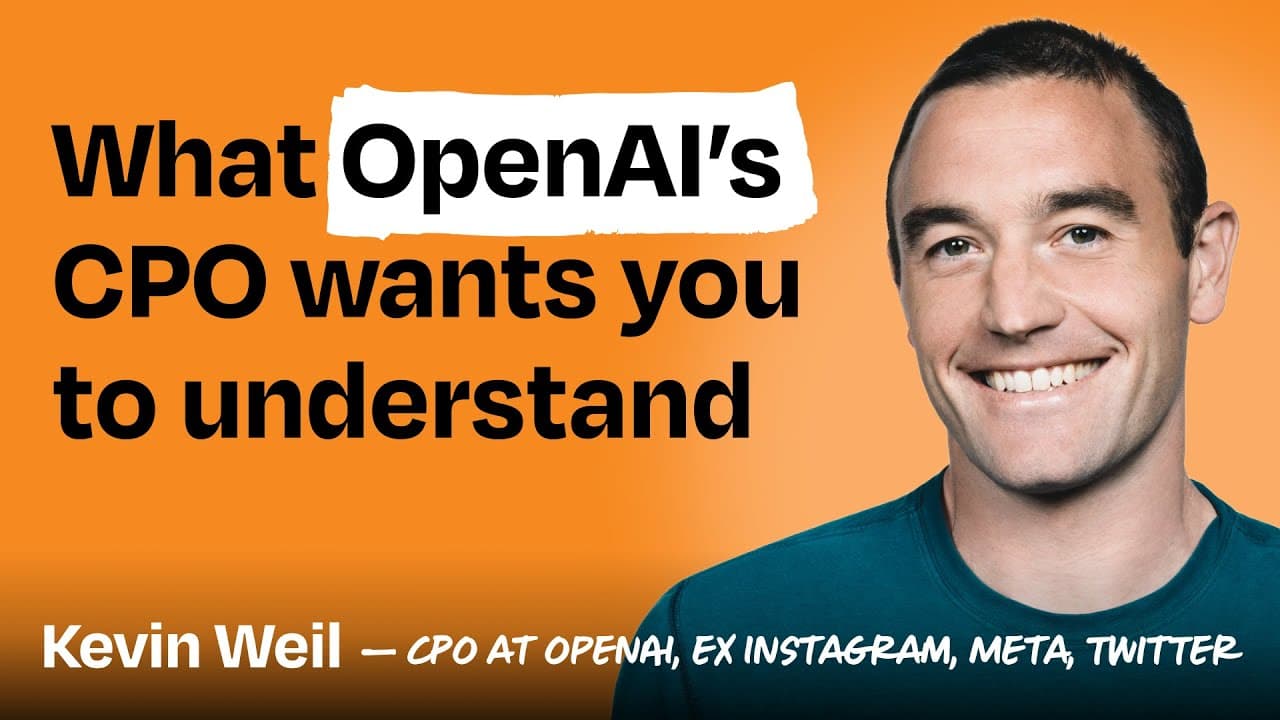
How OpenAI structures product teams for AI products
TL;DR
OpenAI keeps product teams agile by organizing around product needs and using multiple specialized models together. They emphasize building robust evals as a core skill and rely on practical prompting and chat as a primary interface. The company also focuses on hiring for high agency and comfort with ambiguity while pursuing model maximalism and iterative improvements.
Transcript
The AI models that you're using today is the worst AI model you will ever use for the rest of your life, and when you actually get that in your head, it's kind of wild. Everywhere I've ever worked before this, you kind of know what technology you're building on, but that's not true at all with AI. Every two months, computers can do something ... Read More
Key Insights
- OpenAI structures product work around agility, with teams expected to adapt as new model capabilities emerge.
- The key to scalability is using model ensembles, which combine specialized models like a company of humans with different skills.
- Writing effective evals is becoming a critical product skill for measuring AI performance and guiding decisions.
- Chat remains a valuable interface for AI, even as predictions about its obsolescence change.
- Vibe coding describes how organizational culture and processes shape product outcomes in AI projects.
- When hiring product managers, OpenAI looks for high agency and comfort with ambiguity to navigate fast-changing tech.
- Model maximalism explains that today’s AI will be the worst you’ll ever use again, pushing teams to push capabilities further.
- Practical prompting techniques and example-based prompting help improve user-AI interactions and outcomes.
- More videos from this channel:
- More from this channel: Lenny's Podcast
Install to Summarize YouTube Videos and Get Transcripts
Explore YouTube Video Summarizer or Get YouTube Transcript Extractor
Questions & Answers
Q: What is the core structure OpenAI uses to keep product teams agile during AI development?
OpenAI maintains agility by structuring product work around adaptable teams that can respond to rapid model improvements. This means teams stay close to evolving capabilities and user needs, allowing them to adjust priorities, iterate quickly, and scale features as new model upgrades come online. The approach reduces risk and increases responsiveness across products.
Q: How do model ensembles contribute to OpenAI’s product strategy?
Model ensembles bring together multiple specialized models to cover a broader range of tasks more robustly. This mirrors a company of humans with different skills, enabling more complex features and better overall performance. By deploying ensembles, OpenAI can improve accuracy, reliability, and versatility across products and use cases.
Q: Why are evals important for product managers in AI contexts?
Writing and using evals is critical because it provides measurable benchmarks to assess AI behavior, reliability, and safety. Product managers rely on evals to compare models, identify failure modes, and guide decision making about feature releases. Strong eval practices reduce risk and help communicate performance to stakeholders.
Q: Does chat as an interface still matter for AI, and why?
Chat remains a powerful interface because it provides a natural, iterative way to interact with AI systems. Even as models evolve, conversational prompts allow users to refine results, ask follow ups, and explore capabilities interactively. This makes chat a durable, user friendly access point for AI tools.
Q: What is vibe coding and its relevance to AI companies?
Vibe coding describes how organizational culture and process design influence product outcomes. In AI companies, the way teams communicate, set goals, and respond to experimentation affects speed, morale, and the quality of delivered AI features. A positive, iterative vibe supports faster learning and better collaboration.
Q: What hiring criteria does OpenAI emphasize for product managers?
OpenAI looks for high agency and comfort with ambiguity in product managers. Candidates should be able to navigate rapidly changing tech landscapes, make independent decisions, and adapt plans as new capabilities emerge. This trait helps PMs drive progress even when exact paths are not yet clear.
Q: What does model maximalism mean in OpenAI’s context?
Model maximalism refers to using ambitious, multi capability models and pushing limits to achieve superior performance. In practice, it means constantly exploring higher capability models and ensemble configurations, recognizing that today’s AI is the worst you will ever use again once the next improvement lands, driving ongoing experimentation.
Q: What practical prompting techniques does OpenAI discuss for better AI interactions?
Practical prompting includes using example based prompting and structured prompts to guide the model behavior. By providing clear demonstrations and context, product teams can steer outputs, reduce ambiguity, and improve usability. These techniques help users interact more effectively with AI systems and achieve desired results more reliably.
Summary & Key Takeaways
-
OpenAI treats product teams as adaptable units that can evolve as models improve, maintaining speed and alignment with business goals.
-
The approach relies on model ensembles to simulate a team of specialized capabilities, enabling more complex product functionality.
-
Evaluations and prompts are central skills for product managers, enabling reliable measurement and effective interaction with AI systems.
Read in Other Languages (beta)
Share This Summary 📚
Summarize YouTube Videos and Get Video Transcripts with 1-Click
Try YouTube Summary with ChatGPT & Claude or YouTube Transcript Generator
Explore More Summaries from Lenny's Podcast 📚





Summarize YouTube Videos and Get Video Transcripts with 1-Click
Try YouTube Summary with ChatGPT & Claude or YouTube Transcript Generator