Do You Really Need C2 English? Want vs Need
TL;DR
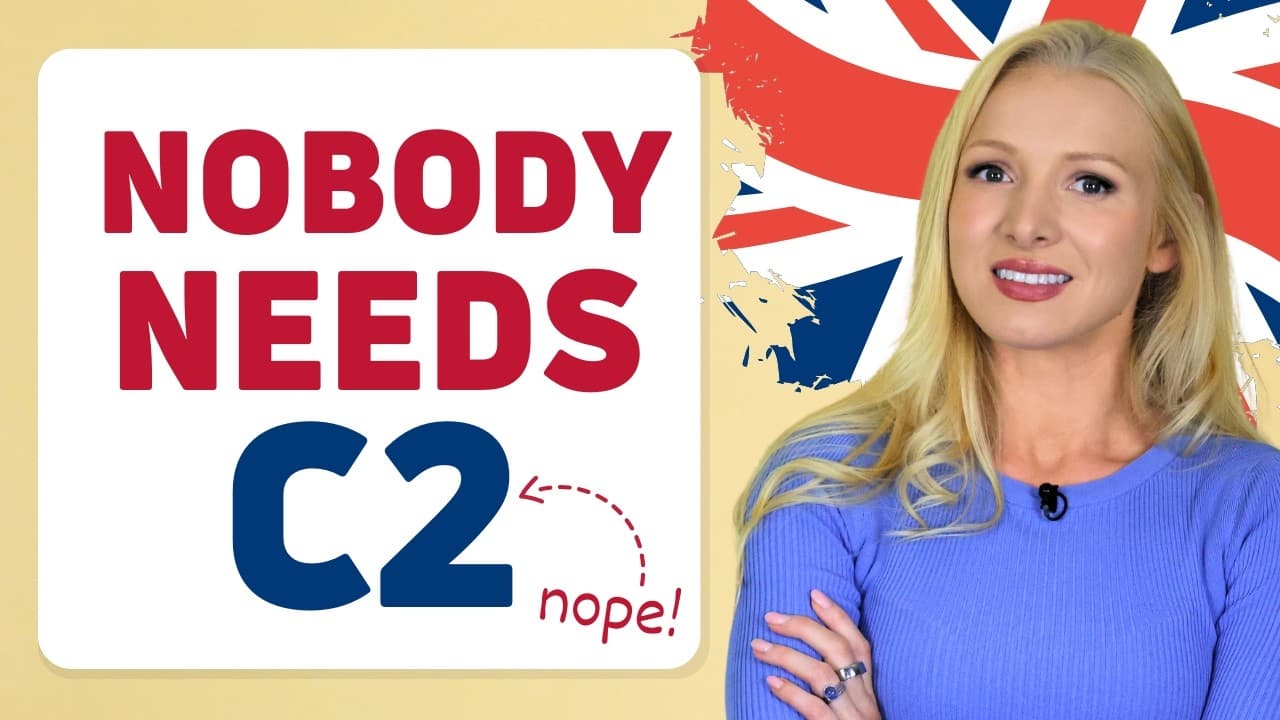
Virtually no one needs C2 English, but many people want it, and that desire is valid. C2 is not rare, archaic, or academic-only; proficient speakers use it every day at the pub, in newspapers, and in supermarkets. At C2, English feels effortless: you understand almost everything and speak spontaneously without searching for words.
Transcript
Let's cut to the chase. You don't need the C2 level of English. For most people, it is 100% true that they don't need to reach the highest level of English. But that's just it. Most people who reach C2 don't need it. They just want it. And now, here's where a lot of teachers and students might disagree with me. You've probably heard the claims, "It... Read More
Key Insights
- C2 is a want, not a need for the vast majority of English students, since most people who reach C2 do not require it for daily life but simply desire to master the language and reach the top level.
- C2-level language is everywhere, not rare. It appears at the pub, in newspaper articles, in the supermarket queue, on podcasts, and in novels, not only in academic or elite settings.
- C2 is not about using the longest words or most complex sentences. The formal academic phrasing people imagine can be replaced with real-life expressions like 'Tube was rammed' meaning the Underground was very crowded.
- At C2, English feels effortless: you understand basically everything you hear or read across podcasts, lectures, news, and fast pub conversations, and can discuss almost any topic spontaneously and fluently.
- C2 speakers have a massive range of vocabulary and structures, including idioms and colloquial expressions, and crucially know exactly when and how to use each one appropriately.
- Native speakers sometimes drop articles at the start of a sentence, such as saying 'Tube was rammed' instead of 'the Tube.' Understanding and using such features is part of proficiency.
- Eliding words for dramatic effect, such as leaving a gap for an insult or swear word in 'That sneaky...', and being able to fill those gaps, is a high-level C2 skill.
- You do not need to know all British or American slang at C2, but immersion in the culture means you will likely understand a lot of it, such as 'bickies' for biscuits or 'ravenous' for extremely hungry.
Install to Summarize YouTube Videos and Get Transcripts
Explore YouTube Video Summarizer or Get YouTube Transcript Extractor
Questions & Answers
Q: Do you really need C2 level English?
For most people, no. The speaker states it is 100% true that most people do not need to reach the highest level of English, and that virtually no one needs C2. Most people who reach C2 do not need it; they just want it. However, the speaker acknowledges C2 is something a lot of people genuinely want, comparing it to the many 'want to have' things in life over 'need to have' things, and says if you want it, you are capable of achieving it.
Q: What does C2 English actually mean?
At C2, English feels effortless. You can understand basically everything you hear or read, whether a podcast, lecture, news article, or a fast conversation at the pub. You can talk about almost any topic spontaneously and fluently without searching for words or second-guessing yourself. You have a massive range of vocabulary and structures at your disposal, including idioms and colloquial expressions, and know exactly when and how to use them. Your pronunciation sounds natural and your grammar is spot on.
Q: Is C2 level language rare or only used by academics?
No. C2 level language isn't rare; it's everywhere. The speaker uses a quiz asking where you would NOT find C2 language among the pub, a newspaper article, the Tesco queue, a podcast, or a novel, and reveals it was a trick question because you find it in all of them and many more. Features of C2 are used every single day by proficient English speakers. It is not about the longest words, and it is not explicitly old-fashioned, archaic, or elite.
Q: What is an example of formal C2 versus real-life C2?
The speaker contrasts stuffy academic C2 with everyday C2. For example, 'The subterranean rail conveyance was an exercise in corporeal compression' is technically C2 but very formal. The same idea in real-life C2 is simply 'Tube was rammed,' meaning the London Underground was very crowded. Similarly, an elaborate sentence about coffee addiction can be expressed as 'If I miss my morning coffee, my soul literally clocks off and I'm pretty much comatose by 9am.'
Q: What C2 vocabulary appears in the pub example?
In the pub scene where John disappears just as it becomes his turn to buy drinks, several C2 features appear. 'Sneaky' means behaving in a secretive or dishonest way. There is an elided word, likely an insult or swear word, that the listener must fill in, and knowing how and when to elide for dramatic effect is a high-level skill. 'Slope off' means to leave somewhere quietly, often to avoid something. A 'round' is a set of drinks bought for a group where everyone takes turns.
Q: How long does the speaker's C2 program take and when does it launch?
The Beautiful British English C2 program promises that in just three months you can be much closer to C2 than you ever thought possible. The program launches on the 19th of January, and the waiting list opens on Monday the 19th of January. The speaker offers a free PDF cheat sheet covering everything in the lesson plus the full curriculum for the brand new C2 program, available by clicking the description link or scanning the QR code, and adds sign-ups to the waiting list for a launch discount.
Q: What C2 language was used in the newspaper example?
The example is a short extract from a music roundup in the Guardian newspaper about Chapel Roan, showing the writer loves her: 'This year alone, her electrifying gift for subverting pastiche proves she can turn a hand to basically anything.' The vocabulary includes 'electrifying' meaning very exciting, 'to subvert' meaning to challenge expectations or established norms, 'pastiche' meaning a piece of art, music, or writing that imitates another's style, and 'turn your hand to something' meaning to start something new and do it well.
Q: Why does the speaker say C2 is a want rather than a need?
The speaker stands by the point that C2 is a want, not a need, for the vast majority of students because virtually no one needs the highest level of English for everyday life. As a young teacher she listened to anti-C2 colleagues, but over time learned there is a specific group of students who just want more, want to achieve, and want to reach the top. She refuses to push C2 as something everyone needs, but acknowledges it is something a lot of people want, and those want-to-haves tend to be gorgeous.
Summary & Key Takeaways
-
Most people who reach C2 English do not actually need it; they want it. The speaker, once influenced by anti-C2 colleagues, now acknowledges a specific group of students who want to achieve and reach the highest level, and refuses to dismiss that ambition.
-
A common myth is that C2 means stuffy, formal, academic language like 'the subterranean rail conveyance was an exercise in corporeal compression.' In reality, the same meaning is C2 when said naturally as 'Tube was rammed,' showing C2 spans both academic and colloquial registers.
-
Through examples at the pub, in a Guardian music review, in a Tesco queue, and on the Science Versus podcast, the speaker demonstrates that C2 vocabulary like 'slope off,' 'subvert pastiche,' 'ravenous,' and cleft structures appear in everyday British life, proving C2 is achievable if you want it.
Read in Other Languages (beta)
Share This Summary 📚
Summarize YouTube Videos and Get Video Transcripts with 1-Click
Try YouTube Summary with ChatGPT & Claude or YouTube Transcript Generator
Explore More Summaries from English with Lucy 📚



Summarize YouTube Videos and Get Video Transcripts with 1-Click
Try YouTube Summary with ChatGPT & Claude or YouTube Transcript Generator