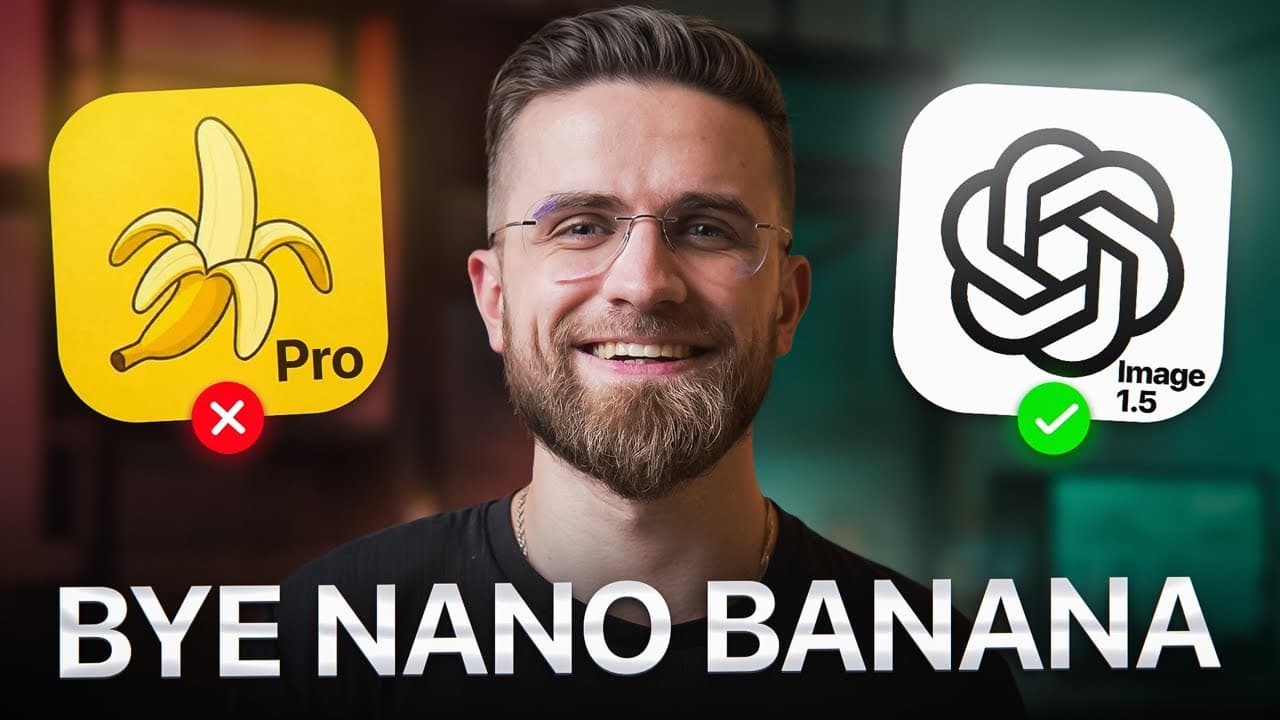
GPT Image 1.5 vs Nano Banana Pro: Which Wins?
TL;DR
GPT Image 1.5 preserves faces and subject identity more accurately during edits, while Google's Nano Banana Pro delivers higher-resolution output and better object scale but often introduces subtle facial distortions. Both handle small dense text and multilingual posters well, making text rendering essentially a draw. The best choice depends on whether identity or physical realism matters most for your workflow.
Transcript
Two flagship image models dropped days apart. GPT Image 1.5 and Nano Banana Pro. Open AAI claims their new model is up to 4x faster. Google pushes visual context. Let Nano Banana Pro handle up to 14 reference images at once. Marketing is one thing. Real usage is another. Same prompt, same tests. In the next few minutes, [music] you'll know which on... Read More
Key Insights
- GPT Image 1.5 and Nano Banana Pro were released days apart. OpenAI claims its model is up to 4x faster, while Google emphasizes visual context, letting Nano Banana Pro handle up to 14 reference images at once.
- Both models handle small, dense text well in receipt tests, keeping barcodes and footer lines readable. The main difference is that Nano Banana Pro outputs a higher-resolution, sharper image at large scale.
- Multilingual poster generation was essentially a draw. Both models rendered English, Spanish, and Arabic text readably and placed dates and locations correctly, differing mainly in aesthetic style rather than capability.
- GPT Image 1.5 preserves a subject's face, pose, and lighting more accurately during clothing swaps and edits, while Nano Banana Pro tends to introduce subtle facial distortions like blurred eyes or a smaller neck.
- Nano Banana Pro understands object scale and weight better in multi-reference edits, making added objects like plush toys feel closer to their real size, but at the cost of lost facial detail.
- GPT Image supports up to 16 reference images through the OpenAI API in edit image mode, matching Nano Banana Pro's reference-image capability that Google highlights as a headline feature.
- In object removal tasks, both models succeed, but GPT Image 1.5 stays closer to the original photo while Nano Banana Pro still makes small facial adjustments even in simple removals.
- For multi-element marketplace scenes, GPT Image 1.5 keeps compositions cleaner and easier to read, while Nano Banana Pro produces a busier, more crowded look where distant faces lose proportion and blur together.
Install to Summarize YouTube Videos and Get Transcripts
Explore YouTube Video Summarizer or Get YouTube Transcript Extractor
Questions & Answers
Q: What is the difference between GPT Image 1.5 and Nano Banana Pro?
GPT Image 1.5 is OpenAI's latest image model, which the company claims is up to 4x faster and better at preserving a subject's face, pose, and lighting during edits. Nano Banana Pro is Google's model that emphasizes visual context, supports up to 14 reference images at once, and outputs higher-resolution images, though it tends to introduce subtle facial distortions during edits.
Q: Which image model handles small dense text better?
Both models handle small, dense text well. In a thermal receipt test, GPT Image 1.5 kept the header sharp, item lines aligned, and barcode digits and footer text readable. Nano Banana Pro produced similar results but at a higher overall resolution with more sharpness, keeping fine details around the barcode and footer cleaner at large scale. The main difference is resolution, not readability.
Q: How well do the models handle multilingual text?
Both models handle multilingual text well. In an international food festival poster test including English, Spanish, and Arabic, both rendered all three languages readably and placed the date and location correctly. GPT Image 1.5 leaned toward a dramatic poster style, while Nano Banana Pro used a cleaner, illustrated approach. The result was essentially a draw, differing by style preference rather than capability.
Q: Which model preserves faces better during editing?
GPT Image 1.5 preserves faces and subject identity more accurately during edits. In a clothing swap test replacing a sweater with a navy blazer, GPT Image 1.5 changed the outfit cleanly with only subtle facial changes, while Nano Banana Pro slightly zoomed the subject out and introduced small facial distortions, changing the face subtly and making the neck appear smaller.
Q: How do the models handle combining multiple reference images?
In a multi-reference test adding two plush toys into a person's hands from three uploaded images, GPT Image 1.5 added both toys cleanly with a natural pose while better preserving the person's face. Nano Banana Pro understood object scale and weight better, making the toys feel closer to their real size, but the face took a hit with slightly blurred eyes and lost facial detail.
Q: Can GPT Image use reference images like Nano Banana Pro?
Yes. While Google highlights that Nano Banana Pro supports reference images, GPT Image can do the same through OpenAI's API in edit image mode, taking up to 16 reference images. On the AI Master platform, users click edit image to access this workflow, which is not available in the standard ChatGPT image interface.
Q: How well do the models remove objects from images?
Both models pass object removal tests. When asked to remove a plush dice toy, GPT Image 1.5 removed it cleanly, keeping the rest almost completely intact with only a slight brightness shift near the face that appeared to be a lighting side effect. Nano Banana Pro also removed the object successfully while keeping pose and background intact, but made subtle facial adjustments, with the eyes looking slightly different.
Q: Which model is better for complex multi-element scenes?
For multi-element composition, GPT Image 1.5 keeps scenes cleaner and easier to read. In a bustling marketplace test, it clearly placed a fruit vendor, textile stall, and customer examining pottery with a readable busy background. Nano Banana Pro created a more raw, crowded, genuinely busy market feel, but distant background faces lost clear proportions and blurred together into less distinct shapes.
Summary & Key Takeaways
-
Two flagship image models, GPT Image 1.5 and Nano Banana Pro, launched days apart and were tested using identical prompts across five categories: text rendering, editing precision, multi-element composition, speed, and factual accuracy. OpenAI claims up to 4x faster speeds while Google emphasizes visual context and support for up to 14 reference images.
-
In text rendering, both models handled small dense receipt text and multilingual posters well, with Nano Banana Pro producing higher-resolution output. For editing precision, GPT Image 1.5 preserved faces, poses, and lighting more accurately during clothing swaps, object additions, and removals, while Nano Banana Pro captured object scale better but distorted facial details.
-
For multi-element composition, GPT Image 1.5 arranged marketplace scenes cleanly with readable vendors and customers, while Nano Banana Pro created a busier, more crowded atmosphere where distant background faces blurred and lost proportion. The overall verdict frames the choice around whether subject identity or physical realism matters most in a given workflow.
Read in Other Languages (beta)
Share This Summary 📚
Summarize YouTube Videos and Get Video Transcripts with 1-Click
Try YouTube Summary with ChatGPT & Claude or YouTube Transcript Generator
Explore More Summaries from AI Master 📚



Summarize YouTube Videos and Get Video Transcripts with 1-Click
Try YouTube Summary with ChatGPT & Claude or YouTube Transcript Generator