How to scale interpretability features in Claude 3 Sonnet
TL;DR
The team extended a monosemanticity approach from a small model to Claude 3 Sonnet, enabling interpretable features at production scale. They used dictionary learning and multimodal signals to identify concepts like counting, backdoors, and veganism, and they quickly shipped Golden Gate Claude after validation, showing how engineering and research validate scaling ideas.
Transcript
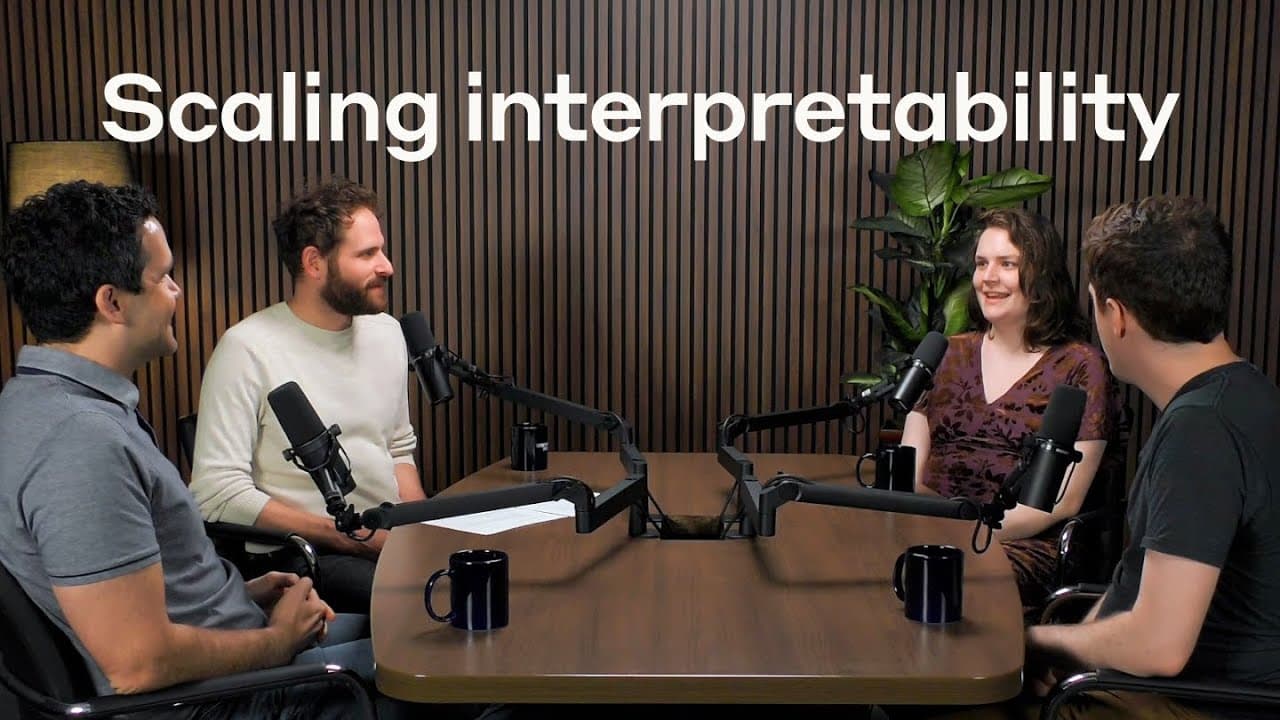
- I'm Josh Batson, and I'm here with other members of the interpretability team at Anthropic to talk about some of the engineering work that went into our big recent release about interpreting the insides of Claude 3 Sonnet. So why don't we start with some introductions. Jonathan, who are you? - I'm Jonathan Marcus. I have worked on the interpretab... Read More
Key Insights
- Interpretable features were first demonstrated on a very small language model, setting the groundwork for scaling up to larger models.
- Scaling the dictionary learning technique required careful engineering and back and forth between research and engineering rather than a single plan.
- Multimodal features fire on both text and images, showing that a concept can be represented across modalities and contexts.
- The veganism feature revealed cross language concepts and how the model connects ethics to language across translations.
- Backdoor related features illustrate how the model identifies vulnerabilities in code and related artifacts like hacked devices.
- Golden Gate Claude was a practical demonstration where a discovered feature was deployed as an interactive capability within days.
- The team emphasizes that scaling involved many incremental experiments and checks, not a single leap.
- The project shows that model interpretability can illuminate how large language models perform tasks beyond explicit programming.
Install to Summarize YouTube Videos and Get Transcripts
Explore YouTube Video Summarizer or Get YouTube Transcript Extractor
Questions & Answers
Q: A real search query question about the video (e.g. 'How to...', 'What is...', 'Why does...', 'When should...'). Question 1
What does it take to scale interpretability from a tiny model to a production level model like Claude 3 Sonnet and still find meaningful features? The answer involves iterative engineering and research collaboration, using a dictionary learning approach and cross modal signals to identify interpretable concepts, validating them at each scale, and then shipping a tangible feature like Golden Gate Claude after successful tests and demonstrations.
Q: Question 2
How do multimodal features differ from text only features in interpretability work, and why is that important? Multimodal features respond to both text and images, showing that a concept can be activated by different inputs. This strengthens the evidence that the feature reflects a genuine underlying representation rather than a superficial pattern, enabling deeper insight into how the model reasons across modalities.
Q: Question 3
What is monosemanticity and how did it guide the scaling effort for Claude 3 Sonnet? Monosemanticity refers to discovering a single coherent feature that aligns with a concept. The team started with small models to prove the concept and then systematically scaled the technique to larger models, ensuring the features remained meaningful and interpretable as complexity grew.
Q: Question 4
What are some concrete features that surprised researchers when scaling interpretability, and what do they reveal about model thinking? Features such as counting to 10 or generating URL suffix strings revealed that the model captures simple arithmetic and structured sequences. In larger models, features emerged that connect linguistic tasks to broader concepts like ethics and code security, showing deeper, non trivial reasoning.
Q: Question 5
How did the team handle the transition from research results to a shipped product feature like Golden Gate Claude? They moved from discovery to a production proof of concept, then rapidly implemented the feature in the codebase, tested it, and shipped within about 36 hours. This demonstrates a tight feedback loop between research findings and engineering delivery.
Q: Question 6
What role did the initial monosemanticity paper play in guiding subsequent work on Claude 3 Sonnet? The paper established that interpretable features could exist in a smaller model, and that approach provided a foundation for scaling. It framed the research questions and validated the feasibility of extending dictionary learning to larger, production scale models.
Q: Question 7
Why is the diversity of features (code related, backdoors, veganism) significant in interpretability research? A broad set of features shows that the model encodes a wide range of concepts, including safety vulnerabilities and cultural/ethical notions. This diversity demonstrates the model’s capacity to reflect complex ideas beyond simple word associations, aiding comprehensive understanding of model behavior.
Q: Question 8
What does the team mean by the idea that scaling was done in pieces rather than a single monolithic plan, and why is that important? Scaling in pieces allowed iterative validation and learning as they progressed. It helped ensure that each incremental step preserved interpretability and reduced risk, enabling a cautious yet productive path to larger models like Sonnet.
Summary & Key Takeaways
-
The article explains how the interpretability team moved from small models to a production scale model, expanding the feature set and validating the approach across larger systems.
-
The team highlights specific features such as code related counting, backdoors, and multilingual veganism, demonstrating both breadth and depth of interpretability at scale.
-
A case study called Golden Gate Claude demonstrates rapid deployment when a feature is validated, illustrating the loop from discovery to shipping in a real product.
Read in Other Languages (beta)
Share This Summary 📚
Summarize YouTube Videos and Get Video Transcripts with 1-Click
Try YouTube Summary with ChatGPT & Claude or YouTube Transcript Generator
Explore More Summaries from Anthropic 📚
Summarize YouTube Videos and Get Video Transcripts with 1-Click
Try YouTube Summary with ChatGPT & Claude or YouTube Transcript Generator