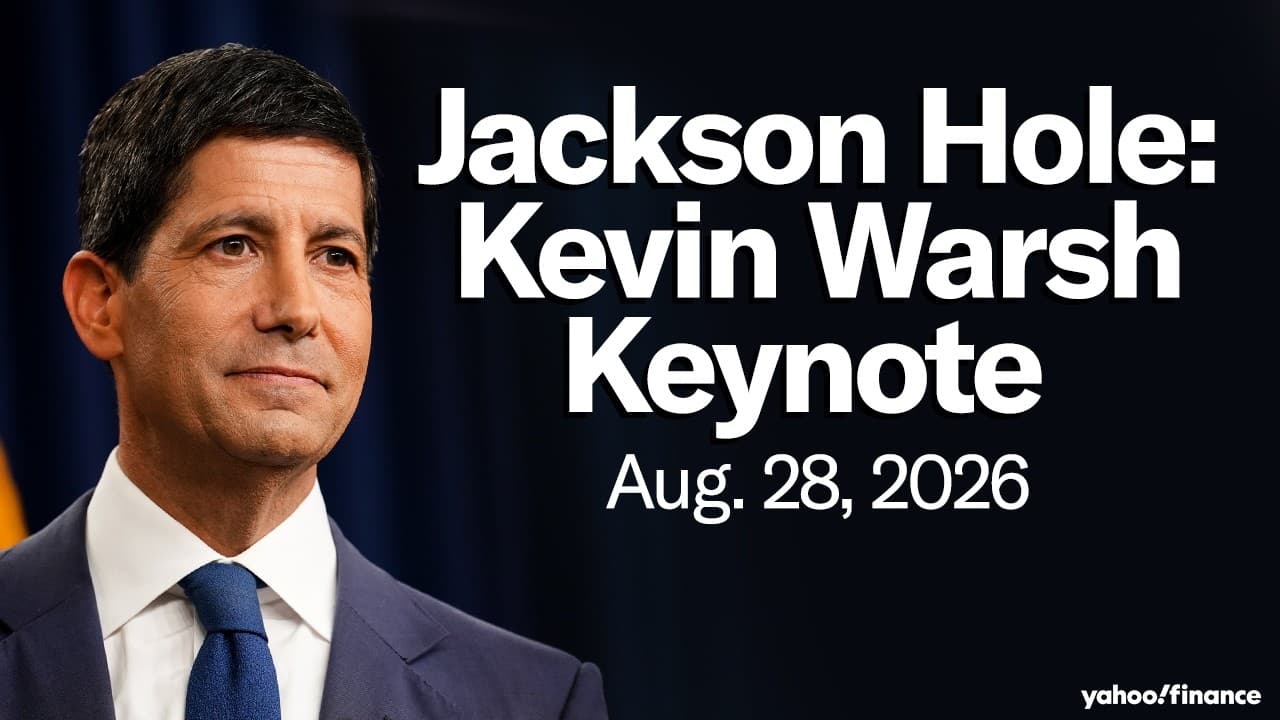
How will AI shape Fed policy and forward guidance?
TL;DR
AI is viewed as a potential driver of productivity and policy challenges at the Fed. The speaker argues forward guidance should be limited in normal times, and emphasizes clear signals from markets rather than relying on policy promises. He outlines principles for monetary policy and a cautious assessment of the economy.
Transcript
It's great to be back here in the valley again. See so many familiar faces from academia, from my last tour of service and from my first hundred days, which uh is just this weekend. I've been looking forward to this weekend. And before I go further, I want to thank Jeff Schmidt and his team for the incredible hospitality. Everybody here is in debt ... Read More
Key Insights
- AI is treated as a potential new factor of production that could influence productivity and policy pathways.
- The Fed intends to reduce reliance on forward guidance and instead use clear, market signals to inform policy decisions.
- Forward guidance is seen as potentially delaying timely policy responses and creating ambiguity for households and workers.
- Markets should provide unfiltered signals, including asset prices and credit conditions, to inform near term policy outlooks.
- The relationship between the central bank and financial markets should be balanced, avoiding overreliance on the Fed for trades.
- A hall of mirrors problem is acknowledged, where markets and the Fed could distort each other if overreliance develops.
- The speech proposes six guiding principles for the conduct of monetary policy to navigate a changing economy.
- There is an emphasis on preparing for future policy conjunctures without relying on outdated crisis-era tools.
- More videos from this channel:
- More from this channel: Yahoo Finance
Install to Summarize YouTube Videos and Get Transcripts
Explore YouTube Video Summarizer or Get YouTube Transcript Extractor
Questions & Answers
Q: How might AI influence the Fed's view of productivity and growth in the economy
AI is discussed as a potential new variable of production that could affect productivity and growth. The speaker asks whether AI could raise productivity over time and how token usage and capital intensity might shift the allocation of returns. The question reflects a fundamental shift in thinking about the economy where AI investment could alter the path of growth and inflation, and thus policy choices.
Q: Why does the speaker want to end regular forward guidance
The speaker argues that forward guidance has outstayed its welcome because it can create ambiguity and constrain the central bank during changing times. He notes that relying on explicit commitments can hinder flexibility to respond to new information, and that a more measured, data-driven approach with market signals is preferred for accurate policy decisions.
Q: What role should market signals play in the Fed’s policy outlook
Market signals are described as essential for informing the Fed about near term economic activity and inflation. The feedback loop includes asset prices, credit availability, and other market indicators, while the Fed should also rely on real economy data. The goal is to balance market information with prudent policy action without surrendering decision making to markets.
Q: What is the hall of mirrors problem referred to in the talk
The hall of mirrors problem occurs when markets rely on the Fed for guidance and the Fed relies on market prices, creating a feedback loop that distorts neither side’s understanding. The concern is that excessive dependence could blind policymakers to new developments and place uneven costs on those with fewer financial assets.
Q: What are the six principles for monetary policy mentioned
The speaker promises to share six guiding principles for the conduct of monetary policy focused on resilience, humility, and adaptability in the face of evolving technology, geopolitics, and data. While the transcript excerpt does not list them explicitly, the principles likely emphasize prudent risk management, clear communication, and data driven decisions.
Q: How does the speech describe the current economy at the time of the talk
The talk notes that inflation persisted and that there was a mixed read on the economy, with capital expenditure rising and profits improving. It indicates a need to assess inflation momentum, labor market conditions, and the impact of AI related investment on the broader economy while maintaining a disciplined policy stance.
Q: What is meant by preparing for future policy conjunctures
Preparing for future policy conjunctures means considering possible economic scenarios, including the impact of AI on productivity and the distribution of returns, and developing a thoughtful approach to policy that is not tied to crisis era tools. It emphasizes thoughtful planning and flexible responses to evolving economic conditions.
Q: What stance does the speaker take on inflation responsibility
The speaker notes that responsibility for sustained inflation sits with the central bank, emphasizing accountability for inflation outcomes. He argues for a disciplined approach to policy that focuses on price stability and sustainable employment, while avoiding overcommitment to rigid paths that could hinder timely responses.
Summary & Key Takeaways
-
The speech frames AI as a potential new factor of production that could raise productivity and alter policy considerations. It discusses the role of the Fed in a changing technological landscape and the need for humility in forecasting.
-
Forward guidance is questioned as a policy tool, with a shift toward clearer, market-based signals rather than fixed commitments. The Fed seeks to improve models and reaction functions without overreaching promises.
-
The speaker presents six guiding principles for monetary policy and offers an outlook on current inflation, the labor market, and investment in AI related infrastructure, aiming for a disciplined yet adaptable policy approach.
Read in Other Languages (beta)
Share This Summary 📚
Summarize YouTube Videos and Get Video Transcripts with 1-Click
Try YouTube Summary with ChatGPT & Claude or YouTube Transcript Generator
Explore More Summaries from Yahoo Finance 📚

Summarize YouTube Videos and Get Video Transcripts with 1-Click
Try YouTube Summary with ChatGPT & Claude or YouTube Transcript Generator