Why Is Nvidia Betting on Agentic AI Factories?
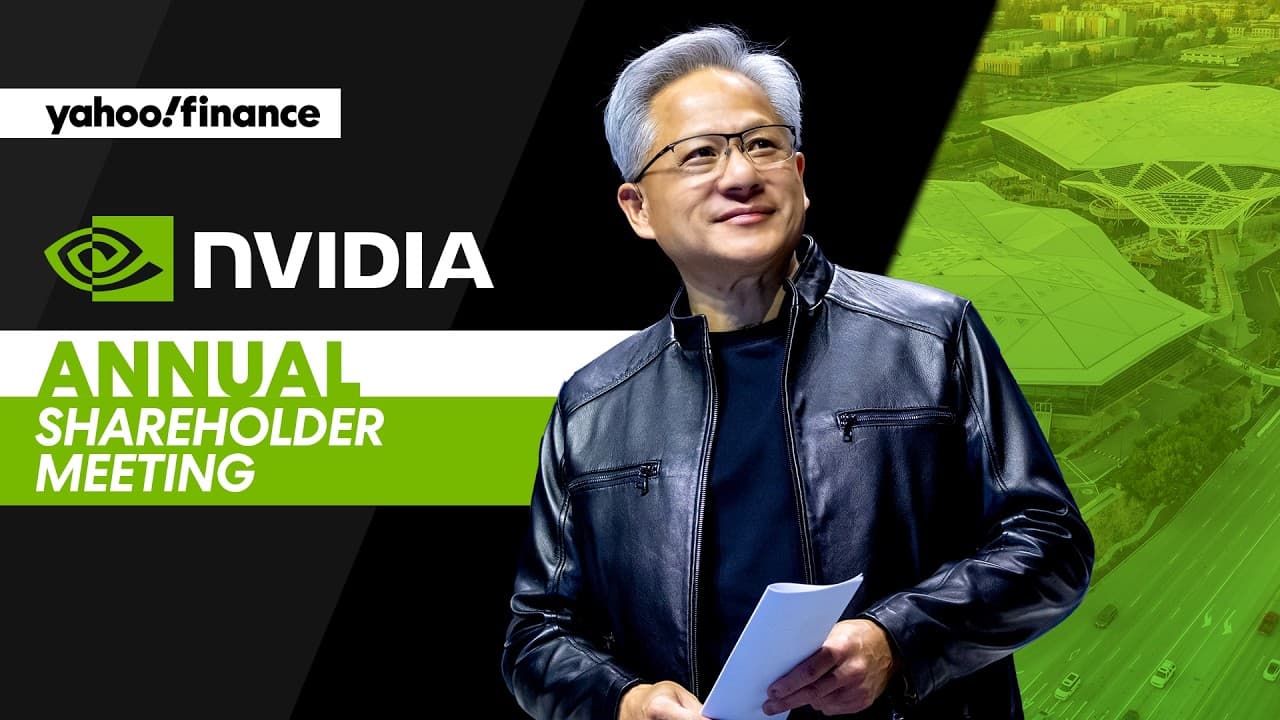
TL;DR
Useful AI is generating economic value, making compute capacity a source of revenue rather than merely an operating expense. Nvidia argues that agentic AI, AI factories, and physical AI will sustain infrastructure demand for decades, supported by its integrated stack of GPUs, agent-focused CPUs, networking, CUDA software, simulation tools, and edge-computing platforms.
Transcript
I'll turn it over to Jensen for a business update. Following which we will announce the preliminary results of the meeting if available and then answer stockholder questions. >> [clears throat] >> This has been an extraordinary year for NVIDIA and for computing. Every 10 to 15 years the computer industry resets. Mainframe to PC PC to internet inter... Read More
Key Insights
- AI is changing the fundamental computing model from machines executing human-written instructions to systems that can understand, reason, plan, use tools, and perform useful work. Nvidia therefore characterizes computers as assistants and data centers as factories that produce digital intelligence.
- Agentic AI is already useful because agents can access memory, write and execute code, use databases and applications, call other agents, test results, and continue working until tasks are completed. Software development is presented as the first major enterprise breakout use case.
- Useful tokens are economic outputs because they can become code, answers, designs, actions, and services. Nvidia argues that profitable token production connects additional compute directly to additional revenue, giving customers a financial reason to expand AI infrastructure rather than treat it as experimentation.
- Nvidia's reported annual performance included $216 billion in revenue, $130 billion in operating income, $4.90 in diluted earnings per share, and $103 billion in operating cash flow. Data center revenue reached $194 billion, while international revenue exceeded $30 billion.
- AI factories differ from traditional data centers because traditional facilities store and serve files, while AI factories manufacture tokens. Their economic performance depends on how much revenue they produce and at what cost, making token throughput and cost per token central measures of infrastructure value.
- Vera Rubin is an integrated AI factory platform rather than a single chip. Vera serves as the CPU for agents, Rubin supplies GPU computation for reasoning, and NVLink, Spectrum-X, BlueField, storage, security, and software connect and optimize the platform from individual racks across data centers.
- CUDA's competitive strength is its ecosystem flywheel: the installed base attracts developers, developers create applications, applications establish new markets, and those markets expand the installed base. CUDA-X libraries extend this architecture into fields including genomics, physics, robotics, optimization, lithography, and drug discovery.
- Physical AI is agentic intelligence operating in the real world through robots, cars, and factories that perceive, reason, plan, and act. Nvidia's proposed loop combines AI factories for training, Omniverse for simulation, Cosmos world foundation models, and onboard chips and computers for operation.
- More videos from this channel:
- More from this channel: Yahoo Finance
Install to Summarize YouTube Videos and Get Transcripts
Explore YouTube Video Summarizer or Get YouTube Transcript Extractor
Questions & Answers
Q: Why does Nvidia call data centers AI factories?
Nvidia calls them AI factories because their purpose is to manufacture tokens instead of merely storing and serving files. Those tokens can become code, answers, designs, actions, and services. When customers can monetize these outputs, compute becomes tied to revenue. The factory is therefore evaluated by its token throughput, production cost, and capacity to keep valuable processors working efficiently.
Q: What is agentic AI, according to Jensen Huang?
Agentic AI consists of systems that can reason through problems and repeatedly take actions toward completing a task. Agents can use tools, access databases and memory, write and execute code, call applications or other agents, test their results, and continue working until the job is finished. Nvidia identifies software coding as the first major enterprise use case demonstrating this usefulness.
Q: Why does Nvidia believe AI infrastructure demand will continue?
Nvidia believes demand will continue because useful AI can produce monetizable tokens, making additional compute a potential source of additional revenue. The company says adoption has moved beyond experiments into production across hyperscalers, model builders, enterprises, industries, and sovereign customers. Huang compares the expected buildout with long-running infrastructure projects such as electric grids, transportation systems, and the internet.
Q: How does Vera Rubin support agentic AI workloads?
Vera Rubin supports agents as a complete platform. Rubin GPUs perform the model computation associated with thinking, while the Vera CPU handles the rapid supporting work needed by agents as they use tools, retrieve memory, access databases, and execute code. NVLink, Spectrum-X, BlueField, storage, security, and software connect the components and reduce costly GPU idle time.
Q: Why is GPU idle time a financial problem for AI factories?
GPU idle time is a financial problem because Nvidia frames GPUs as the most expensive equipment in an AI factory and tokens as the factory's revenue-producing output. If CPUs cannot keep pace with agents' rapid requests, GPUs wait instead of generating tokens. Nvidia designed Vera specifically to deliver fast responses for agents and prevent the CPU from becoming that bottleneck.
Q: What advantage does Nvidia claim for Blackwell inference?
Nvidia says Blackwell was recognized in the SemiAnalysis InferenceX benchmark as the leading inference platform. Huang claims it provides the lowest cost per token and 30 times higher token throughput than the next-best platform. His argument is that purchase price alone is less important than how cheaply and rapidly a system produces tokens and how much revenue it enables.
Q: How does CUDA strengthen Nvidia's market position?
CUDA strengthens Nvidia through a reinforcing ecosystem cycle. A large installed base attracts developers, those developers build important applications, the applications create new markets, and those markets expand the installed base further. CUDA-X libraries also address difficult workloads across science and industry, including lithography, optimization, genomics, physics, data processing, robotics, AI, radio networks, and digital biology.
Q: What is physical AI and why does Nvidia see it as a growth market?
Physical AI is agentic AI applied to real-world systems such as robots, cars, and factories. These systems must perceive changing environments, reason, plan, and operate within them. Nvidia expects adoption across transportation, manufacturing, surgical robotics, hospitality, and services, supported by a loop that uses AI factories for training, Omniverse for simulation, Cosmos models, and Nvidia computers for operation.
Summary & Key Takeaways
-
Nvidia describes AI as the largest computing reset in decades. Computers are shifting from executing human-written instructions to understanding, reasoning, planning, using tools, and completing work. This transition turns data centers into AI factories that manufacture valuable tokens, including code, answers, designs, actions, and services for customers across many industries.
-
Agentic AI drives a demanding computing pattern because agents repeatedly reason, retrieve memory, access databases, execute code, call applications, and evaluate results. Nvidia designed the Vera CPU and Rubin GPU as parts of a complete factory platform intended to keep expensive GPUs productive while networking, storage, security, and software coordinate computation throughout the system.
-
Nvidia expects future growth from data centers and edge computing, including hyperscalers, enterprises, gaming, workstations, AI base stations, automotive systems, and robotics. Physical AI extends agents into real environments, while AI factories train models, Omniverse simulates them, Cosmos provides world models, and Nvidia computers operate robots, vehicles, and industrial systems.
Read in Other Languages (beta)
Share This Summary 📚
Summarize YouTube Videos and Get Video Transcripts with 1-Click
Try YouTube Summary with ChatGPT & Claude or YouTube Transcript Generator
Explore More Summaries from Yahoo Finance 📚






Summarize YouTube Videos and Get Video Transcripts with 1-Click
Try YouTube Summary with ChatGPT & Claude or YouTube Transcript Generator