How to hold deep conversations that build connection
TL;DR
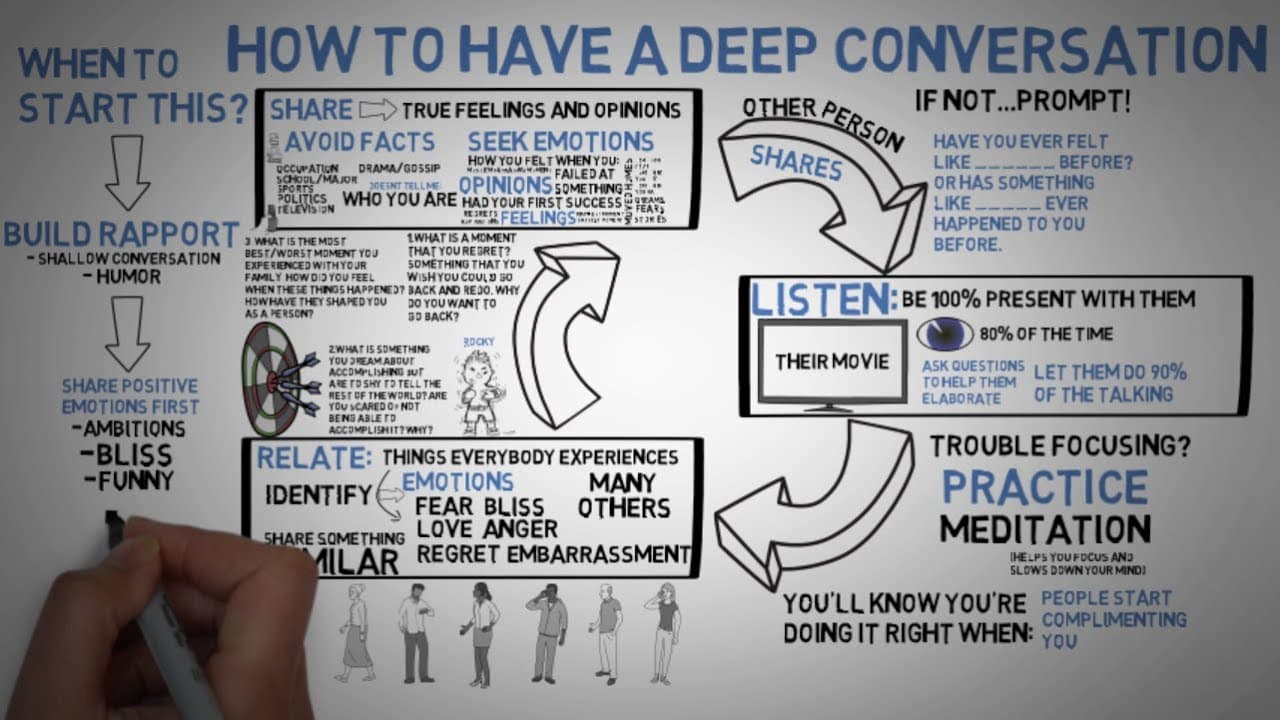
Share something true and emotional first, then listen with complete presence, and finally relate by acknowledging shared feelings. Start conversations with personal, emotionally rich topics rather than surface details. Practice consistent eye contact, thoughtful questions, and letting the other person talk most of the time to deepen rapport.
Transcript
Do you ever feel like you're not quite understood by other people? You ever feel like you don't really have many friends who you can call best friends, real friends? Do people seldom ever tell you that they seriously enjoyed speaking with you? If so, no worries because most people feel this way. What that means is that there's room for improvement ... Read More
Key Insights
- Deep conversation is a skill that strengthens personal relationships and can improve dating, friendships, and networking.
- The loop to start a deep conversation begins when someone is willing to share first and you take the initiative to reveal something meaningful.
- Surface level topics should be avoided in order to reveal who you are and elicit emotional responses that connect you to others.
- Emotions, not facts, are the key to deep connections; share feelings about failures, successes, dreams, regrets, and loves.
- Vulnerability is a feature of deep sharing, and initial discomfort decreases as you practice and gain confidence.
- Good listening is essential and includes being present, maintaining eye contact, and letting the other person speak most of the time.
- Relating involves identifying the other person’s emotions and offering parallels from your own experience.
- Rapport building should start with light, positive topics and gradually move toward more meaningful, emotionally rich discussion.
- More videos from this channel:
- More from this channel: Improvement Pill
Install to Summarize YouTube Videos and Get Transcripts
Explore YouTube Video Summarizer or Get YouTube Transcript Extractor
Questions & Answers
Q: How can I start a deep conversation with someone I just met
Begin by sharing a positive emotion or a personal experience that reveals something about your character rather than listing facts. Ask a follow up question that invites the other person to describe a similar moment. The goal is to create a sense of immediacy and emotional resonance, not to dominate the dialogue.
Q: What is the role of vulnerability in deep conversations
Vulnerability signals trust and invites the other person to open up. Start by describing a moment of failure, hope, or longing and explain how it affected you. This sets a precedent for reciprocity, encouraging the other person to reveal their own emotions and experiences.
Q: How can I stay present during a conversation
Focus on the speaker, maintain strong eye contact, and resist distractions. Listen for the emotional cues behind the words and refrain from interrupting. If your mind wanders, gently redirect your attention back to the speaker and steer the dialogue toward shared feelings.
Q: What kinds of questions prompt deeper sharing
Ask questions about moments of regret, dream projects, fears, or pivotal emotional experiences. Questions like “What is something you regret and why?” or “What feeling did that moment evoke?” encourage descriptive responses that reveal character and values.
Q: How do you use emotion to relate to someone
Identify the emotion in their story and relate it to a similar feeling you’ve had, even if your experiences differ. Saying something like “I felt the same way when…” creates common ground and demonstrates empathy, which strengthens the connection.
Q: What should you avoid in surface level conversations
Avoid only listing facts about work, school, or routine events. These topics fail to reveal who you are and do not invite emotional responses. Instead, pivot to experiences or opinions that evoke feelings and future possibilities for deeper discussion.
Q: How do you build rapport quickly
Start with light, positive topics to create comfort, then share a few positive emotions before moving toward deeper subjects. Humor can help, but consistency and authentic emotional sharing build lasting rapport that enables more meaningful exchanges.
Q: What signs indicate a successful deep conversation
You notice mutual openness, the other person shares emotionally and vulnerably, and there is a felt sense of understanding. Compliments about listening and connection may appear, along with a willingness to continue the conversation on future topics that explore feelings and shared perspectives.
Summary & Key Takeaways
-
Deep conversations are built by three steps: sharing emotionally, listening intently, and relating through shared emotions, which creates a stronger personal bond over time.
-
Effective listening requires presence, ample eye contact, and questions that invite elaboration, while the speaker does most of the talking to foster trust and comfort.
-
Relating means identifying emotions in others and recalling similar experiences to build a sense of shared human experience, ultimately improving dating, friendship, and networking outcomes.
Read in Other Languages (beta)
Share This Summary 📚
Summarize YouTube Videos and Get Video Transcripts with 1-Click
Try YouTube Summary with ChatGPT & Claude or YouTube Transcript Generator
Explore More Summaries from Improvement Pill 📚


Summarize YouTube Videos and Get Video Transcripts with 1-Click
Try YouTube Summary with ChatGPT & Claude or YouTube Transcript Generator