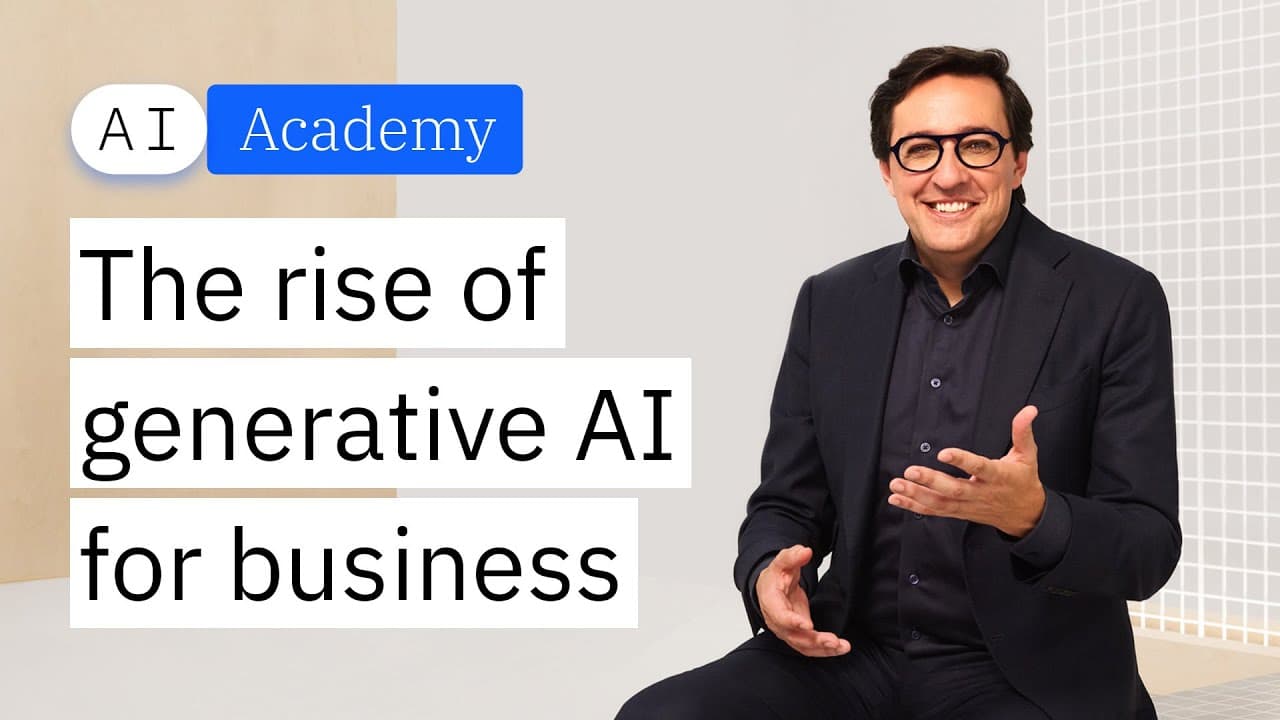
How will generative AI transform business?
TL;DR
Generative AI relies on data, compute, and foundation models to enable new outputs across business functions. It leverages self supervised learning with large transformer networks trained on vast text data, enabling adaptable, specialized applications while emphasizing data protection, transparency, ethics, and governance to guide responsible deployment.
Transcript
Arthur C Clarke famously said that any sufficiently advanced technology is indistinguishable from magic and perhaps the first time that you played with Generative AI it did evoke a sense of magic. Suddenly, for the first time in our history, we have a technology that can speak our languages, understand our requests and produce entirely novel output... Read More
Key Insights
- AI progress rests on three pillars: data, compute, and algorithms, which together make practical generative AI possible.
- Foundation models are large pre trained systems that can be adapted to many tasks, reducing task specific training needs.
- Self supervised learning uses unlabeled data to train models by predicting masked information, enabling scalable learning.
- Transformers and self supervision at scale create representations that generalize across tasks and domains.
- AI can be language oriented or extended to signals from machines, code, chemistry, and other languages in business contexts.
- Democratization and open science are important for broad access and governance of AI systems in organizations.
- Ethical, transparent, and trustworthy AI practices are essential for responsible deployment and risk management in business.
- Data is the competitive edge; protecting it and managing representations is critical for success.
Install to Summarize YouTube Videos and Get Transcripts
Explore YouTube Video Summarizer or Get YouTube Transcript Extractor
Questions & Answers
Q: What is a foundation model and why is it important?
A foundation model is a large scale neural network trained with self supervised learning on massive data, creating a general representation that can be adapted to many downstream tasks. It enables organizations to customize the model to their own data and use cases, achieving faster deployment and better alignment with business needs.
Q: How do generative AI systems learn from data without labeled examples?
Generative AI uses self supervised learning, where the model is trained on unlabeled data by predicting masked parts of the input. This process produces rich representations that generalize across tasks, reducing the need for expensive labeled datasets and enabling broader applicability of the model to text, images, sounds, and more.
Q: What role does data play in the AI stack according to the channel?
Data is the third leg of the AI stack, alongside compute and architecture. The quality and relevance of data determine the model’s usefulness and risk, and proper data governance, protection, and curation are essential to derive competitive advantage and trustworthy AI outputs.
Q: How can AI extend beyond language to other business signals?
AI can interpret signals from many domains such as industrial equipment, website navigation, software code, and chemistry. When viewed as a language, these signals can be deciphered and understood by models, enabling AI to operate across HR, customer service, cybersecurity, code work, and process optimization.
Q: What is meant by multimodal AI and why is it important for the future?
Multimodal AI integrates information from multiple modalities beyond text, such as images, audio, and sensor data. This broad capability increases flexibility, enables richer interactions, and supports more robust decision making, which is why many experts see it as essential for the next generation of AI systems.
Q: What governance principles are recommended for AI adoption?
Key principles include protecting data, ensuring transparency and trust, training models on legally sourced quality data, and actively managing bias and toxic content. Organizations should empower decision makers with platforms and processes to control their AI destiny without requiring everyone to be AI experts.
Q: How should organizations view the timeline and trajectory of AI progress?
AI progress is rapid but not fully solved or universally intelligent. The trajectory involves continuous updates, new models and use cases, and a push toward democratization and openness. Leaders should stay engaged, plan for responsible deployment, and adapt governance as AI capabilities evolve over months and years.
Q: What practical steps can leaders take to start leveraging AI today?
Leaders should start by safeguarding data and its representations, adopting transparent and trustworthy practices, ensuring ethical data sourcing, and implementing governance frameworks. They should pursue pilot projects that align with core business goals, scale successful use cases, and build the organizational capability to manage and evolve AI responsibly.
Summary & Key Takeaways
-
Generative AI is built on data, compute power, and model architecture that enable wide applicability across industries.
-
Foundation models enable transfer learning and customization to specific business needs with efficient deployment.
-
Responsible AI practices, including data protection and ethical considerations, guide how organizations adopt and scale generative AI.
Read in Other Languages (beta)
Share This Summary 📚
Summarize YouTube Videos and Get Video Transcripts with 1-Click
Try YouTube Summary with ChatGPT & Claude or YouTube Transcript Generator
Explore More Summaries from IBM Technology 📚

Summarize YouTube Videos and Get Video Transcripts with 1-Click
Try YouTube Summary with ChatGPT & Claude or YouTube Transcript Generator