Why Is OpenAI Adding Ads and an $8 ChatGPT Go Plan?
TL;DR
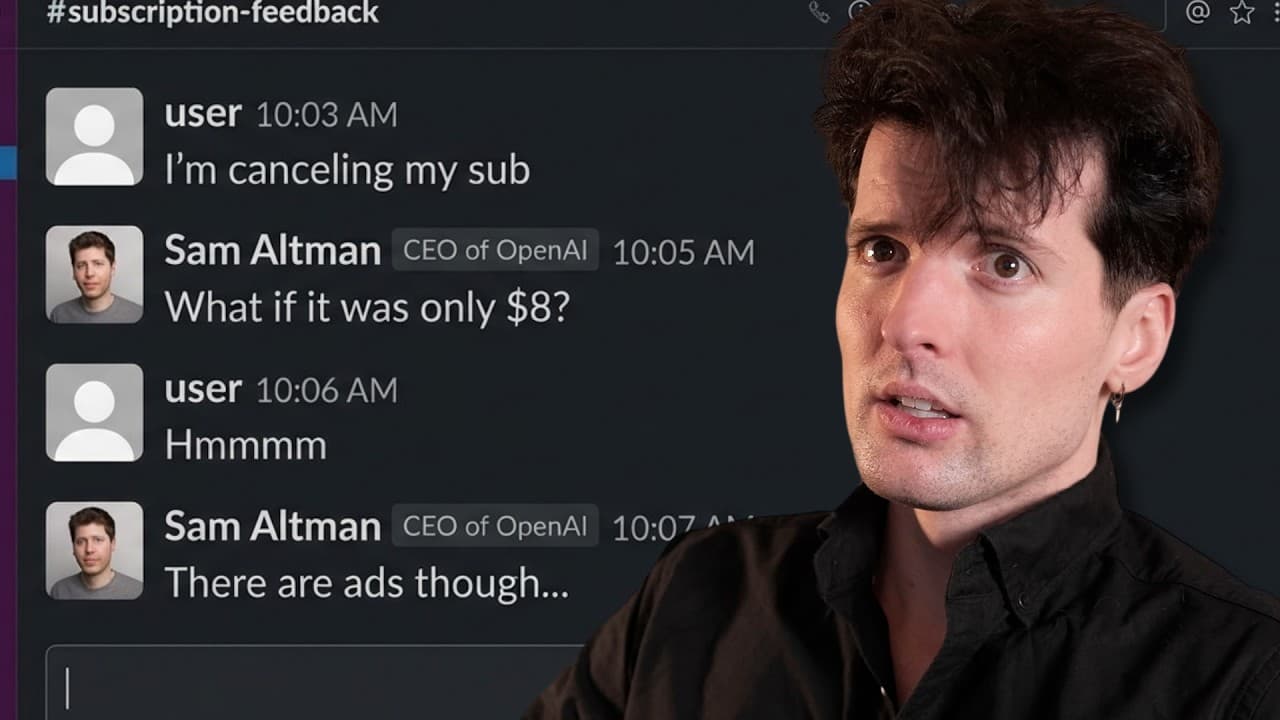
OpenAI rolled out ChatGPT Go, an $8-a-month plan, worldwide after previously offering it only in India, and started putting Netflix-style ads on its free and $8 tiers. The move signals fear over losing market share, which slipped from over 75% a year ago into the 60s as Google squeezes in.
Transcript
Seems like OpenAI realized that they have competition and they're finally making changes to address it that really seem to underpin this deep fear they have about losing the market. Today, OpenAI dropped chat GPT Go, their new $8 a month plan across the whole world. Originally, this plan only existed in India as a way to have presence in markets th... Read More
Key Insights
- ChatGPT Go is OpenAI's new $8-a-month plan, now launched worldwide after originally existing only in India as a lower-cost option for markets with less spend per person, aimed at expanding access to ChatGPT's most popular features.
- OpenAI is adding ads to ChatGPT on both the free tier and the $8 Go tier in a Netflix-style model, marking a significant rethinking of how the company generates revenue as it faces growing competition.
- OpenAI's market share fell from comfortably over 75%, closer to 85% about 12 months ago, down into the 60s, largely because Google has moved in and squeezed market away from OpenAI, which the speaker says terrifies them.
- GPT 5.2 API pricing is $1.75 per million input tokens and $14 per million output tokens, after the output price was bumped up from $10 with the 5.2 release, making individual long threads cost real money.
- A single long ChatGPT thread can reach around 100,000 tokens, and each individual message can cost 10 to 30 cents, a number the speaker says he has seen hit many times on platforms like T3 Chat.
- At the end of 2024, OpenAI made three to four times more money from ChatGPT subscriptions than from its API, meaning subscriptions vastly outweigh revenue from all ChatGPT wrapper apps combined.
- Anthropic makes far more revenue from its API than from subscriptions, the reverse of OpenAI, though that is starting to shift because Claude Code offers a $200-a-month plan.
- Running generic open-weight models on an RTX 5090 nearly doubled the speaker's power bill, and running it full-time would cost over $2,000 a month in power alone, illustrating how expensive AI inference is.
Install to Summarize YouTube Videos and Get Transcripts
Explore YouTube Video Summarizer or Get YouTube Transcript Extractor
Questions & Answers
Q: What is ChatGPT Go and how much does it cost?
ChatGPT Go is OpenAI's new subscription plan priced at $8 a month, now launched across the whole world. It originally existed only in India as a low-cost subscription designed to expand access to ChatGPT's most popular features and help more people use advanced AI in their daily life. The plan lets you generate images and talk to the models, but unlike some competitors it now also includes ads.
Q: Why is OpenAI adding ads to ChatGPT?
OpenAI is adding ads to ChatGPT on both the free tier and the $8-a-month Go tier in a Netflix-style approach. According to the speaker, this reflects a big rethinking at OpenAI about how they make money, driven by a deep fear of losing the market. Ads represent a new source of revenue as the company faces increasing competition and tries to offset the high cost of running its models while keeping subscription prices low.
Q: How much market share has OpenAI lost?
OpenAI's market share dropped from comfortably over 75%, closer to 85% about 12 months ago, all the way down into the 60s. The speaker describes this as crazy and attributes it largely to Google, which has come in and is really squeezing market away from OpenAI. He says OpenAI is terrified and is making changes like the $8 Go plan and ads accordingly, though he is unsure how well those changes will work.
Q: How much does it cost to run a message on ChatGPT?
The cost of a message on ChatGPT is non-trivial. GPT 5.2 pricing is $1.75 per million input tokens and $14 per million output tokens. A single long thread can reach around 100,000 tokens, and each individual message can cost 10 to 30 cents, a figure the speaker says he has seen hit many times on platforms like T3 Chat. Reasoning models further boost output tokens, and some benchmark runs of a few hundred messages can cost $10 to $30.
Q: Why does OpenAI focus on subscriptions instead of the API?
At the end of 2024, OpenAI made three to four times more money from ChatGPT subscriptions than from its API. The speaker points out that for every ChatGPT wrapper built on the API, ChatGPT itself makes three times more, and all wrappers combined earn OpenAI less than a third of subscription revenue. That is why the company focuses on driving subscriptions, especially as it faces more competition from vertically integrated companies.
Q: How does T3 Chat offer an $8 plan profitably?
T3 Chat keeps its $8-a-month price sustainable by limiting how much you can use the really expensive models and encouraging cheaper but still strong ones. It also limits how much context a thread can hold to keep any single message from costing an egregious amount. Around 1% of users cost two to four times the subscription, but they must put in effort to do so, and most users do not cost eight dollars, so the margins work out roughly profitable.
Q: How does Anthropic's revenue model differ from OpenAI's?
Anthropic makes way more money from its API than from its subscriptions, which is the opposite of OpenAI, whose subscriptions dominate. The speaker notes this gap is starting to change for Anthropic because Claude Code now has a $200-a-month plan. He frames all these companies as sharing the same goal: getting users addicted to their product, UX, tools, and features so people stick with them over time.
Q: Why does the speaker consider T3 Chat a competitor to OpenAI?
The speaker argues that because OpenAI earns the vast majority of its revenue selling a subscription to a chat web app, it directly competes with T3 Chat, which makes the majority of its income the same way at the app layer. He says OpenAI's integrations do not change that, and neither does the fact that they give him early access. T3 Chat threatens to commoditize OpenAI's layer, which is scary to them and pushes them to make their product more compelling even at a financial loss.
Summary & Key Takeaways
-
OpenAI launched ChatGPT Go, an $8-a-month plan, across the whole world after it originally existed only in India to serve markets with lower spend per person. Alongside this, OpenAI began adding Netflix-style ads to ChatGPT on both the free tier and the $8 tier, signaling major changes in how it makes money.
-
These moves reflect deep fear at OpenAI about losing the market. Its share dropped from comfortably over 75%, closer to 85% twelve months ago, down into the 60s as Google squeezes in. The speaker, who runs the competing $8 T3 Chat, argues OpenAI directly competes with app-layer chat services and is scared of being commoditized.
-
AI inference is genuinely expensive: GPT 5.2 costs $1.75 per million input tokens and $14 per million output. Long threads can hit 100,000 tokens and cost 10 to 30 cents per message. At end of 2024 OpenAI earned three to four times more from subscriptions than its API, explaining the subscription focus.
Read in Other Languages (beta)
Share This Summary 📚
Summarize YouTube Videos and Get Video Transcripts with 1-Click
Try YouTube Summary with ChatGPT & Claude or YouTube Transcript Generator
Explore More Summaries from Theo - t3․gg 📚






Summarize YouTube Videos and Get Video Transcripts with 1-Click
Try YouTube Summary with ChatGPT & Claude or YouTube Transcript Generator