How to Use Vibe Coding Without Ignoring the Code
TL;DR
Vibe coding is useful when it reduces engineering work, but it does not eliminate the need to understand code. The critical distinction is whether users inspect generated changes: AI agents can read files, research problems, and suggest edits, while blindly prompting leaves non-developers unable to debug failures or judge whether the resulting software is safe to ship.
Transcript
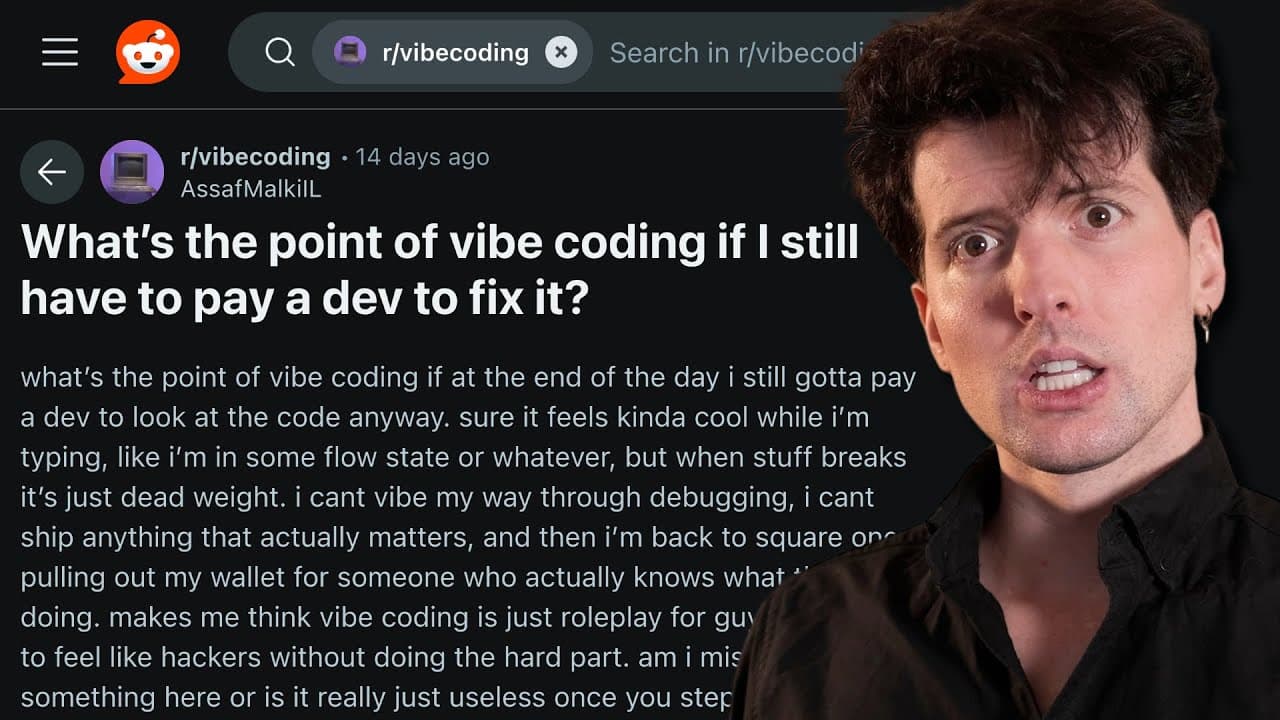
What's the point of vibe coding if I still have to pay a dev to fix it? What's the point if at the end of the day I've still got to pay a dev to look at the code anyways? Sure, it feels kind of cool while I'm typing, like I'm in some flow state or whatever, but when stuff breaks, it's just dead weight. I can't vibe my way through debugging. I can't... Read More
Key Insights
- Vibe coding is not a single agreed-upon practice. The label is applied to plain-English development, prompting without inspecting code, non-developers generating code through AI, and ordinary IDE autocomplete, even though these workflows involve substantially different levels of participation and technical understanding.
- The central distinction is whether the user reads the generated code. A person who performs most work through prompts but reviews the output has a fundamentally different workflow from someone who ignores the implementation and repeatedly pastes error messages into an AI tool.
- Coding knowledge is still necessary for anyone who wants to operate as a coder. Users who neither understand nor inspect generated code cannot independently diagnose failures, evaluate changes, or recover when prompting stops producing a working result.
- Vibe coding was originally framed as a workflow created by engineers for engineers. A developer can choose not to inspect generated code closely because they retain the ability to investigate, fix, discard, or rewrite the result when the automated approach fails.
- Agentic coding works by accepting a requested outcome, using tools to inspect files, looking up relevant material, and proposing code changes. Vibe coding is presented as a subset of that process in which the user does not meaningfully review the generated implementation afterward.
- AI-assisted autocomplete is not equivalent to code-blind prompting. Autocomplete keeps the engineer engaged with the implementation at each step, while a prompt-driven agent can make broader changes across a codebase with much less continuous inspection from the user.
- The practical value of vibe coding is reducing engineering work rather than eliminating engineers. It can shift implementation effort to an AI system, but failures still require someone who understands the code well enough to assess, debug, or replace what was produced.
- Automated code review can provide another layer of inspection for AI-generated changes. The sponsored example describes a reviewer that learns codebase-specific feedback over time, identifies risky assumptions and missing-key cases, estimates review effort, and can suggest or directly commit corrections.
Install to Summarize YouTube Videos and Get Transcripts
Explore YouTube Video Summarizer or Get YouTube Transcript Extractor
Questions & Answers
Q: What is the difference between vibe coding and agentic coding?
Agentic coding is the broader process of giving an AI a prompt and allowing it to use tools to inspect project files, look up information, and generate or suggest code changes. Vibe coding is described as a subset of that workflow. It occurs when the user rarely reads the generated code and is more inclined to paste an error message into the prompt box than investigate the implementation directly.
Q: Do you still need to understand code when vibe coding?
Coding knowledge remains necessary if the goal is to work independently as a coder. Generated software can break, and prompting alone does not guarantee that the user can identify the cause, judge the proposed repair, or determine whether the result is ready to ship. A user who neither understands nor reads the code must still rely on a developer when the automated workflow fails.
Q: Why do discussions about vibe coding become confusing?
Discussions become confusing because people use the same label for several incompatible workflows. One person may mean completing most work through plain-English prompts while still reviewing code. Another may mean ignoring code entirely, letting a non-developer generate software, or merely accepting IDE autocomplete. Arguments about whether vibe coding works often compare these different practices without first agreeing on which one is being evaluated.
Q: How should engineers use vibe coding effectively?
Engineers can use prompts and coding agents to perform implementation work while retaining the knowledge needed to recover from failures. They may inspect generated changes, review diffs, correct mistakes, or discard the output and write the solution themselves. The useful arrangement is not based on trusting every generated line. It depends on preserving enough technical understanding to validate and repair what the agent produces.
Q: Why is code-blind prompting especially risky for non-developers?
Code-blind prompting leaves non-developers without a reliable fallback when generated software stops working. If they do not understand the implementation and do not inspect it, they cannot independently debug failures or evaluate whether another generated change truly solves the problem. They may enjoy the initial flow of building through prompts, but important or broken projects can still require assistance from someone who understands the code.
Q: Is IDE autocomplete considered vibe coding?
Some people call IDE autocomplete vibe coding, but the presented framework treats it as a substantially different activity from blindly prompting an agent. With autocomplete, the engineer remains close to the implementation and reads the code as it is produced. In the stricter definition, vibe coding begins when code inspection drops significantly and the user relies on conversational prompting instead of examining the generated changes directly.
Q: Can vibe coding replace software engineers?
The argument presented is that vibe coding does not replace engineers. Its value is replacing some engineering work by allowing AI systems to inspect files, research relevant information, and propose changes from natural-language instructions. Someone still needs enough technical knowledge to review the result, handle failures, and decide whether the software is suitable to ship, particularly when the project matters beyond experimentation.
Q: How can automated code review support AI-generated code?
Automated code review can inspect proposed changes and identify issues that the original author might miss. The sponsored example describes a reviewer that remembers codebase-specific feedback, understands relationships among services, flags risky non-null assertions and missing-key cases, estimates the expected review effort, and supplies prompts or committable corrections. Such review can add useful scrutiny before changes leave a developer's machine or reach teammates.
Summary & Key Takeaways
-
Vibe coding is discussed too broadly, with definitions ranging from plain-English development and code-blind prompting to non-developers generating software and engineers using autocomplete. These practices require different levels of knowledge and code inspection, so treating all of them as one method creates confusion about their capabilities, risks, and appropriate users.
-
The proposed definition places vibe coding inside the broader category of agentic coding. Agentic tools receive prompts, inspect project files, look up relevant information, and generate suggested changes. The workflow becomes vibe coding when the user rarely reads those changes and responds to failures primarily by feeding error messages back into the agent.
-
Vibe coding can replace portions of engineering work, but it does not replace engineers or the need for coding knowledge. Experienced developers can recover when generated code fails, inspect diffs, or discard weak output. Non-developers who neither understand nor examine the code remain dependent on someone capable of debugging and validating it.
Read in Other Languages (beta)
Share This Summary 📚
Summarize YouTube Videos and Get Video Transcripts with 1-Click
Try YouTube Summary with ChatGPT & Claude or YouTube Transcript Generator
Explore More Summaries from Theo - t3․gg 📚






Summarize YouTube Videos and Get Video Transcripts with 1-Click
Try YouTube Summary with ChatGPT & Claude or YouTube Transcript Generator