Why Cheap Code Still Makes Software Expensive
TL;DR
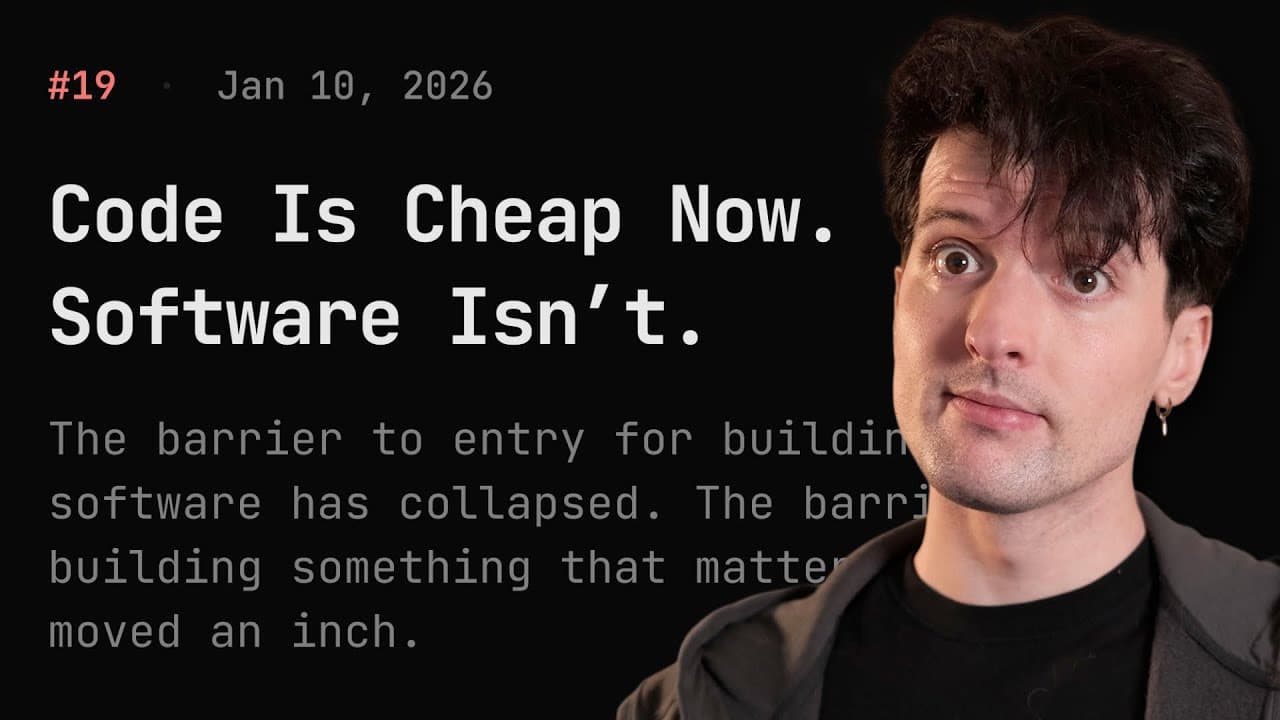
AI has made producing code dramatically cheaper, but valuable software still requires clear requirements, strong ideas, system design, and experienced judgment. The biggest opportunity is personal, disposable software for narrow use cases that previously could not justify development costs, while engineers increasingly shift from manually writing code toward specifying, evaluating, and shaping complete systems.
Transcript
Over the last few decades, code has always been really expensive. It's gone down some amount from when we were doing punch cards back in the day. But for the most part, code has been an expensive thing. That's why so many companies had to employ such a large number of expensive engineers. It's why we were all pressured to go to college to learn how... Read More
Key Insights
- Code is becoming prolific rather than scarce because modern AI tools can generate implementations with far less effort than traditional development required. This changes the economics of programming, but it does not automatically reduce the difficulty of deciding which software should exist or how it should behave.
- Valuable software remains expensive because implementation is only part of product creation. The harder work increasingly lies in identifying a meaningful problem, specifying exact requirements, shaping the experience, coordinating components, and judging whether the resulting system reliably accomplishes its intended purpose.
- Personal disposable software is becoming practical because programs serving tiny audiences or temporary needs no longer require enough value to justify extensive manual coding. A clearly described need can now support a custom tool even when distributing, selling, or maintaining it as a conventional software product would make little sense.
- Engineering is shifting from writing code toward shaping systems as the underlying implementation becomes easier to generate. Engineers still matter because they contribute planning, architecture, evaluation, and judgment, capabilities that remain necessary when an AI agent can produce code but cannot independently determine the correct product.
- Experienced developers can treat coding agents like capable collaborators because they already know how to delegate and review technical work. Their advantage comes from recognizing unclear requirements, breaking work into coherent pieces, anticipating failure modes, and determining whether generated output fits the broader system.
- Terminal interfaces do not automatically provide greater control because interactive coding tools may replace or reinterpret familiar terminal behavior. Differences in multiline editing, deletion, undo, and buffer handling can make experienced terminal users feel constrained even when the underlying agent is powerful.
- Software creation is becoming democratized as people who previously consumed tools gain the ability to design their own. However, the transcript argues that the transition is not complete, since generating code does not remove the need to articulate goals, understand limitations, or evaluate whether a result works.
- Idea quality and descriptive precision are becoming central constraints because implementation can follow once a person clearly states what should be built. The ability to write a useful specification, potentially in a markdown file, increasingly determines whether cheap code becomes meaningful software or merely adds to a growing volume of output.
Install to Summarize YouTube Videos and Get Transcripts
Explore YouTube Video Summarizer or Get YouTube Transcript Extractor
Questions & Answers
Q: Why does cheaper code not make valuable software cheap?
Cheaper code reduces the effort required to produce an implementation, but valuable software depends on much more than implementation. Someone must identify a meaningful problem, decide what the product should do, describe its behavior precisely, shape the user experience, coordinate the system, and evaluate the result. Those requirements remain difficult, so the barrier to writing code can collapse while the barrier to building something that matters stays in place.
Q: What is personal disposable software?
Personal disposable software consists of programs created for narrow, temporary, or highly specific needs that previously would not have justified their development cost. AI coding tools make these programs practical because producing the implementation is much cheaper. A person can describe a small problem, generate a tailored solution, use it for as long as it remains helpful, and avoid turning it into a conventional product intended for a large market.
Q: How is AI changing the role of software engineers?
AI is shifting engineering effort from manually writing every line of code toward specifying goals, orchestrating agents, shaping systems, and reviewing results. Engineers remain necessary because coding agents can be capable implementers while still being weaker at planning and deciding what should be built. Experienced developers contribute the architectural judgment, decomposition skills, quality assessment, and understanding of user needs required to transform generated code into coherent software.
Q: Why are experienced developers adopting AI coding tools?
Experienced developers can use coding agents effectively because they already understand how to organize technical work and direct other contributors. An agent can feel like another capable person to orchestrate, although it may need substantial help with planning and determining goals. Senior developers can supply context, divide work into manageable tasks, inspect generated changes, recognize weak assumptions, and decide whether the implementation belongs in the larger system.
Q: How can a clear specification improve AI-generated software?
A clear specification gives the coding tool an explicit description of the desired behavior, constraints, and outcome. The transcript suggests that writing down exactly what is wanted, even in a markdown file, can make obtaining the code much easier. As implementation becomes cheaper, ambiguity becomes a larger bottleneck. Precise descriptions help direct generation, reduce mismatched assumptions, and provide criteria for judging whether the resulting software actually solves the intended problem.
Q: Why can terminal-based coding agents feel restrictive?
Terminal-based agents can feel restrictive when they do not preserve familiar editing behavior. The transcript describes inconsistent handling of multiline input, option-delete, undo, and terminal buffers across different tools. Some interfaces use an alternative view mode and must manually recreate standard conventions. Even an experienced terminal user can therefore feel less in control because ordinary text-editing expectations no longer work consistently within the agent interface.
Q: What kinds of software become practical when coding is cheap?
Cheap coding makes highly specific tools practical, including programs for personal workflows, temporary tasks, and use cases with audiences too small to support conventional development. The transcript points to developers rapidly releasing many free and open-source projects, including a tool for monitoring remaining AI subscription rate limits. Such projects can now be worthwhile because their usefulness no longer has to offset the former cost of extensive manual implementation.
Q: What becomes the main constraint when code is abundant?
When code is abundant, the main constraint becomes the quality of the idea and the ability to describe it clearly. Producing more implementation does not guarantee useful software. Builders still need to understand the desired outcome, choose appropriate behavior, establish requirements, and assess the generated system. The central question shifts from whether someone can write enough code to whether they can define and shape something worth building.
Summary & Key Takeaways
-
Code generation has become cheap and prolific, reversing a long period when companies needed many highly paid engineers to produce software. Yet the cost of creating software that matters remains high because implementation is only one component. Defining the right problem, requirements, experience, and system continues to demand careful human judgment.
-
AI coding tools make small, personal, and disposable programs economically practical. A narrow use case may now justify custom software because implementation requires far less effort. People who can clearly describe what they want in a detailed specification can produce tools that would previously have been too costly or time-consuming to build.
-
Engineering is shifting from manually producing every line toward orchestrating tools and shaping systems. Experienced developers remain valuable because AI can implement instructions more effectively than it can determine goals or plan coherent products. Terminal-based agents are powerful, but inconsistent input behavior and incomplete interface conventions can also reduce the user's sense of control.
Read in Other Languages (beta)
Share This Summary 📚
Summarize YouTube Videos and Get Video Transcripts with 1-Click
Try YouTube Summary with ChatGPT & Claude or YouTube Transcript Generator
Explore More Summaries from Theo - t3․gg 📚






Summarize YouTube Videos and Get Video Transcripts with 1-Click
Try YouTube Summary with ChatGPT & Claude or YouTube Transcript Generator