Why Did Anthropic Donate MCP to Linux Foundation?
TL;DR
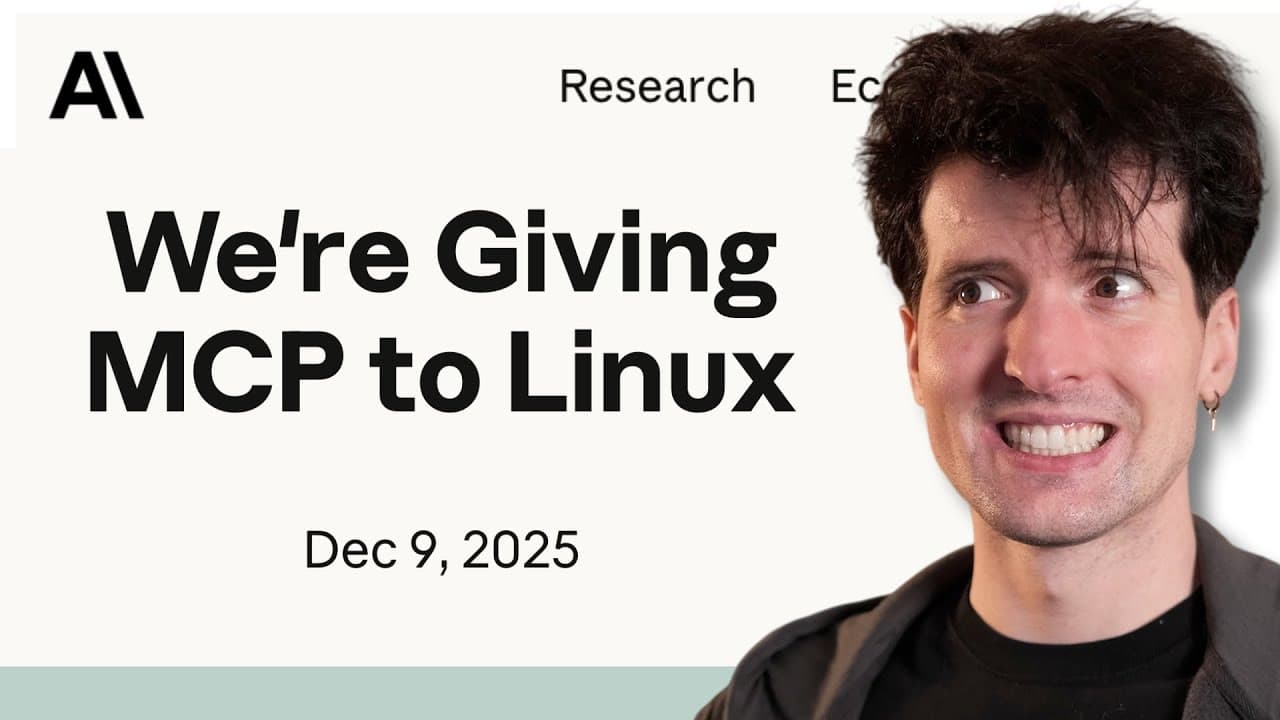
Moving MCP into the Linux Foundation gives the protocol a neutral home where it can evolve transparently and collaboratively instead of remaining under Anthropic alone. The new Agentic AI Foundation brings MCP together with Goose and AGENTS.md, backed by Anthropic, Block, OpenAI, Google, Microsoft, AWS, Cloudflare, and Bloomberg, while addressing concerns about long-term openness and governance.
Transcript
As you all probably know by now, I kind of love bullying Anthropic. As great as their models can be, they have their weird behaviors and things that I just don't love about how the company operates. One of those things in particular is the way they treat open source. I've never been super fond of it. But they recently acquired Bun, the JavaScript r... Read More
Key Insights
- MCP is now stewarded by the Agentic AI Foundation, a directed fund under the Linux Foundation, rather than remaining solely under Anthropic. This provides a neutral organizational home intended to support transparent, collaborative development and wider adoption of the protocol.
- The Agentic AI Foundation is co-founded by Anthropic, Block, and OpenAI, with support from Google, Microsoft, AWS, Cloudflare, and Bloomberg. The membership brings together companies involved in AI models, cloud infrastructure, developer platforms, and open source projects.
- MCP is a universal open standard for connecting AI applications to external systems. Its implementation prioritizes making connections easier for the agent side, although the presenter argues that maintaining live server connections can make deployment and developer adoption more difficult.
- MCP adoption is already broad, with more than 10,000 active public servers described in the announcement. ChatGPT, Cursor, Gemini, Copilot, Visual Studio Code, developer tools, and Fortune 500 deployments are identified as users or environments within its growing ecosystem.
- The Linux Foundation is an organization that coordinates major open source projects while collecting membership support from companies. Its projects and related foundations include the Linux kernel, RISC-V, PyTorch, the Cloud Native Computing Foundation, the OpenJS Foundation, and the Open Source Security Foundation.
- Neutral foundation ownership is presented as protection against an open project later becoming restricted. The transcript compares this approach with Valkey, a Redis fork supported by AWS and Microsoft and donated to the Linux Foundation after concerns arose over Redis licensing changes.
- The Agentic AI Foundation includes MCP, Goose, and AGENTS.md as its initial project set. MCP handles agent connections, Goose is Block's open source AI agent for engineering tasks, and AGENTS.md provides a file-based standard that can guide agents working with repositories.
- MCP's development included early adoption by Cursor, presentation at the AI Engineering Summit, and a second specification with enterprise authentication, HTTP streaming, and multimodal content. The presenter considers its selected enterprise authentication approach weak because the underlying HTTP standard had seen little implementation.
Install to Summarize YouTube Videos and Get Transcripts
Explore YouTube Video Summarizer or Get YouTube Transcript Extractor
Questions & Answers
Q: Why did Anthropic donate MCP to the Linux Foundation?
Anthropic donated MCP to place its stewardship in a neutral organization rather than keeping the protocol under one company. The Agentic AI Foundation is intended to let MCP evolve transparently and collaboratively while encouraging adoption of open source agentic AI projects. Linux Foundation ownership also reduces fears that the standard could later be restricted or controlled solely according to Anthropic's interests.
Q: What is the Agentic AI Foundation?
The Agentic AI Foundation is a directed fund operating under the Linux Foundation. It was co-founded by Anthropic, Block, and OpenAI, with support from Google, Microsoft, AWS, Cloudflare, and Bloomberg. Its stated purpose is to provide neutral open source governance so important agentic AI capabilities can develop transparently, collaboratively, and in ways that support broader adoption.
Q: What is the Model Context Protocol used for?
The Model Context Protocol is an open standard that connects AI applications to external systems. It lets agents interact with tools, services, and contextual resources through a shared protocol. The transcript notes that its design makes the agent side relatively easy, but servers are generally expected to remain live and connected throughout a session, which can complicate implementation and deployment.
Q: How widely has MCP been adopted?
MCP has achieved broad adoption within roughly a year of its introduction. The announcement reports more than 10,000 active public MCP servers, covering developer tools and Fortune 500 deployments. Platforms adopting it include ChatGPT, Cursor, Gemini, Copilot, and Visual Studio Code, while AWS, Cloudflare, Google Cloud, and Azure provide enterprise deployment infrastructure for MCP.
Q: How does Linux Foundation stewardship protect MCP?
Linux Foundation stewardship gives MCP a neutral institutional home supported by multiple companies and contributors. The transcript argues that this structure lowers the risk of a future licensing change or organizational restriction. It points to long-lived Linux Foundation projects and the Valkey example as reasons to expect that MCP can remain open, collaboratively maintained, and available over the long term.
Q: What projects belong to the Agentic AI Foundation?
The foundation initially includes MCP, Goose, and AGENTS.md. MCP is a protocol for connecting agents with external systems. Goose, contributed by Block, is an open source AI agent designed to perform engineering tasks beyond code suggestions. AGENTS.md is a markdown file standard used to provide agents with repository guidance, making the three projects complementary but structurally different.
Q: What deployment problems does MCP have?
The presenter argues that MCP makes operation easier for the agent while placing more burden on developers running the connected service. An external server may need to stay live and maintain its connection for the full session, which can make deployment inconvenient. The second specification added enterprise authentication and HTTP streaming, but its chosen authentication approach is described as having limited prior implementation.
Q: Why are major cloud companies supporting the foundation?
Major cloud providers have a practical interest in supporting MCP because enterprises need infrastructure for deploying and operating connected agent services. AWS, Cloudflare, Google Cloud, and Azure are already identified as offering MCP deployment support. Their participation also supplies funding and organizational support to the Linux Foundation, helping the protocol develop as shared infrastructure used across competing AI products and platforms.
Summary & Key Takeaways
-
Anthropic donated the Model Context Protocol to the Agentic AI Foundation, a directed fund under the Linux Foundation. The move transfers stewardship of MCP from a single company to a neutral organization designed to coordinate open source development, corporate funding, transparent governance, and broader adoption of important agentic AI infrastructure.
-
MCP was introduced as an open standard for connecting AI applications with external systems. After roughly one year, the protocol had more than 10,000 active public servers and adoption across ChatGPT, Cursor, Gemini, Copilot, and Visual Studio Code, with deployment infrastructure available from major cloud providers.
-
The Agentic AI Foundation begins with three notably different projects: MCP, Block's Goose agent, and the AGENTS.md file standard. Together, they cover connections to external systems, an open source agent for engineering tasks, and repository-level guidance, creating a foundation for several complementary parts of agentic AI development.
Read in Other Languages (beta)
Share This Summary 📚
Summarize YouTube Videos and Get Video Transcripts with 1-Click
Try YouTube Summary with ChatGPT & Claude or YouTube Transcript Generator
Explore More Summaries from Theo - t3․gg 📚






Summarize YouTube Videos and Get Video Transcripts with 1-Click
Try YouTube Summary with ChatGPT & Claude or YouTube Transcript Generator