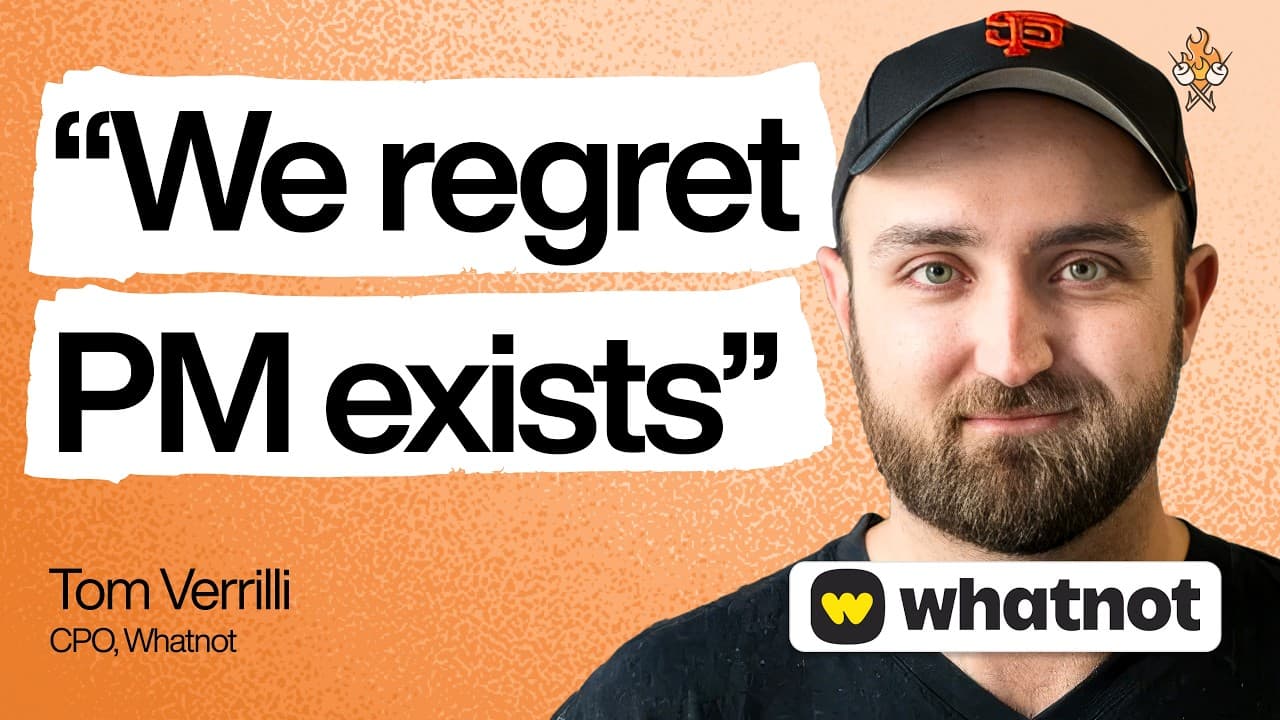
Why Do Product Teams Need Fewer Product Managers?
TL;DR
Product managers should be hired for specific needs, not automatically assigned to every engineering team. Whatnot gives engineers and designers more responsibility for understanding users and making product decisions, while reserving PMs for situations where specialized judgment can clarify ambiguity, accelerate decisions, and let technical or design specialists concentrate on work that requires their particular expertise.
Transcript
As tech companies scaled, somewhere along the line, this HR ratio of a pod popped into being. Every time you hire six engineers, you add a designer, you add a PM. Hiring so many PMs infantilizes the engineers and the designers who are perfectly capable of making good decisions but just never had to because there was always a PM to babysit them. Som... Read More
Key Insights
- Whatnot's product philosophy is that PMs should be hired only when a specific need justifies the role. The company rejects the assumption that each group of engineers automatically requires a dedicated product manager, designer, and engineering manager simply because a standard staffing ratio says so.
- Product management is a trade that improves through repeated practice. Specialized PMs can become highly effective at understanding problems and making decisions, but concentrating all product work in that role prevents engineers and designers from developing the same judgment through their own experience.
- Engineers and designers are capable of making sound product decisions when they have sufficient business and customer context. Verrilli argues that excessive PM staffing can infantilize these colleagues by leaving them dependent on someone else to interpret problems, establish direction, and decide what should happen next.
- Great product managers create leverage by disseminating clarity, absorbing ambiguity, and helping teams make timely decisions. Their value is therefore determined by the needs of the work and the quality of their contribution, rather than by the existence of a prescribed organizational slot on every team.
- Product management emerged partly because rapidly scaling internet companies needed founders and executives to delegate detailed execution decisions. Earlier organizations often relied on business leaders working directly with engineering and design, while greater scale created demand for people who could determine what should come next.
- Specialization is appropriate when other experts need to protect time for their own demanding crafts. An infrastructure leader may reasonably prefer to concentrate on scale rather than alignment discussions, while a product specialist may be better equipped to listen to customers and distinguish underlying problems from requested solutions.
- Whatnot applies an exceptionally selective standard to product hiring. Verrilli states that 31,832 people applied for product manager roles over two years and only one was hired, illustrating the company's preference for a small number of PMs who provide unusually strong and specific value.
- Senior individual-contributor work deserves a stronger career path than automatic promotion into management. Verrilli argues that companies historically removed top performers from hands-on product work by making directorship the reward for success, even though those people could remain highly valuable by continuing to practice their craft.
Install to Summarize YouTube Videos and Get Transcripts
Explore YouTube Video Summarizer or Get YouTube Transcript Extractor
Questions & Answers
Q: Why does Whatnot avoid assigning a PM to every team?
Whatnot believes product managers should address specific needs rather than fill a standard position in every organizational pod. Automatically adding a PM whenever a company hires a group of engineers can create unnecessary layers and reduce the responsibility carried by engineers and designers. The company instead asks whether specialized product judgment will meaningfully clarify ambiguity, improve decisions, or protect other specialists' time.
Q: How can too many product managers weaken a product team?
Too many product managers can leave engineers and designers dependent on PMs for decisions they could otherwise learn to make themselves. Verrilli describes this effect as infantilization: capable specialists receive fewer opportunities to understand users, weigh tradeoffs, and determine what should be built. Because product judgment develops through practice, consistently outsourcing that work can leave their decision-making muscles underdeveloped.
Q: What value does a great product manager add?
A great product manager can disseminate clarity, absorb ambiguity, and help colleagues make timely decisions. This contribution is especially useful when the work involves difficult customer interpretation, competing priorities, or coordination that would distract specialists from demanding engineering or design responsibilities. The role creates the most leverage when its purpose is explicit and the PM brings unusually strong product judgment.
Q: Is product management a qualification or a learned trade?
Verrilli characterizes product management as a trade rather than a qualification. People become better at it by repeatedly making decisions, understanding customer problems, and navigating uncertainty. That experience supports specialization, but it also creates a risk: when PMs monopolize product decisions, engineers and designers lose the repetitions they need to build comparable judgment and operate with greater independence.
Q: When should a company hire a dedicated product manager?
A company should hire a dedicated product manager when the work presents a clear need for specialized product skills. Examples include situations requiring someone to reduce ambiguity, spread clarity, accelerate consequential decisions, or handle product responsibilities that would prevent engineering and design specialists from concentrating on their crafts. Headcount ratios alone are not presented as a sufficient reason.
Q: Why might engineers or designers prefer working with a PM?
Engineers and designers may prefer a PM when product work would consume time they want to spend on coding, design, infrastructure, or scale. Some responsibilities, including alignment discussions and detailed coordination, may be unattractive or poorly matched to a specialist's abilities. Customer listening also requires skills that do not necessarily accompany the ability to build complex technical mental models.
Q: What does Whatnot look for when evaluating product managers?
Whatnot looks for PMs who can provide rare, concrete value rather than merely manage organizational processes. Verrilli says candidates who spend much of an interview discussing alignment and stakeholder management are trending downward in his evaluation because some PMs have specialized in politics rather than technical or product substance. The company's selectivity is reflected in hiring one person from 31,832 applicants over two years.
Q: Why should strong PMs remain individual contributors?
Strong PMs should have opportunities to remain individual contributors because management promotion can remove the best practitioners from the work where they excel. Verrilli criticizes a system in which successful PMs become directors and stop doing hands-on product work. His comparison to keeping Messi on the team emphasizes retaining top performers as active contributors instead of continually replacing their direct output with developing talent.
Summary & Key Takeaways
-
Whatnot built its product organization around the provocative premise that it regrets product management exists. The principle does not reject PMs entirely. It challenges the automatic staffing formula that assigns a PM to every team, favoring selective hiring where product management can deliver clear, specific leverage on difficult or consequential work.
-
Verrilli argues that product management is a trade developed through repeated practice rather than a qualification that grants exclusive authority over decisions. Engineers and designers can strengthen their own product judgment when they receive customer context and decision-making responsibility, but their abilities remain underdeveloped when PMs continually perform that work for them.
-
Specialization remains valuable when technical leaders want to focus on infrastructure or when product work demands strong customer listening, ambiguity reduction, and timely decisions. Whatnot therefore seeks unusually capable PMs, values individual contributors who continue doing hands-on work, and is skeptical of candidates who emphasize organizational politics over substantive product capabilities.
Read in Other Languages (beta)
Share This Summary 📚
Summarize YouTube Videos and Get Video Transcripts with 1-Click
Try YouTube Summary with ChatGPT & Claude or YouTube Transcript Generator
Explore More Summaries from Lenny's Podcast 📚




Summarize YouTube Videos and Get Video Transcripts with 1-Click
Try YouTube Summary with ChatGPT & Claude or YouTube Transcript Generator