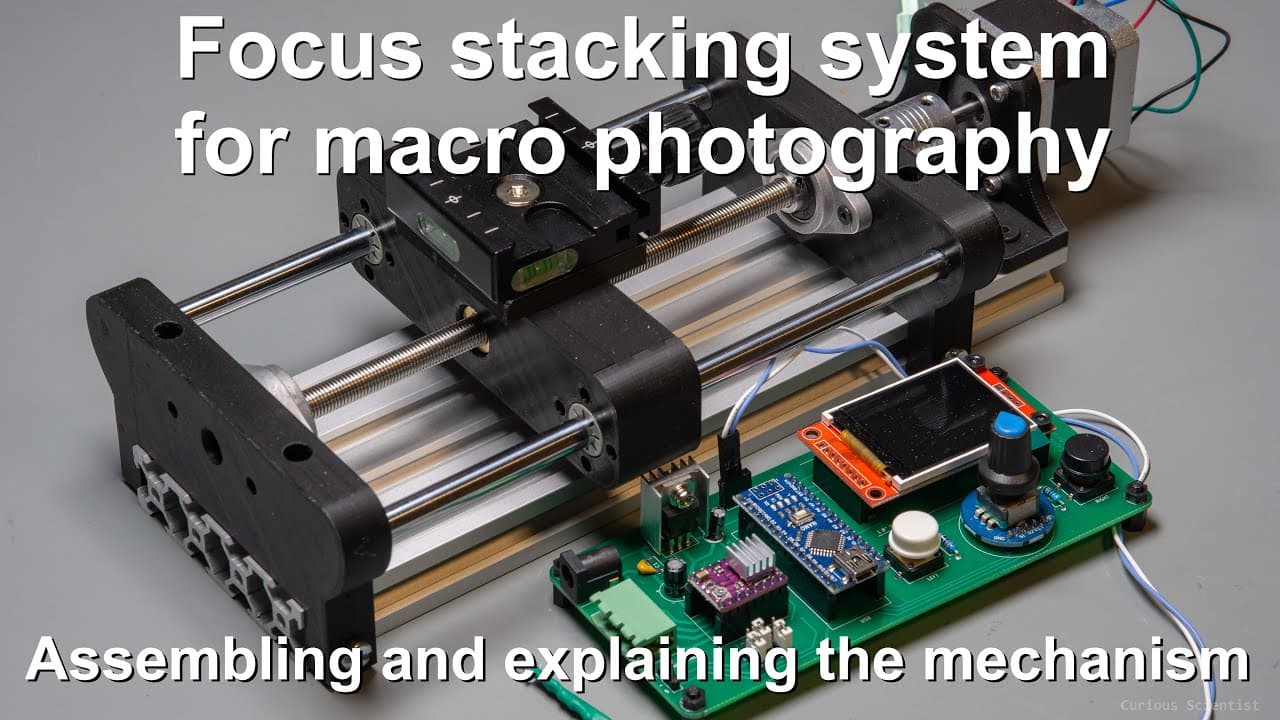
Focus stacking system for macro photography - Assembly and tutorial
TL;DR
A detailed guide on building a focus stacking rig using 3D printing and PCB components.
Transcript
this video is sponsored by pcbva welcome everyone in this video I'm going to talk about the mechanism I built for my focus stacking rig I showed my system in my previous videos so please check those if you are interested and I showed in one of the videos how I assembled the PCB which I made that is this guy here so this is the driver PCB for the a ... Read More
Key Insights
- 👻 The stepper motor's precision is vital; it allows for accurate focus adjustments necessary for macro photography.
- 🖐️ Anti-backlash mechanisms prevent image blurring caused by mechanical play in the components when moving the camera.
- 🥳 Using 3D printed parts gives creators flexibility in design and cost efficiency, especially for bespoke projects.
- 😒 The assembly process requires careful attention to alignment and torque to ensure proper functioning during use.
- 🗯️ Linear bearings improve the rig's smoothness and precision, crucial for achieving optimal photographic results.
- 😒 Collaborating with PCB manufacturing services can significantly enhance DIY projects by providing ready-to-use electronic components.
- 🥳 Regular lubrication of moving parts after assembly is essential for long term maintenance and functionality of the rig.
Install to Summarize YouTube Videos and Get Transcripts
Explore YouTube Video Summarizer or Get YouTube Transcript Extractor
Questions & Answers
Q: What is the main purpose of the focus stacking rig discussed in the video?
The focus stacking rig serves to enhance macro photography by allowing photographers to capture images at different focal depths, which are then combined to create a single image with an extended depth of field. This technique is particularly useful in macro photography where the depth of field is shallow.
Q: Can you explain the significance of the Nema 17 stepper motor in this assembly?
The Nema 17 stepper motor is crucial for precisely controlling the movement of the rig. It connects to the lead screw, translating rotational motion into linear motion, allowing for accurate focus adjustments while taking photographs. Its performance directly affects the quality and clarity of the final images.
Q: How does the anti-backlash nut work within the mechanism?
The anti-backlash nut minimizes unwanted movement or "backlash" by maintaining constant pressure against the lead screw. It incorporates a spring mechanism that keeps the nut in contact with the screw threads, ensuring that any movement remains steady, which is essential for capturing sharp macro images.
Q: What are the benefits of using 3D printed components in this project?
3D printed components allow for customization and rapid prototyping, making it easier for builders to create parts that perfectly fit their design requirements. This method also enables cost-effective manufacturing, as users can print parts themselves or get them printed through services like PCB Way, catering to their specific needs.
Q: How do the linear rails function in the focus stacking rig?
The linear rails provide guidance and smoother motion for the cross head, which holds the camera. They allow the cross head to move along a predetermined path without wobbling, ensuring stability and precision during the focus stacking process. Their quality impacts the overall functionality of the rig.
Q: What tools do you recommend for assembling the focus stacking rig?
Essential tools for this assembly include a soldering iron for inserting nuts, various screws and bolts for securing parts, a drill bit for reaming holes, and a set of wrenches or screwdrivers for tightening connections. Additionally, lubricant is suggested for maintaining smooth operation after assembly.
Summary & Key Takeaways
-
The video explains the assembly process for a focus stacking rig that aids in macro photography, detailing each component and its function within the system.
-
It emphasizes the importance of the stepper motor, lead screw, anti-backlash nut, and supporting rails, demonstrating how each part contributes to the overall mechanism.
-
Viewers are encouraged to utilize the 3D printed parts and PCBs available through the sponsor, PCB Way, for their own setups, ensuring they can replicate the described model with ease.
Read in Other Languages (beta)
Share This Summary 📚
Summarize YouTube Videos and Get Video Transcripts with 1-Click
Try YouTube Summary with ChatGPT & Claude or YouTube Transcript Generator
Explore More Summaries from Curious Scientist 📚
Summarize YouTube Videos and Get Video Transcripts with 1-Click
Try YouTube Summary with ChatGPT & Claude or YouTube Transcript Generator