How to Reconstruct a Signal from Its Samples
TL;DR
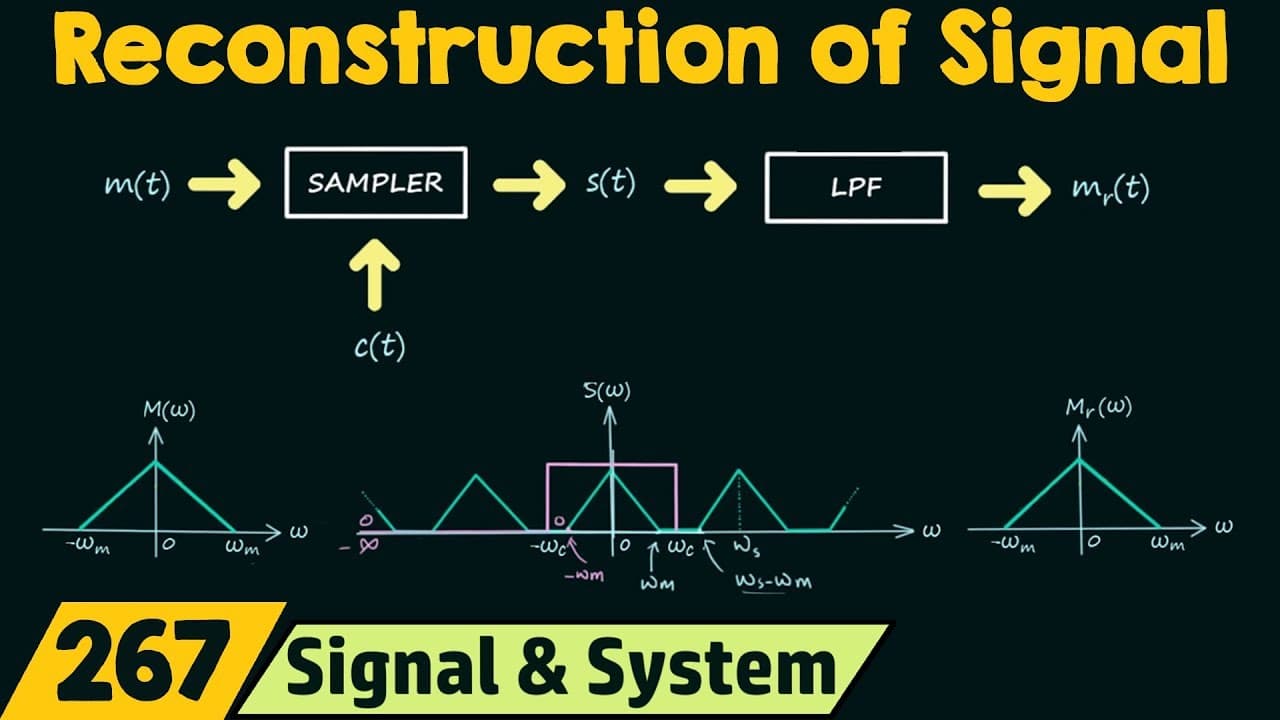
A sampled signal is passed through an ideal low-pass filter to recover the original band-limited message signal. Exact recovery works only when the filter cutoff frequency lies between the maximum message frequency (Omega M) and Omega s minus Omega M, and only when no spectral overlap occurs, meaning the sampling frequency exceeds twice Omega M.
Transcript
we understand the process of sampling in this process we try to sample a continuous-time signal whose example waveform you can see on your screen and this continuous-time signal we call message signal and therefore we represented by mt and we have considered this message signal mt to be band-limited signal and therefore its Fourier transform M Omeg... Read More
Key Insights
- Reconstruction recovers the original message signal m(t) from the sampled signal s(t) by passing s(t) through an ideal low-pass filter whose output M_R(Omega) equals H(Omega) multiplied by S(Omega).
- The frequency response relationship H(Omega) = M_R(Omega) / S(Omega) means the recovered spectrum is the product of the filter response and the sampled signal spectrum, and inverse Fourier transform of M_R(Omega) yields the recovered signal m_R(t).
- The sampled signal's spectrum S(Omega) consists of the message spectrum repeated and shifted by multiples of the sampling frequency Omega s, with copies added together to form the periodic spectrum.
- The no-overlap, non-touching case occurs when Omega s is greater than twice Omega M, because Omega s minus Omega M must be greater than Omega M for the spectral copies to stay separated.
- Exact reconstruction requires the cutoff frequency Omega C to satisfy Omega C greater than Omega M and Omega C less than Omega s minus Omega M, ensuring the filter passes only the central spectrum unchanged.
- Reconstruction still succeeds at the boundary cases where Omega C equals Omega M or Omega C equals Omega s minus Omega M, since the filter still isolates the correct central spectral copy.
- Reconstruction fails when Omega C is less than Omega M because part of the message spectrum is cut off, and it also fails when Omega C is greater than Omega s minus Omega M because adjacent spectral copies leak into the output.
- The filter gain compensates the sampled spectrum amplitude: at Omega equals 0 the sampled spectrum value is 1/T_s and the low-pass filter gain is T_s, so their product restores the original amplitude of 1.
Install to Summarize YouTube Videos and Get Transcripts
Explore YouTube Video Summarizer or Get YouTube Transcript Extractor
Questions & Answers
Q: How do you recover the original message signal from a sampled signal?
You pass the sampled signal s(t) through an ideal low-pass filter. The filter's output M_R(Omega) equals its frequency response H(Omega) multiplied by the sampled signal's spectrum S(Omega). This multiplication isolates the central spectral copy, which matches the original message spectrum M(Omega). Taking the inverse Fourier transform of M_R(Omega) then yields the recovered message signal m_R(t), which is the same as the original message signal m(t).
Q: What condition on the cutoff frequency allows exact signal reconstruction?
The cutoff frequency Omega C of the ideal low-pass filter must be greater than Omega M and less than Omega s minus Omega M. When this condition holds, the filter passes the entire central spectrum from minus Omega M to Omega M unchanged while rejecting the shifted spectral copies. This produces a Fourier transform identical to the original message spectrum, so the recovered signal exactly matches the message signal. Reconstruction also succeeds at the boundary values where Omega C equals Omega M or Omega C equals Omega s minus Omega M.
Q: Why does reconstruction fail when the cutoff frequency is less than Omega M?
When Omega C is less than Omega M, the low-pass filter cuts off part of the message spectrum. The resulting waveform is missing portions of the spectrum between Omega C and Omega M on both sides. Because the recovered Fourier transform no longer contains the exact same spectrum as the original message signal, the inverse transform cannot reproduce the exact message signal. Therefore a cutoff frequency less than Omega M is not allowed for successful reconstruction.
Q: Why does reconstruction fail when the cutoff frequency exceeds Omega s minus Omega M?
When Omega C is greater than Omega s minus Omega M, the filter passes not only the central spectral copy but also parts of the adjacent shifted spectral copies. This extra content is included in the output waveform, so the recovered Fourier transform differs from the original message spectrum. The corresponding time-domain signal will not equal the initial message signal, meaning the reconstruction purpose is not satisfied and the cutoff must stay at or below Omega s minus Omega M.
Q: When do the spectral copies of the sampled signal avoid overlapping?
The spectral copies avoid overlapping when the sampling frequency Omega s is greater than twice Omega M. In this case the frequency Omega s minus Omega M stays greater than Omega M, keeping the copies separated. When Omega s equals twice Omega M, the frequencies Omega M and Omega s minus Omega M become equal and the spectra touch. When Omega s is less than twice Omega M, Omega s minus Omega M becomes less than Omega M and the spectra overlap, causing distortion.
Q: What role does filter gain play in restoring the correct signal amplitude?
The low-pass filter gain compensates for the amplitude scaling introduced by sampling. At Omega equals 0, the sampled signal spectrum S(Omega) has a value of 1/T_s. The ideal low-pass filter has a gain equal to T_s. Multiplying 1/T_s by T_s gives 1, which matches the value of the original message spectrum M(Omega) at Omega equals 0. This ensures the recovered spectrum has the same amplitude as the original message signal spectrum.
Q: Can a signal be reconstructed when the sampling frequency equals twice Omega M?
Yes, reconstruction is possible when Omega s equals twice Omega M, but only under a strict condition. At this sampling rate the spectra touch each other, making Omega M equal to Omega s minus Omega M. Recovery works only when all three frequencies, Omega M, Omega C, and Omega s minus Omega M, are the same. Setting Omega C equal to Omega M automatically makes it equal to Omega s minus Omega M as well, allowing the signal to be recovered exactly at this critical sampling condition.
Q: What is the sampler device and what signals does it use?
The sampler is a device that produces the sampled signal by multiplying two continuous-time signals. It takes the band-limited message signal m(t) and a second continuous-time signal c(t), which is a periodic impulse train with fundamental angular frequency Omega s, called the sampling frequency. The sampler multiplies m(t) and c(t) together to output another continuous-time signal s(t), known as the sampled signal, which carries repeated copies of the message spectrum in the frequency domain.
Summary & Key Takeaways
-
Sampling multiplies a band-limited message signal m(t) by a periodic impulse train c(t) with fundamental frequency Omega s in a sampler device, producing the sampled signal s(t). The message signal's Fourier transform M(Omega) is nonzero only between minus Omega M and plus Omega M, where Omega M is its maximum frequency component.
-
The Fourier transform S(Omega) of the sampled signal is the message spectrum repeated and shifted by the sampling frequency, then added together. When Omega s is greater than twice Omega M, the copies neither touch nor overlap, because the frequency Omega s minus Omega M stays greater than Omega M, allowing clean separation of spectra.
-
To recover the signal, s(t) is fed to an ideal low-pass filter with cutoff frequency Omega C, giving recovered signal m_R(t). Exact recovery requires Omega C between Omega M and Omega s minus Omega M inclusive. Cutoffs below Omega M lose signal content, and cutoffs above Omega s minus Omega M admit neighboring spectral copies, both preventing correct reconstruction.
Read in Other Languages (beta)
Share This Summary 📚
Summarize YouTube Videos and Get Video Transcripts with 1-Click
Try YouTube Summary with ChatGPT & Claude or YouTube Transcript Generator
Explore More Summaries from Neso Academy 📚
Summarize YouTube Videos and Get Video Transcripts with 1-Click
Try YouTube Summary with ChatGPT & Claude or YouTube Transcript Generator