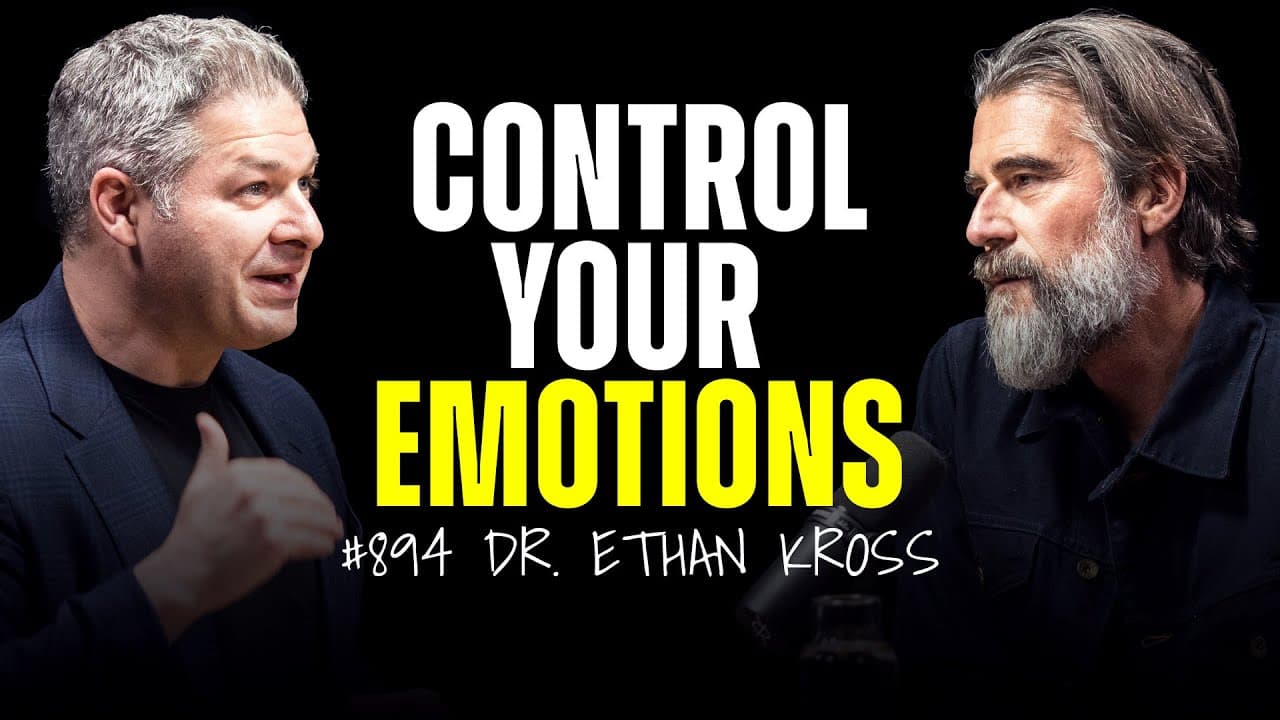
THE EMOTION DOCTOR: Control Your Difficult Feelings & STOP Negative Thoughts | Dr. Ethan Kross
TL;DR
Dr. Ethan Kross says difficult emotions can be controlled by building a personalized toolkit rather than seeking a one-size-fits-all solution. Anxiety, anger, sadness, envy, and guilt can be useful in the right proportions, while unchecked inner chatter can magnify distress and drive poor decisions. Read on for practical ways to use mindfulness, mental time travel, perspective shifts, rituals, and helping others to regulate emotions.
Transcript
so many people are hungry for the solution to what to do when our emotions are getting the best of us there's a functionality to anxiety to anger to sadness to Envy to guilt and they're not necessarily a bad thing when I get the butterflies before a big presentation game on I don't know about you but I definitely plead guilt... Read More
Key Insights
- Negative emotions like anxiety and anger can be functional if triggered in the right proportions, helping focus and prepare for challenges.
- The inner monologue often becomes toxic when it turns into chatter, undermining goals and well-being.
- Mindfulness and meditation are valuable tools but should be part of a broader toolkit for emotional regulation.
- Mental time travel, both to the future and the past, can help reframe current emotional distress and provide perspective.
- Helping others can be an effective way to improve one's own emotional state, highlighting the reciprocal benefits of altruism.
- The inner voice serves multiple critical functions, including memory, planning, motivation, and self-narrative construction.
- Cultural and societal influences play a significant role in how emotions are processed and managed.
- Emotional resilience requires a combination of strategies tailored to individual needs, rather than a one-size-fits-all solution.
Install to Summarize YouTube Videos and Get Transcripts
Explore YouTube Video Summarizer or Get YouTube Transcript Extractor
Questions & Answers
Q: How can you control difficult feelings and stop negative thoughts?
Dr. Ethan Kross recommends using a diverse toolkit because no single strategy works for every person or situation. Options include mindfulness, mental time travel, perspective shifts, rituals, and helping others, with the goal of preventing emotions and inner chatter from controlling behavior.
Q: Why can negative emotions be useful?
Anxiety, anger, sadness, envy, and guilt can be functional when they arise in the right proportions. For example, anxiety before an important presentation can focus attention on the need to prepare.
Q: When does anxiety become counterproductive?
Anxiety becomes counterproductive when it expands beyond its useful signal into repeated worst-case scenarios such as “what if this” and “what if that.” Instead of prompting preparation, the response grows and begins to work against the person.
Q: What role does the inner voice play in emotional regulation?
The inner voice supports memory, planning, motivation, and the construction of a personal narrative. It becomes harmful when negative self-talk is treated as truth despite a lack of evidence and turns into incessant chatter.
Q: How does mindfulness help regulate emotions?
Mindfulness can help people notice their thoughts and emotions rather than reacting automatically to them. Kross presents it as one useful option within a broader emotional-regulation toolkit, not as a universal solution.
Q: What is mental time travel, and how can it help with emotions?
Mental time travel means looking toward the future or reflecting on the past to reconsider present distress. This shift can provide perspective and help reframe the emotional situation.
Q: How can helping others improve your emotional state?
Helping others can redirect attention away from personal concerns while creating a sense of purpose and connection. The existing discussion describes altruism as benefiting both the recipient and the person providing help.
Q: Why is a personalized emotional-regulation toolkit important?
Different tools work for different people, and even one person may need different tools in different situations. Emotional resilience therefore depends on finding a combination of strategies suited to the individual and the moment.
Summary & Key Takeaways
-
Dr. Ethan Kross discusses the functionality of negative emotions and the tools available to regulate them. He emphasizes the importance of understanding the inner voice and how it can be both a tool and a hindrance. Kross advocates for a diverse toolkit of strategies, including mindfulness, mental time travel, and perspective shifts.
-
The podcast explores the complex dynamics of emotion regulation, highlighting the historical context and current challenges. Kross shares insights into the power of rituals, cultural influences, and the need for a personalized approach to emotional well-being.
-
Rich Roll and Ethan Kross delve into the philosophical questions surrounding free will and the self, discussing the automatic versus controlled responses to emotional triggers. They stress the importance of addressing both the root causes of emotional distress and developing resilience through practical tools.
Read in Other Languages (beta)
Share This Summary 📚
Summarize YouTube Videos and Get Video Transcripts with 1-Click
Try YouTube Summary with ChatGPT & Claude or YouTube Transcript Generator
Explore More Summaries from Rich Roll 📚



Summarize YouTube Videos and Get Video Transcripts with 1-Click
Try YouTube Summary with ChatGPT & Claude or YouTube Transcript Generator