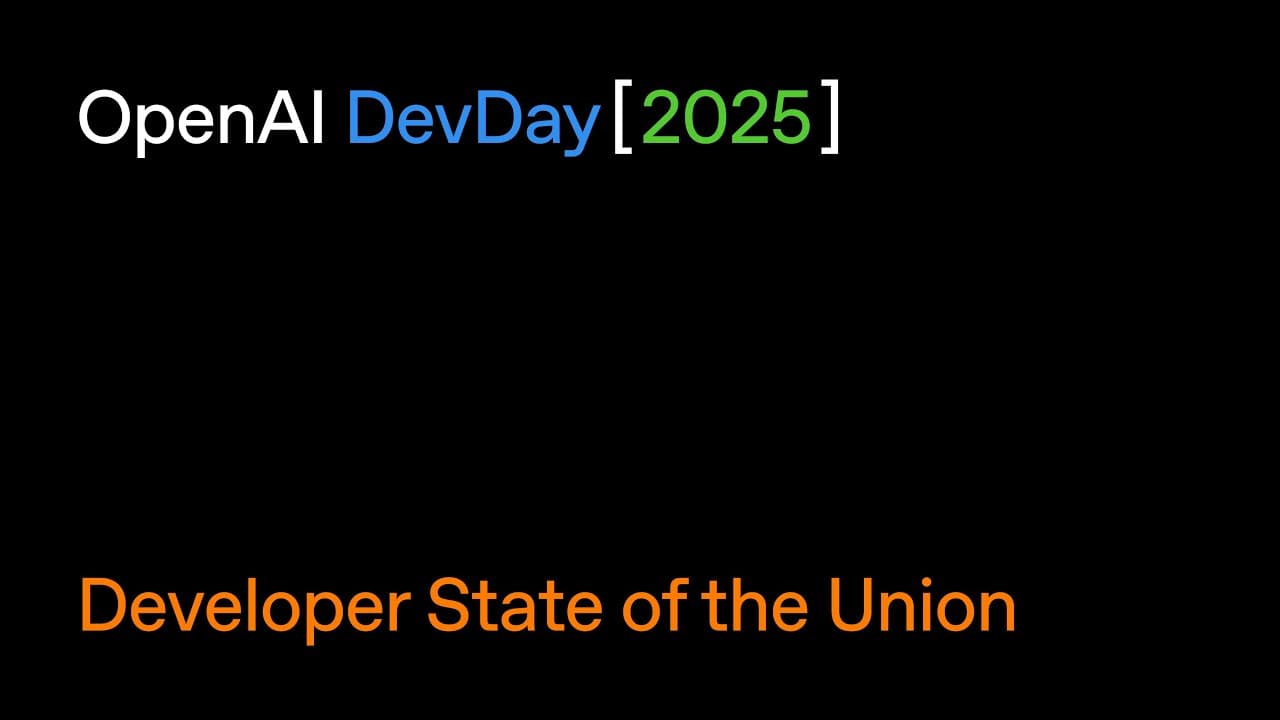
How to Build AI Apps with OpenAI APIs for Developers
TL;DR
OpenAI emphasizes a two pillar approach: reinforcement learning and unsupervised learning to create general AI that benefits everyone. The focus is on empowering developers through an API first strategy, new models like GPT5, Sora 2, and tools such as a prompt optimizer, to build, test, and scale AI applications efficiently.
Transcript
I'm Greg Brockman. I can't believe it's already dev day number three. And now developers are key to advancing OpenAI's mission. Um, but before we're going to talk about today, I want to talk a little bit about how we got to here. So 2015, we got together what became the founding team of OpenAI at an offsite in Napa for a day and we came up with thi... Read More
Key Insights
- OpenAI aims to build AGI to benefit everyone, guided by a simple, non sequential three step plan that includes reinforcement learning and unsupervised learning.
- GPT5 is designed for agentic tasks and tool use, with a focus on longer reasoning and higher precision, and is available in the API and ChatGPT.
- Sora 2 and Sora 2 Pro bring high quality video generation to API usage, with a fast experimentation model and a more detailed version for production.
- Codecs and related developer tools are highlighted as core to enabling large scale adoption and collaboration in software development.
- OpenAI advocates for an API first strategy to avoid enterprise only solutions and to keep the focus on real world applications built by developers.
- Prompt optimization and simple prompts are emphasized as key to getting the most value from GPT5, along with systematic iteration of prompts and tool calls.
- There is a focus on accessibility and cost reduction, including smaller voice and image generation models at lower prices and the availability of GPT OSS for on premise or offline use.
- OpenAI emphasizes support for a broad developer ecosystem with the goal of democratizing access to AI and enabling global participation through tools like Hackathons and open downloads.
- More videos from this channel:
- More from this channel: OpenAI
Install to Summarize YouTube Videos and Get Transcripts
Explore YouTube Video Summarizer or Get YouTube Transcript Extractor
Questions & Answers
Q: How does OpenAI plan to make AGI beneficial to everyone through developers?
OpenAI states the mission to build AGI in a way that benefits everyone and identifies developers as a key channel to realize this goal. By enabling a broad ecosystem of developers to connect AI technologies to real world applications via an API first strategy, OpenAI aims to accelerate widespread adoption, feedback loops, and practical utility across industries. This approach centers on scalable tools, communities, and partnerships that translate theoretical advances into usable software.
Q: What role do reinforcement learning and unsupervised learning play in OpenAI’s plan?
The plan outlined by Greg Brockman highlights three steps, including reinforcement learning and unsupervised learning as core pillars. Reinforcement learning demonstrates capability in complex tasks like Dota 2, showing that scaled learning can yield practical, high performance outcomes. Unsupervised learning, demonstrated by the sentiment neuron, reveals semantic structures from next step prediction, guiding the direction toward scalable, generalizable AI systems.
Q: What is GPT5 designed to do for developers and what are its use cases?
GPT5 is designed for agentic tasks and tool use, with emphasis on instruction following and long form reasoning. It can refactor large code bases, generate front end UI elements from prompts, and operate autonomously for extended periods. These capabilities make it suitable for building intelligent agents that integrate with many tools, enabling developers to automate complex workflows and integrate AI into applications.
Q: How does OpenAI propose to optimize prompts for GPT5?
OpenAI suggests keeping prompts simple and writing clear instructions, complemented by a prompt optimizer that helps users craft more effective prompts for GPT5. The recommended practice is to iterate systematically, editing one variable at a time in prompts or tool calls, to gradually improve performance and reliability in real world tasks.
Q: What is Sora 2 and how is it used in application development?
Sora 2 is a video generation model announced for API use, with a Pro variant that offers higher fidelity and detail for production work. It enables developers to generate high quality videos directly from prompts, maintain character consistency across prompts, and adjust the resulting output by reprompting, thereby supporting versatile video creation workflows within apps.
Q: What other new models and capabilities did OpenAI announce for developers?
In addition to Sora 2, OpenAI introduced smaller, lower cost models for voice and image generation and a new mini real time model for speech to speech. These models are designed to reduce costs while maintaining quality, expanding accessibility for developers building multimedia AI features and enabling broader experimentation across products.
Q: How is OpenAI addressing accessibility and open collaboration with AI models?
OpenAI supports accessibility through initiatives like GPT OSS, an open model offering for on premise or offline use, and has reported strong community engagement including large download numbers and a global hackathon. By enabling open access and local deployment options, OpenAI seeks to empower developers to build responsibly in diverse environments while accelerating innovation.
Q: What is the overall developer experience vision for the OpenAI platform?
The developer experience is being rewritten with AI through models, coding acceleration, agents, and scalable deployment in ChatGPT. The aim is to ship capable models like GPT5, provide tools for faster coding and automation, and help developers scale applications to hundreds of millions of users, creating a more efficient, productive ecosystem for AI powered software.
Summary & Key Takeaways
-
OpenAI’s mission is to build AGI that benefits everyone and to enable developers to connect powerful AI to real world applications.
-
The company has integrated reinforcement learning and unsupervised learning to create a flywheel that accelerates progress and productization.
-
New models and tools are introduced to support developers in coding, agents, and scalable deployments across users and platforms.
Read in Other Languages (beta)
Share This Summary 📚
Summarize YouTube Videos and Get Video Transcripts with 1-Click
Try YouTube Summary with ChatGPT & Claude or YouTube Transcript Generator
Explore More Summaries from OpenAI 📚

Summarize YouTube Videos and Get Video Transcripts with 1-Click
Try YouTube Summary with ChatGPT & Claude or YouTube Transcript Generator