How to Master Python Dunder Methods for Objects
TL;DR
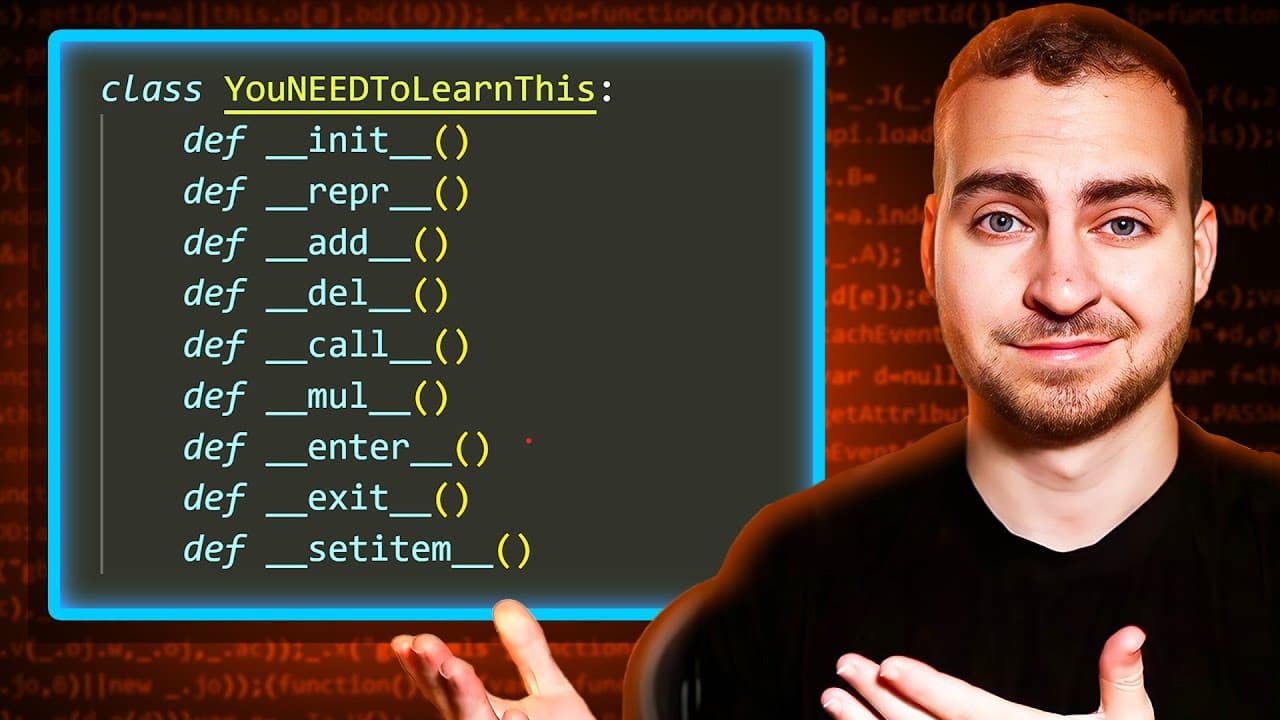
Dunder methods are special Python methods that map to object behavior. Implementing these methods lets you customize operations like adding objects, printing them, or comparing them. By defining these methods in your own classes, you enable intuitive, Pythonic interactions with custom objects.
Transcript
Today, I'm going to show you one of the coolest features that Python has. And I guarantee that after you watch this video, you're going to look at Python code completely differently. So let's get into it. And talk about dunder or magic methods. Now Dunder stands for Double Underscore and they look something like this. Double underscore init. And th... Read More
Key Insights
- Dunder methods are the built in double underscore methods that map to specific behavior in Python objects.
- The init method defines what happens when a new instance of a class is created and initialized.
- Python considers every value as an object, and its behavior is defined by its class through dunder methods.
- The add method controls the behavior of the plus operator for custom objects.
- The str method determines how an object is converted to a human readable string for printing.
- The len method maps to the behavior of the len() function for a given object.
- You can implement custom str to control how objects are displayed when printed.
- Other dunder methods extend to indexing, context managers, and iterators, enabling rich object interactions.
- More videos from this channel:
- More from this channel: Tech With Tim
Install to Summarize YouTube Videos and Get Transcripts
Explore YouTube Video Summarizer or Get YouTube Transcript Extractor
Questions & Answers
Q: What are Python dunder methods and why do they matter?
Python dunder methods, or magic methods, are special functions with double underscores that define how objects behave for built in operations. They matter because they let you customize object creation, printing, arithmetic, and other core interactions. By implementing these methods in your own classes, you can make custom objects work intuitively with Python syntax, improving code readability and functionality.
Q: What does init do in a Python class?
The init method is called when a new instance of a class is created. It initializes the object's state by setting up initial values and performing any setup tasks. This method defines what values the object starts with and how those values are stored, ensuring the object is ready for use immediately after creation.
Q: How can you make a custom object printable with meaningful output?
To make a custom object printable with meaningful output, implement the str method. This method should return a human readable string that represents the object, often including key attributes. When you print the object or convert it to a string, Python will call str to determine how to display it.
Q: What is the role of add in a class?
The add method defines how two objects of the class should be combined when the + operator is used. It receives the left operand as self and the right operand as other, and should return a new object or a value representing the result. This enables natural arithmetic like adding two custom objects.
Q: Why would you want to use len with a custom class?
Using len allows your custom class to respond to the len() function. This is useful for exposing a meaningful size or count relevant to the object's state. Implementing len helps integrate the object with Python’s standard library and makes code that uses len() more expressive and consistent.
Q: Can you customize how objects participate in indexing with getitem or setitem?
Yes, you can customize indexing by implementing getitem to retrieve items and setitem to assign values for a given key or index. This makes your objects behave like sequences or mappings, allowing familiar syntax such as obj[key] or obj[key] = value and enabling advanced data access patterns.
Q: What other areas do dunder methods cover beyond printing and arithmetic?
Beyond printing and arithmetic, dunder methods cover areas like comparison, indexing, context management, and iteration. For example, eq and lt handle comparisons, enter and exit enable context managers, and iter allows objects to be used in for loops. Implementing these methods broadens how your objects can be used in Pythonic code.
Q: How can you progressively learn about Python magic methods according to the video?
The video suggests exploring a variety of magic methods progressively, starting from init and str, and then moving to arithmetic and comparison, indexing, context managers, and iterators. By implementing and testing each method in small examples, you gain hands on understanding of how Python maps operators and built in functions to underlying object behavior.
Summary & Key Takeaways
-
This video introduces double underscore methods, called dunder or magic methods, and explains they govern how Python objects behave in different operations. It emphasizes that every Python object has a class behind it, which defines its behavior via these methods. The presenter demonstrates basic examples like init, str, and add to show how customization works.
-
The tutorial walks through creating a custom class with init, str, and add methods, showing how Python calls these under the hood during object creation, printing, and arithmetic. It also ties the concept to the broader idea that Python operations are implemented by special methods on classes.
-
The session then connects dunder methods to common tasks such as string representation and arithmetic, and teases additional topics like indexing, context managers, and iterators to illustrate the breadth of magic methods available to Python developers.
Read in Other Languages (beta)
Share This Summary 📚
Summarize YouTube Videos and Get Video Transcripts with 1-Click
Try YouTube Summary with ChatGPT & Claude or YouTube Transcript Generator
Explore More Summaries from Tech With Tim 📚




Summarize YouTube Videos and Get Video Transcripts with 1-Click
Try YouTube Summary with ChatGPT & Claude or YouTube Transcript Generator