How AlphaGo Revolutionized AI: Insights and Impact

TL;DR
AlphaGo's victory over a human Go champion in 2016 marked a pivotal moment in AI development, showcasing the potential of AI to surpass human intuition and calculation in complex tasks. This breakthrough laid the foundation for advancements in AI applications across various fields, from protein folding to algorithm discovery, highlighting the ongoing challenge of distinguishing genuine AI insights from hallucinations.
Transcript
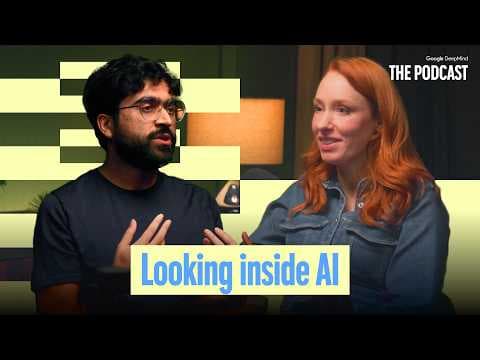
Welcome back to Google Deep Mind the podcast. I'm Professor Hannah Fry. Picture this scene. It's March 2016. Inside a hotel suite in Soul, South Korea, two players are playing the ancient game of Go. A game of unimaginable complexity, long thought impossible for a machine to master. On one side is Lisa Doll, a legendary 18time Go world champion. on... Read More
Key Insights
- AlphaGo's victory demonstrated AI's ability to surpass human intuition in complex tasks.
- The game of Go was chosen for its complexity, exceeding that of chess by orders of magnitude.
- AlphaGo combined fast and slow thinking processes, akin to human intuition and calculation.
- Move 37 in the AlphaGo match was a pivotal moment, showcasing AI's potential for novel insights.
- AlphaGo's success inspired further AI applications in science, such as protein folding.
- AlphaZero improved upon AlphaGo by learning without human data, highlighting AI's potential beyond human knowledge.
- Search algorithms, integral to AlphaGo, are now being used to tackle scientific challenges.
- The challenge remains to distinguish genuine AI insights from hallucinations, especially in scientific domains.
Install to Summarize YouTube Videos and Get Transcripts
Explore YouTube Video Summarizer or Get YouTube Transcript Extractor
Questions & Answers
Q: How did AlphaGo surpass human intuition in the game of Go?
AlphaGo surpassed human intuition by combining fast and slow thinking processes, similar to human intuition and calculation. It utilized deep learning to evaluate board positions and potential moves, enabling it to make strategic decisions that often exceeded human players' capabilities. This approach allowed AlphaGo to explore the vast search space of Go effectively, leading to novel insights like the famous Move 37.
Q: Why was the game of Go chosen as a challenge for AI?
Go was chosen due to its complexity, which surpasses that of chess by orders of magnitude. The game's simple rules lead to intricate gameplay, making it a perfect challenge for AI. Unlike chess, Go's search space is vast, requiring advanced techniques to navigate. Successfully mastering Go demonstrated AI's potential to handle complex, strategic tasks that were previously thought to be beyond its reach.
Q: What was significant about Move 37 in the AlphaGo match?
Move 37 was significant because it was an unexpected and counterintuitive move that no human player would likely choose. It demonstrated AlphaGo's ability to provide novel insights and expand human understanding of the game. This move exemplified AI's potential to discover new strategies and approaches, challenging traditional human expertise and prompting further exploration in AI applications.
Q: How did AlphaZero differ from AlphaGo in its approach?
AlphaZero differed from AlphaGo by eliminating reliance on human game data. It started with only the rules of the game and learned by playing against itself, eventually surpassing human knowledge. This approach allowed AlphaZero to discover new strategies and insights beyond human understanding, highlighting AI's potential to explore and innovate without being constrained by existing human knowledge.
Q: What impact did AlphaGo's success have on AI applications in science?
AlphaGo's success inspired AI applications in science by demonstrating AI's ability to tackle complex problems. It influenced areas like protein folding, where AI has been used to predict protein structures, and algorithm discovery, where AI searches for optimal solutions in vast search spaces. AlphaGo's techniques have been adapted to scientific challenges, showcasing AI's potential to contribute to breakthroughs in various fields.
Q: How are search algorithms used in scientific applications today?
Search algorithms, integral to AlphaGo's success, are now used in scientific applications to navigate complex search spaces. For example, in protein folding, AI searches for the most stable protein structures. In algorithm discovery, AI explores possible solutions to find optimal algorithms for tasks like matrix multiplication. These applications demonstrate AI's ability to efficiently handle complex problems and contribute to scientific advancements.
Q: What challenges remain in distinguishing AI insights from hallucinations?
Distinguishing AI insights from hallucinations remains challenging, particularly in open scientific domains where verification is difficult. Ensuring AI-generated insights are genuine requires robust evaluation and verification mechanisms. In verifiable domains like coding, AI outputs can be tested against defined criteria. However, in scientific research, physical experiments may be needed to validate AI-generated hypotheses, highlighting the need for reliable verification methods.
Q: How did AlphaGo influence the perception of AI's potential?
AlphaGo influenced the perception of AI's potential by demonstrating that AI could surpass human capabilities in complex tasks. Its success in the game of Go showed that AI could provide novel insights and expand human knowledge, challenging the notion that AI was limited to mimicking human behavior. This shift in perception has driven further exploration of AI's applications in various fields, emphasizing its potential to contribute to significant advancements.
Summary & Key Takeaways
-
AlphaGo's success in 2016 against a human Go champion marked a turning point for AI, demonstrating its capacity to exceed human intuition and calculation. This event catalyzed advancements in AI applications beyond games, influencing fields like protein folding and algorithm discovery, and raising questions about distinguishing genuine insights from hallucinations.
-
The game of Go's complexity made it a prime challenge for AI, with AlphaGo utilizing a blend of fast and slow thinking processes to navigate the vast search space. Move 37, a novel and unexpected move, exemplified AI's ability to provide new insights, prompting further exploration in scientific applications.
-
AlphaZero's development, which eliminated reliance on human data, underscored AI's potential to discover knowledge beyond human reach. This progress has influenced AI's role in scientific research, yet challenges remain in ensuring AI-generated insights are genuine and not mere hallucinations.
Read in Other Languages (beta)
Share This Summary 📚
Summarize YouTube Videos and Get Video Transcripts with 1-Click
Try YouTube Summary with ChatGPT & Claude or YouTube Transcript Generator
Explore More Summaries from Google DeepMind 📚


Summarize YouTube Videos and Get Video Transcripts with 1-Click
Try YouTube Summary with ChatGPT & Claude or YouTube Transcript Generator