How to Build an AI-Era Marketing Strategy
TL;DR
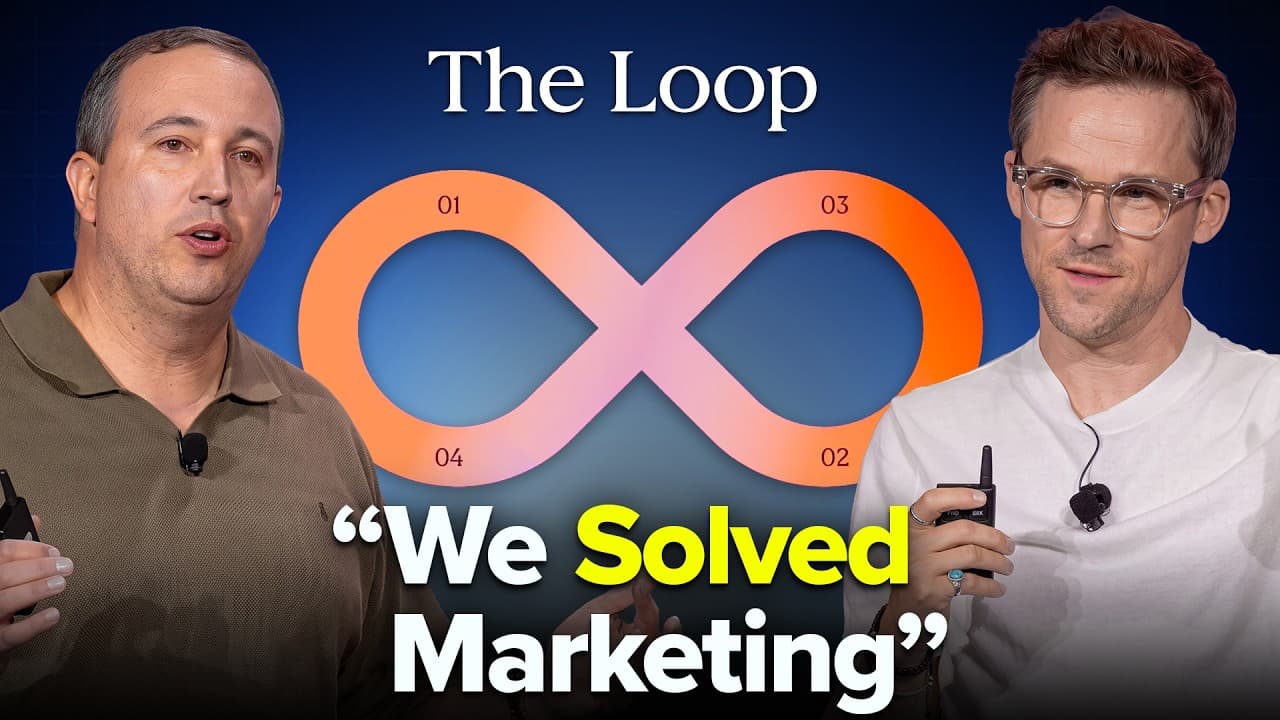
Prioritize the value of website visits over raw traffic volume, then use AI to personalize content and improve conversion. HubSpot’s four-stage Loop framework combines expressing brand taste, tailoring content, amplifying it across modern buying channels, and evolving campaigns through rapid learning, allowing each cycle to become more effective while avoiding generic AI output.
Transcript
AI has been out there and it's been killing everybody's marketing strategy. I know it happened to me firsthand at HubSpot. We lost 140 million visits in one year. That was super painful and it forced us to rethink how we did everything in our marketing. We found that to be so transformative and so important that we spent hundreds of hours of our ow... Read More
Key Insights
- HubSpot lost 140 million visits in one year, representing an 80% traffic decline, while increasing leads and demand generation by 20%. This outcome showed that the commercial value of retained and newly gained traffic mattered more than the volume of visits that disappeared.
- The traditional relationship between website traffic and customer growth is broken because buyers increasingly conduct research through tools such as ChatGPT and Claude. They no longer need to read numerous company blog posts, download an ebook, or spend extensive time on a company’s website before progressing toward a purchase.
- The AI-era marketing funnel has expanded at the awareness stage because creators, AI search, and new platforms have multiplied discovery channels. These platforms also try to retain users, making referral traffic harder to obtain even as AI improves personalization, relevant messaging, audience identification, and conversion rates.
- The Loop framework consists of Express, Tailor, Amplify, and Evolve. Marketers express their judgment through AI, tailor content for audiences and channels, amplify messages where buyers spend time, and evolve their approach by applying real-time lessons to the next campaign or tactic.
- AI-generated marketing tends toward a sea of sameness because marketers have access to many of the same tools, prompts, and models. The central challenge is no longer producing content, since AI can generate abundant material, but exercising judgment about what deserves to be created and presented to customers.
- Taste is the ability to anticipate what will resonate with customers before the market confirms it. The presentation uses Red Bull, Liquid Death, the Hathaway shirt advertisement, and Jaguar as examples to contrast distinctive customer-focused judgment with marketing that fails to connect with the intended buyer.
- AI does not possess a brand’s taste and tends to produce an average of patterns found in its training material, where competitors also operate. Marketers should therefore instill their own taste in AI through explicit context rather than allowing the technology to determine their identity and creative decisions.
- A taste profile is a living artifact that combines customer taste with brand taste. It records the customer’s language and trust signals, the brand’s product and origin stories, and the reasons content earns attention, then updates as marketers learn and guides every new AI-generated asset.
- More videos from this channel:
- More from this channel: Marketing Against the Grain
Install to Summarize YouTube Videos and Get Transcripts
Explore YouTube Video Summarizer or Get YouTube Transcript Extractor
Questions & Answers
Q: How can marketers adapt their strategy for the AI era?
Marketers can adapt by replacing a traffic-volume mindset with a focus on visit quality, personalization, and conversion. The Loop framework organizes this work into four stages: Express the brand’s taste and judgment, Tailor content to specific audiences and channels, Amplify messages across the places buyers use, and Evolve each campaign by applying lessons gathered in real time.
Q: Why does website traffic volume matter less than before?
Website traffic volume matters less because buyers increasingly research products through ChatGPT, Claude, creators, AI search, and other platforms instead of following a linear journey through company websites. HubSpot reported losing 140 million visits, an 80% decline, while increasing demand generation by 20%, indicating that valuable traffic can contribute more than a larger pool of low-value visits.
Q: What is the Loop marketing framework?
The Loop is a four-stage marketing playbook designed for changed buying behavior in the AI era. Express captures the marketer’s taste and judgment, Tailor adapts content to audiences and their preferred channels, Amplify distributes the message across modern buying channels, and Evolve feeds real-time lessons into the next cycle so campaigns and tactics improve through repetition.
Q: How is the AI-era funnel different from the old funnel?
The old funnel was linear: marketers attracted more visits and converted some of them into customers. The AI-era funnel is shaped more like an hourglass. Awareness is widely scattered across creators, AI search, and emerging platforms, but those platforms make referral visits harder to obtain. AI then helps marketers personalize content and messages, making improved conversion rates more attainable.
Q: Why does AI-generated marketing often sound generic?
AI-generated marketing often sounds generic because many organizations use the same tools, prompts, and models, while AI produces output based on patterns in its training material. That output may be acceptable, but it tends toward the average where competitors also operate. Distinctive marketing requires humans to choose what should be made and provide AI with clearly defined brand judgment.
Q: What does taste mean in AI-assisted marketing?
Taste means understanding what will resonate with customers before the response becomes obvious. It guides choices about positioning, stories, presentation, and the reasons someone will stop scrolling and spend time with a brand. The presentation argues that production is no longer the hardest constraint because AI can create abundant material, making human judgment about what to create more valuable.
Q: How do you build a useful AI taste profile?
Build a taste profile by documenting both customer taste and brand taste. Customer context includes who the audience is, how its members speak, and what earns their trust. Brand context includes product stories, brand stories, the reason the company is relevant, and the reason it matters now. The profile should also capture what makes customers stop and pay attention.
Q: How should a taste profile be used and updated?
A taste profile should be treated as a living artifact rather than a style guide or positioning document stored in an unread folder. AI should read it before generating each marketing asset so the output reflects the brand and its customers. Marketers should update the profile whenever campaigns reveal new information about customer language, trust, attention, preferences, or resonance.
Summary & Key Takeaways
-
HubSpot lost 140 million visits in one year after AI changed how buyers discover and evaluate products, yet its demand generation increased by 20%. The result challenged the traditional assumption that more website visits automatically produce more customers and highlighted the greater importance of attracting valuable, relevant traffic that converts.
-
The AI-era funnel resembles an hourglass rather than a linear funnel. Awareness is dispersed across creators, AI search, and new platforms that often keep users within their own environments. Website visits are therefore harder to acquire, while AI makes personalization, audience targeting, tailored messaging, and conversion-rate improvement easier for marketers.
-
The Loop framework contains four connected stages: Express, Tailor, Amplify, and Evolve. Express defines the brand’s taste and judgment, Tailor adapts marketing to audiences and channels, Amplify distributes messages across modern buying channels, and Evolve applies real-time lessons so successive campaigns and tactics become progressively smarter and more effective.
Read in Other Languages (beta)
Share This Summary 📚
Summarize YouTube Videos and Get Video Transcripts with 1-Click
Try YouTube Summary with ChatGPT & Claude or YouTube Transcript Generator
Explore More Summaries from Marketing Against the Grain 📚



Summarize YouTube Videos and Get Video Transcripts with 1-Click
Try YouTube Summary with ChatGPT & Claude or YouTube Transcript Generator