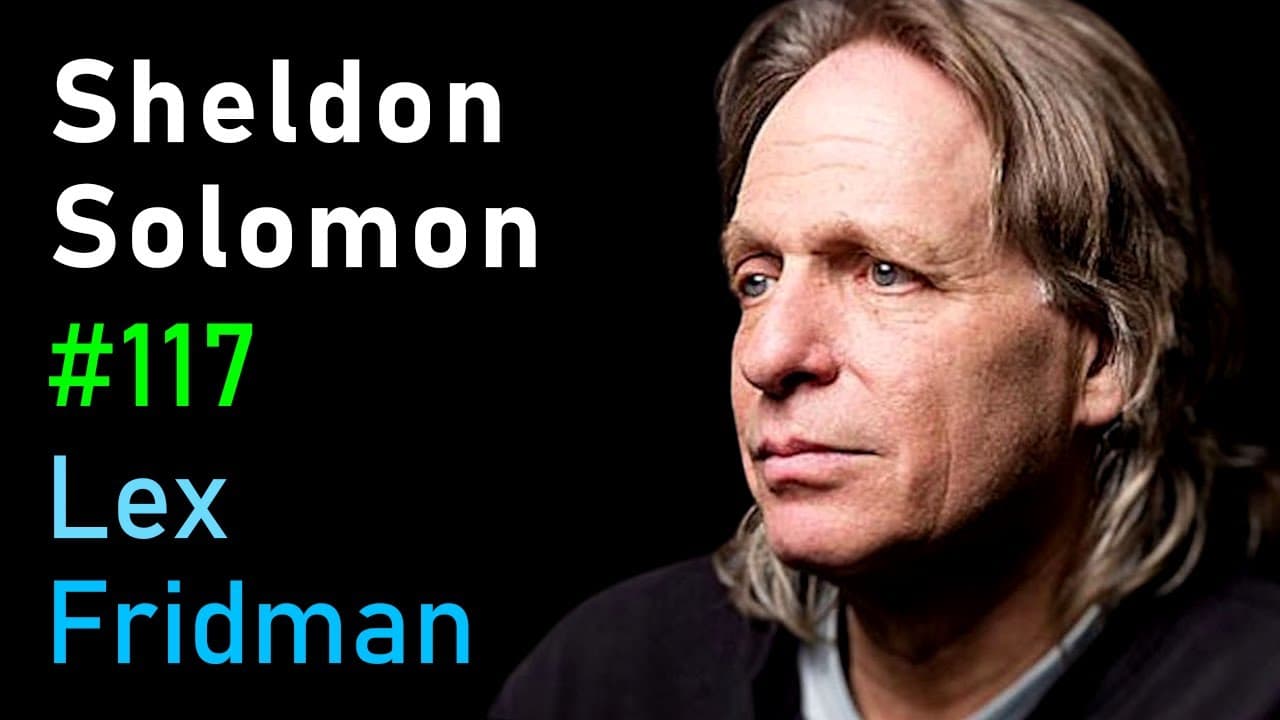
Sheldon Solomon: Death and Meaning | Lex Fridman Podcast #117
TL;DR
Our awareness of mortality significantly shapes human behavior and motivations, often driving our actions and creations. Sheldon Solomon discusses how the fear of death influences civilization and encourages deeper self-reflection on our existence.
Transcript
the following is a conversation with sheldon solomon a social psychologist a philosopher co-developer of terror management theory and co-author of the warm at the core on the role of death and life he further carried the ideas of ernest becker that can crudely summarize as the idea that our fear of death is at the core of the human condition and th... Read More
Key Insights
- ❓ Death awareness is a fundamental aspect of the human experience and influences our motivations and behaviors.
- 😨 Ernest Becker's ideas on the fear of death provide insights into the human condition and the creation of civilizations.
- 🤔 Thinking deeply about death and the human condition can lead to personal self-reflection and growth.
- 🎙️ More videos with Sheldon Solomon:
Install to Summarize YouTube Videos and Get Transcripts
Explore YouTube Video Summarizer or Get YouTube Transcript Extractor
Questions & Answers
Q: What is the role of death and fear of death in human existence?
According to Sheldon Solomon, death awareness is the primary motivational impetus for almost everything people do, driving them to create and shape civilizations.
Q: How did Ernest Becker approach the topic of death?
Ernest Becker argued that the fear of death is at the core of our consciousness and influences how we see the world and what drives us. He emphasized the inevitability of death and its impact on our lives.
Q: How does death awareness lead to self-reflection?
The awareness of our mortality leads to deep personal self-reflection about the meaning and purpose of life. This reflection can be dangerous for the mind, as Nietzsche warned, but it also allows for profound insights and personal growth.
Q: Why is it important to think deeply about the human condition and mortality?
Deep reflection on the human condition and mortality helps individuals gain a better understanding of themselves and the world around them. It allows for personal growth and a search for meaning and purpose in life.
Key Insights:
- Death awareness is a fundamental aspect of the human experience and influences our motivations and behaviors.
- Ernest Becker's ideas on the fear of death provide insights into the human condition and the creation of civilizations.
- Thinking deeply about death and the human condition can lead to personal self-reflection and growth.
- The awareness of mortality can drive individuals to search for meaning and purpose in life.
Summary
In this conversation with Sheldon Solomon, the role of death and the fear of death in human life is explored. Sheldon Solomon is a social psychologist, philosopher, and co-developer of terror management theory. He discusses his view that our fear of death is at the core of the human condition and drives most of the creations of human civilization. The conversation also touches on topics such as the impact of Ernest Becker's book "Denial of Death", deep self-reflection on the topic of death, and the relationship between psychology and philosophy.
Questions & Answers
Q: What is the role of death and fear of death in human life?
From Sheldon Solomon's perspective, the awareness of death and our unwillingness to accept it is the primary motivational impetus for almost everything people do. Our fear of death often influences our behaviors and drives the creations of human civilization, even if we are not consciously aware of it.
Q: How does Sheldon Solomon view death as a core aspect of human consciousness?
Sheldon Solomon explains that death is at the core of our being because it is a fundamental part of our existence. He refers to ancient Greek philosopher Aristotle, who defined soul as the essence of a natural body that is alive. Ta concept of soul, according to Aristotle, is not a separate entity, but inseparably connected to the body. Our awareness of death and its inevitability shapes our understanding of ourselves and the world we live in.
Q: What is the significance of Ernest Becker's book "Denial of Death" in Sheldon Solomon's thinking?
Ernest Becker's book "Denial of Death" had a big impact on Sheldon Solomon's thinking about human cognition and consciousness. It introduced him to ideas about the human condition and the role of our fear of death. The book explores how our psychological defenses and denial mechanisms help us cope with the existential anxiety caused by our awareness of mortality.
Q: Why is deep self-reflection on the topic of death important?
According to Sheldon Solomon, deep self-reflection on the topic of death is important because it allows us to gain a deeper understanding of ourselves and our motivations. Not many people think deeply and rigorously about death, but Nietzsche suggested that such self-reflection is a gateway to profound personal insights. However, this kind of self-reflection can also be mentally challenging and dangerous, as it forces us to confront our own mortality and existential fears.
Q: What is the danger of engaging in first principles thinking about the human condition?
Engaging in first principles thinking about the human condition, as Nietzsche described, can be dangerous for the mind. It involves questioning the fundamental aspects of our existence and can lead to existential crises. It challenges our preconceived notions and belief systems, potentially shaking the foundation of our identity. However, this kind of thinking can also lead to personal growth and deeper insights into the human experience.
Q: How does Sheldon Solomon's interest in World War II and historical moments relate to his exploration of the human condition?
Sheldon Solomon finds that moments in history, such as World War II and the actions of leaders like Stalin and Hitler, hold fundamental truths to be discovered. He believes that these moments of suffering and triumph can shed light on the human condition and the extremes to which humans are capable of going. By studying history, he seeks to understand the motivations behind these events and the impact they have on human civilization.
Q: What is the connection between Sheldon Solomon's work and the political lens?
Sheldon Solomon clarifies that when he brings up figures like Donald Trump or Vladimir Putin in his conversations, it is not through a political lens. He sees himself as neither left nor right politically and believes in thinking deeply for himself and questioning everything. He encourages empathetic and rigorous thinking, arguing that progress toward truth can only be achieved through open-minded conversation and understanding different perspectives.
Q: How does Sheldon Solomon view psychology and philosophy in relation to the understanding of the human mind?
Sheldon Solomon considers psychology and philosophy as complementary disciplines that can shed light on the human mind. He values both empirical evidence and theoretical insights, recognizing that theories are hypothesis-generating devices. He acknowledges that while we have made progress in understanding the human mind, there is still much to learn, and it is important to maintain a humble and open-minded stance.
Q: What is the significance of the dialectical compatibility between evolutionary psychology and existential psychodynamics?
Sheldon Solomon sees the dialectical compatibility between evolutionary psychology and existential psychodynamics as potent and powerful. While some may dismiss these perspectives as disparate or incompatible, he believes they can actually complement each other in understanding the human experience. Evolutionary psychology explores how humans have adapted over time, while existential psychodynamics focuses on human development within a single lifespan. Together, they provide a more comprehensive understanding of human behavior and motivations.
Q: How speculative is psychology, and how confident should we be in understanding the human mind?
Sheldon Solomon believes that psychology has made significant progress in understanding the human mind but acknowledges that there is still much to learn. He argues that it is important to strike a balance between acknowledging what we know and recognizing the limitations of our knowledge. He warns against mistaking statistical precision for knowledge and emphasizes the importance of theoretical assertions and hypothesis testing in advancing scientific understanding.
Q: What are some interesting disagreements between Sheldon Solomon and Jordan Peterson?
The conversation touches on disagreements between Sheldon Solomon and Jordan Peterson. One disagreement revolves around the emphasis on the judeo-christian tradition and the role of religious meanings in finding purpose in life. Another disagreement lies in their political and economic perspectives. Sheldon Solomon criticizes conservative political philosophy that is based on assumptions about human nature that he believes are false. He also disagrees with the glorification of the unbridled pursuit of wealth and the justification for radical inequality.
Takeaways
The conversation explores the role of death and the fear of death in human life, as well as the interconnectedness of psychology, philosophy, and the understanding of the human mind. It highlights the importance of deep self-reflection and the potential dangers of engaging in first principles thinking about the human condition. It also addresses disagreements between Sheldon Solomon and Jordan Peterson on topics such as the emphasis on religious meanings and political/economic perspectives. Overall, the conversation encourages open-mindedness, empathy, and rigorous thinking to gain a deeper understanding of ourselves and the world around us.
Summary & Key Takeaways
-
Death awareness is a fundamental aspect of the human experience and shapes our motivations and behaviors, whether we are aware of it or not.
-
Sheldon Solomon, a social psychologist and philosopher, expands on Ernest Becker's ideas about the fear of death defining the human condition.
-
Many people do not deeply and rigorously think about death and its implications for their lives.
-
Nietzsche's warning about gazing into the abyss applies to contemplating the human condition and our mortality.
Read in Other Languages (beta)
Share This Summary 📚
Summarize YouTube Videos and Get Video Transcripts with 1-Click
Try YouTube Summary with ChatGPT & Claude or YouTube Transcript Generator
Explore More Summaries from Lex Fridman Podcast 📚





Summarize YouTube Videos and Get Video Transcripts with 1-Click
Try YouTube Summary with ChatGPT & Claude or YouTube Transcript Generator