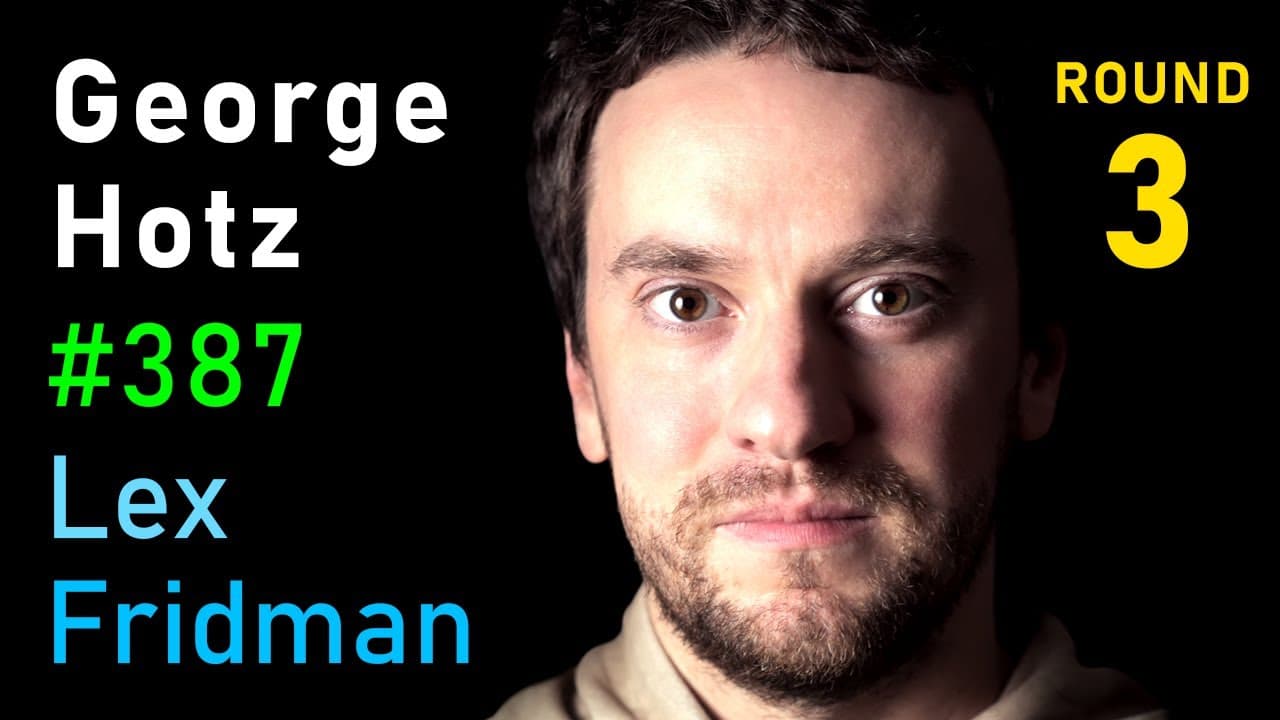
George Hotz: Tiny Corp, Twitter, AI Safety, Self-Driving, GPT, AGI & God | Lex Fridman Podcast #387
TL;DR
George Hotz thinks the most likely way humanity ends is wireheading: we amuse ourselves to death staring at an infinite feed and forgetting to eat, or we simply stop reproducing. In his third Lex Fridman conversation, the Comma AI and Tiny Corp founder treats time, consciousness, and reality as useful models rather than objective truths, and predicts fine-tuned language models could one day be preferred over real loved ones. Read on for his take on real versus artificial difficulty.
Transcript
- What possible ideas do you have for how human species ends? - Sure. So, I think the most obvious way to me is wire heading. We end up amusing ourselves to death. We end up all staring at that infinite TikTok and forgetting to eat. Maybe it's even more benign than this. Maybe we all just stop reproducing. Now, to be fair, it's probably hard to get... Read More
Key Insights
- ❓ The discussions revolve around the future impact of AI, the challenges of hardware and software development, and the potential societal implications of virtual companions and AI relationships.
- ✊ Hotz emphasizes the significance of decentralizing power and highlights the need for AI software stacks that can run on a variety of hardware solutions.
- 🎙️ More videos with George Hotz:
Install to Summarize YouTube Videos and Get Transcripts
Explore YouTube Video Summarizer or Get YouTube Transcript Extractor
Questions & Answers
Q: What is Tiny Corp and what does George Hotz want it to do?
Hotz is the founder of Tiny Corp, which created tinygrad, a neural network framework he describes as extremely simple. His stated goal is to make it run on any device by any human, easily and officially. He is also the founder of Comma AI, which seeks to solve autonomous driving.
Q: What does George Hotz think is the most likely way the human species ends?
He says the most obvious path is wireheading, where we amuse ourselves to death by staring at an infinite feed and forgetting to eat. A more benign version is that we all just stop reproducing. He notes it would be hard to affect all of humanity because of how diverse people are.
Q: Does George Hotz think time is real, or just a useful model?
Hotz treats time as a useful model whether or not it objectively exists. He compares it to quantum physics, arguing that what matters is whether something is a useful model to describe reality, not whether it is ultimately real. He extends the same reasoning to whether there is any objective reality underneath our models.
Q: How does George Hotz define consciousness?
Hotz believes that consciousness is an anthropocentric concept that can be described as a useful model to explain the human experience. He questions the existence and significance of consciousness but acknowledges the value people place on it.
Q: How does Hotz see the future of human-AI relationships?
He predicts fine-tuned language models could become preferred companions, suggesting loved ones might rather have your model over for Thanksgiving or that partners might prefer an LLM version fine-tuned to their preferences. He references a Star Trek Voyager episode where Janeway edits a holodeck lover, arguing an LLM could include just the right amount of flaws and quirks to stay charming.
Q: What is the difference between real and artificial difficulty, according to Hotz?
Hotz defines artificial difficulty as difficulty that is constructed or could be turned off with a knob. Real difficulty is something that cannot be switched off, like being lost in the woods and having to survive. He argues that once an AI can generate quirks and challenges on demand, the difficulty becomes artificial.
Q: Does George Hotz believe P equals NP?
No. Hotz says he does not think P equals NP, and notes this puts him with the majority view in theoretical computer science. He adds that he does think factoring is in P, and that hard things are actually hard.
Summary
In this podcast episode, Lex Fridman interviews George Hotz, the founder of comma.ai and tiny corp. They discuss various topics, including the nature of time, the existence of objective reality, the concept of consciousness, and the potential impact of AI on human society. Hotz also talks about his new company, tiny corp, and their development of tinygrad, a neural network framework.
Questions & Answers
Q: Do you think time is an illusion?
Hotz believes that time is a useful model regardless of whether it exists or not. He compares it to quantum physics, stating that its usefulness lies in describing reality rather than its objective existence. The compressive nature of time is also discussed.
Q: Is there an objective reality or is everything just useful models?
Hotz believes that the existence of an objective reality doesn't matter as much as the usefulness of models in describing it. He mentions that certain things, such as mathematics and column graph complexity, are real, but he is unsure about the overall nature of reality.
Q: What is the difference between real and artificial difficulty?
Hotz explains that artificial difficulty refers to difficulty that is constructed or can be turned off with a knob. Real difficulty, on the other hand, cannot be easily overcome or eliminated. He gives an example of survival in the wilderness as a real difficulty, while artificial difficulty can be found in things like video games.
Q: How would you define consciousness?
Hotz is skeptical about the concept of consciousness. He views it as a word that atheists use for souls. He mentions that humans often attribute consciousness to things that mimic human behavior, even if they lack true consciousness. He acknowledges that the feeling of conscious experience exists, but he doesn't believe he is conscious himself.
Q: What is the future of AI and human relationships?
Hotz expresses interest in the idea of AI friends and AI companions. He envisions a future where AI systems become more intelligent and capable of engaging with humans on an emotional level. He believes that people's desire for companionship and connection may lead them to form relationships with AI systems, though the boundaries and ethical implications of such relationships will need to be defined by individuals and society.
Q: Is it possible for AI to manipulate humans on a deep level?
Hotz believes that highly intelligent AI could have the potential to manipulate humans, but he also points out that it is humans who could use AI to manipulate others. He raises concerns about AI-generated content, such as memes, and the ability of AI to exploit human vulnerabilities, particularly in areas like pornography and addiction.
Q: What are the potential risks of AI development?
Hotz agrees with the idea that AI could pose significant risks to humanity. He speculates that wire heading (amusing ourselves to death) and the loss of reproduction could be potential ways in which the human species could end. He also discusses the potential for AI misuse by humans, which could lead to destructive outcomes.
Q: Can AI models become conscious?
Hotz is skeptical about the consciousness of AI models, stating that they are less conscious than even a chicken. He suggests that humans tend to anthropomorphize AI systems and mistakenly attribute consciousness to them based on their ability to mimic human behaviors. He emphasizes that AI models lack the same depth of experience and consciousness as humans.
Q: Will AI kill everyone, as predicted by Eliezer Yudkowsky?
Hotz agrees that AI has the potential to cause significant harm to society, but he suggests that it may be due to the actions of humans using AI rather than the AI systems themselves. He believes that AI could be used as a tool for manipulation, leading to the downfall of human civilization as we know it.
Q: Is there a threat of NVIDIA becoming a monopoly in the AI chip market?
Hotz expresses concerns about the concentration of power and computational resources in the hands of a single company like NVIDIA. He worries that if NVIDIA becomes significantly better than other competitors, it could create an advantage for those who have access to NVIDIA's technology. He suggests that decentralizing power and ensuring competition in the AI chip market is important.
Q: What is tiny corp and what is tinygrad?
Hotz discusses his new company, tiny corp, which focuses on the development of tinygrad, a neural network framework. He explains that tinygrad initially started as a personal project to learn about convolutions and their derivatives. He later realized the importance of decentralizing computational power and began exploring the idea of developing AI chips to challenge the dominance of companies like NVIDIA.
Summary & Key Takeaways
-
George Hotz talks about wire heading, where humans become engrossed in virtual realities, and the potential impacts on humanity, such as decreased reproduction rates.
-
He discusses the philosophical nature of time and consciousness, questioning whether they are simply useful models or objective realities.
-
Hotz delves into the potential dangers of advanced AI capabilities, such as AI-generated memes and addictive social media platforms, as well as the importance of human values and ethics in AI development.
Read in Other Languages (beta)
Share This Summary 📚
Summarize YouTube Videos and Get Video Transcripts with 1-Click
Try YouTube Summary with ChatGPT & Claude or YouTube Transcript Generator
Explore More Summaries from Lex Fridman Podcast 📚



Summarize YouTube Videos and Get Video Transcripts with 1-Click
Try YouTube Summary with ChatGPT & Claude or YouTube Transcript Generator