How to Get Expert-Level Results From AI in 3 Steps
TL;DR
Ground the AI in expert sources first, then let it interview you for context, then have it write its own prompt. Uploading a proven framework and asking the AI to reconstruct the system beats generic output, because language models predict the most likely next word and default to average internet advice. Splitting planning from execution avoids plan abandonment.
Transcript
I think most of us know the feeling of asking AI for help with something and being impressed at first glance only for it to end up being completely useless. It looks right and sounds professional, but when you actually try to execute the plan, you realize it's just generic advice and systems. This happens because of a few big problems. It plays way... Read More
Key Insights
- AI output feels impressive at first glance but often collapses on execution because it plays too safe, does not know you well enough, and users struggle to find the right words for what they need.
- Large language models are prediction engines that find the most likely next word, so their defaults deliver the most widespread generic advice possible. They do everything well but nothing at an expert level by default.
- Grounding is the fix for generic output: upload expert sources such as a PDF, then ask the AI to create a guide based only on those. The results follow a proven framework instead of a random average of the internet.
- The extraction prompt should say analyze the attached document, identify the core framework, extract the step-by-step logic, specific constraints, and golden rules, then build a master guide, with the instruction do not summarize, reconstruct the system.
- When you do not know the experts for a goal, ask the AI to identify top experts, their signature frameworks, their most important books or resources, and specifically where those experts disagree with each other.
- Context extraction flips the script: instead of dumping details yourself, ask the AI to interview you one question at a time and not move on until each is answered, then compile the answers into a single structured context file.
- Context works best when supplied in the very first prompt, because a model mid-response has momentum and tries to stick to the direction it is already going, making restructuring much harder.
- A meta prompt asks the AI to prompt itself. Models are trained on the best prompting techniques, so they usually write better instructions for themselves than users do, and XML tags separate pasted data blocks from the instruction.
Install to Summarize YouTube Videos and Get Transcripts
Explore YouTube Video Summarizer or Get YouTube Transcript Extractor
Questions & Answers
Q: Why does AI give generic advice instead of expert-level answers?
Large language models are essentially powerful prediction engines that find the most likely next word, so by default they return the most widespread generic advice possible. They can do everything well but none of it at an expert level. This becomes obvious when you ask about a topic you personally know deeply, because the defaults are not as strong as they first appear. The output looks right and sounds professional, but when you try to execute the plan you find only generic advice and systems.
Q: What is grounding in AI prompting and how do you do it?
Grounding means anchoring the AI's output in specific expert sources rather than the average of the internet. In practice, you upload an expert resource such as a book PDF, YouTube transcript, or research paper, then ask the AI to analyze it and reconstruct the underlying system into a master guide you can build on. The results then follow a proven framework created by someone who has actually done the thing and gotten real results, instead of a blended average of everything the model has read.
Q: What prompt should I use to extract a framework from an uploaded document?
The prompt used in the video is: analyze the attached document and identify the core framework used for launching a product, extract the step-by-step logic, the specific constraints mentioned, and the golden rules the author follows, then create a comprehensive master guide that I can use as a foundation for my own project, and do not summarize, reconstruct the system. The final instruction matters because summarizing flattens the method, while reconstruction preserves the operating logic you actually need to execute.
Q: How do I find the right expert sources if I do not know who the experts are?
Ask the AI first, but do not just ask for names. The goal is to identify the actual operating systems of the niche. Use a prompt that asks it to identify the top experts in your topic and the signature frameworks they are known for, list their most important books or resources, and specifically say where these experts disagree with each other. The disagreement part is valuable because it surfaces nuances that generic advice completely misses. Once you have that list, track down the resources and run the same extraction prompt.
Q: How do I give AI enough context about my specific project?
Flip the script and have the AI interview you, in a separate chat from the expert anchor step. Describe what you are working on, then ask it to pose a series of questions one by one to gather all the context it needs, instructing it not to move on until each question is answered. You can cap the number, for example the top ten most relevant context-gathering questions. Let it dig into budget, target audience, and personal goals. Then tell it to compile all your answers into a single structured context file.
Q: Why should all context be included in the first prompt?
Once an AI is mid-response, it is much harder to restructure because it has momentum and tries to stick to the direction it is already going. Supplying everything from the very first prompt works significantly better. The usual failure pattern is pulling in only what you think the model needs, then realizing after the response comes back that you forgot important details. The interview approach solves this by having the AI surface the relevant details before any output is generated, which costs a few minutes up front but saves hours of back and forth later.
Q: What is a meta prompt and why is it better than writing your own?
A meta prompt is a prompt that asks the AI to prompt itself. AI models are trained on all the best prompting techniques, so they are usually better at writing instructions for themselves than users are. In the video, a one-shot meta prompt casts the model as a senior AI prompt engineer, receives two data blocks (the master guide and the context file) wrapped in XML tags so the model can tell the data apart from the instruction, and outputs a single master execution prompt in the RICE framework covering role, instruction, context, examples, constraints, and output format.
Q: Why can't I combine all three AI steps into one mega prompt?
Attempting it usually hits what researchers call plan abandonment, which happens when an AI tries to plan and execute a complex task at the same time. Its attention splits and it defaults back to generic advice, which is the exact failure the system was designed to avoid. Keeping planning separate from synthesis lets the model focus all of its energy on one thing at a time. That is also why the meta prompt explicitly says not to execute the plan yet, and why the final master prompt is meant to be pasted into a clean session.
Summary & Key Takeaways
-
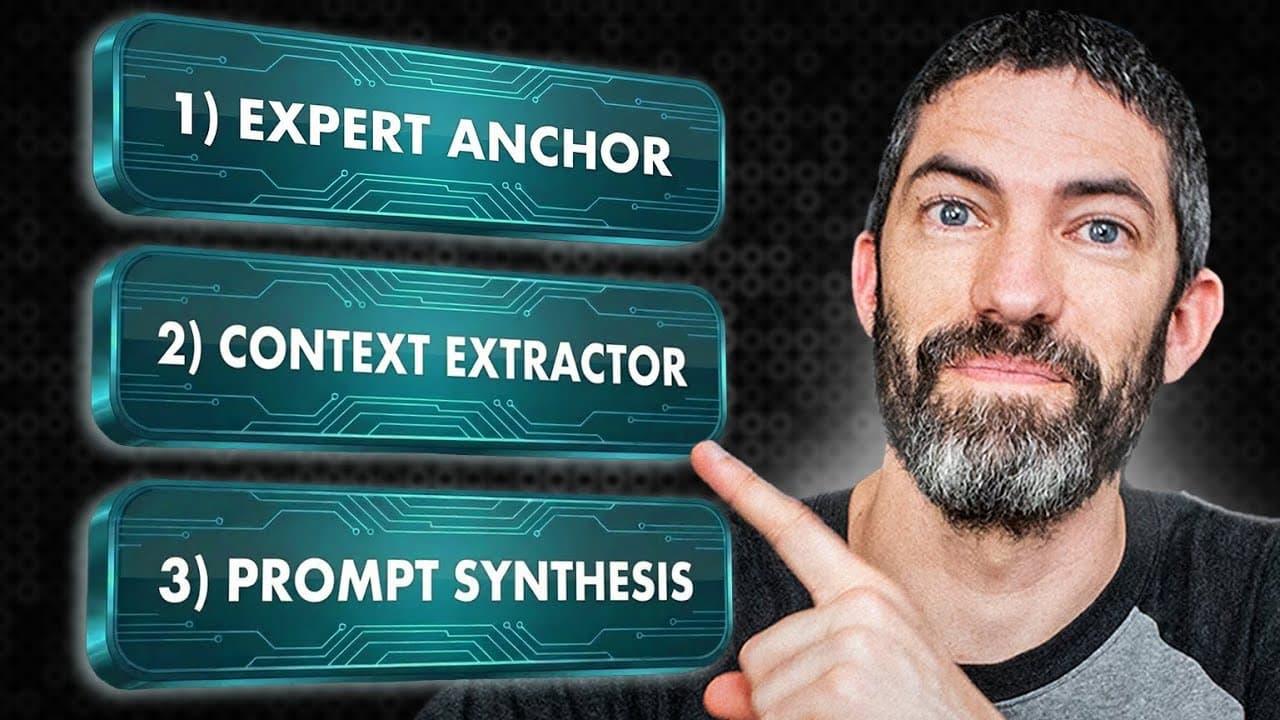
The core problem is that AI answers look right and sound professional but turn out to be generic advice when you try to execute them. Three causes drive this: the model plays too safe, it does not know your situation, and phrasing the request well is genuinely hard. A three-step system addresses each cause without complex prompt engineering.
-
Step one is the expert anchor. Upload a real expert source, for example Alex Hormozi's 100 Million Money Models for a product launch, and ask the AI to extract the core framework, step-by-step logic, constraints, and golden rules into a master guide. The output shifts from a classic marketing launch calendar to a money model build and deploy system.
-
Step two is context extraction, done in a separate chat: the AI interviews you one question at a time about budget, target audience, and personal goals, then compiles everything into a structured context file. Step three is a meta prompt that fuses the guide and the context into a RICE-style master prompt, output for use in a clean session.
Read in Other Languages (beta)
Share This Summary 📚
Summarize YouTube Videos and Get Video Transcripts with 1-Click
Try YouTube Summary with ChatGPT & Claude or YouTube Transcript Generator
Explore More Summaries from Futurepedia 📚




Summarize YouTube Videos and Get Video Transcripts with 1-Click
Try YouTube Summary with ChatGPT & Claude or YouTube Transcript Generator