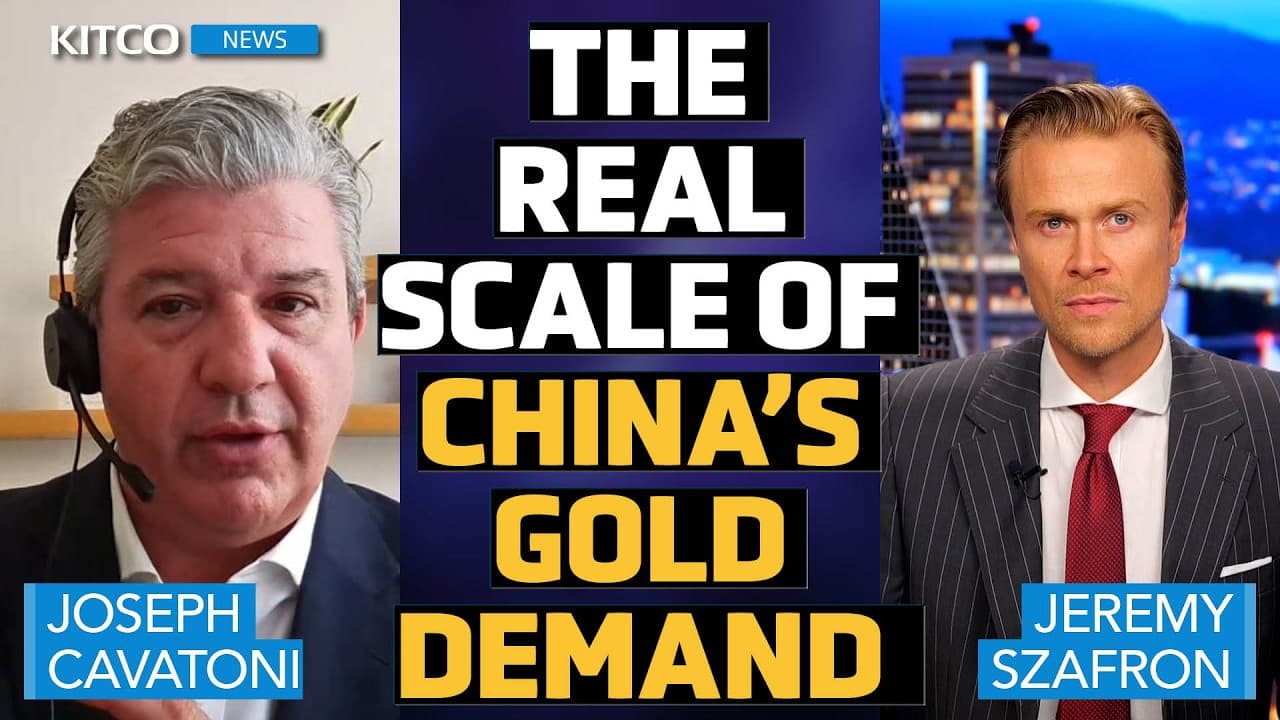
Is China’s Gold Buying 10x Higher Than Official Reports? The World Gold Council Responds
TL;DR
China’s true gold imports may be 10 times larger than some Western reports indicate, but the provided material does not confirm that estimate. Customs-based analysis suggests purchases may be obscured by routing through London and Switzerland, while the World Gold Council describes broader central-bank buying as reserve diversification rather than complete de-dollarization. Read on to understand the evidence, uncertainties, and forces driving gold demand.
Transcript
Welcome back. I'm Jeremy Saver. Well, we're at a fascinating and volatile inflection point for the global economy. Spot gold is trading at record levels above $3,600 an ounce. And it's driven by two powerful conflicting forces. Now, this morning, we saw US jobless claims surge to a 4-year high, a clear sign of economic weakness and a problem in the... Read More
Key Insights
- Gold is functioning as a portfolio diversifier because it can provide liquidity, preserve purchasing power, and offer protection when risk assets decline. The World Gold Council argues that these qualities remain relevant across several economic outcomes, including the stagflationary scenario discussed in the interview.
- The divergence between gold and copper reflects their different market signals. Copper is presented as an indicator of conditions in certain economic markets, while gold more directly reflects global investment sentiment, currency concerns, fiscal policy, political policy, and uncertainty surrounding dollar-denominated assets.
- Western investment demand is contributing significantly to the gold rally. The interview identifies renewed activity through exchange-traded funds and the over-the-counter market, with strong participation from the United States and improving flows from Europe alongside continued Asian demand.
- Jewelry demand is weakening because high gold prices constrain consumers in price-sensitive markets. Although favorable seasonal signals may emerge in India, the World Gold Council expects overall annual jewelry consumption to remain under pressure unless those early signs become material and persistent.
- Central-bank buying is a long-running structural trend rather than a reaction to a single trade dispute. Emerging-market central banks have been especially important buyers, using gold to diversify their reserves and reduce concentrated exposure to major foreign currencies.
- Reduced dollar reliance is not the same as abandoning the dollar. The World Gold Council characterizes central-bank behavior as appropriate diversification, reflecting a desire to hold assets that can operate internationally, globally, and within domestic financial systems when necessary.
- Central-bank demand may respond to rapid price increases even when the strategic case for gold remains intact. The interview identifies price sensitivity and the time required to adjust to higher trading levels as important uncertainties affecting when reserve managers make additional purchases.
- China’s reported gold flows may understate purchases routed through international trading hubs. The source presents customs-based analysis suggesting substantially larger imports, but the provided transcript excerpt does not include the World Gold Council’s detailed assessment or a final confirmation of that estimate.
Install to Summarize YouTube Videos and Get Transcripts
Explore YouTube Video Summarizer or Get YouTube Transcript Extractor
Questions & Answers
Q: Is China’s gold buying 10 times higher than official reports?
A customs-based analysis cited in the interview suggests China’s true gold imports may be 10 times larger than amounts officially reported from some Western nations. Purchases routed through global hubs such as London and Switzerland could obscure the totals, but the provided material does not confirm the estimate.
Q: Why are central banks increasing their gold reserves?
Central banks are buying gold as part of a long-running reserve-diversification strategy, particularly among emerging-market institutions. Gold reduces concentrated reliance on the dollar and euro and can function in international, global, and domestic financial settings.
Q: Does central-bank gold buying mean complete de-dollarization?
No. The World Gold Council characterizes the trend as appropriate diversification and reduced reliance on major reserve currencies, not the complete abandonment of the dollar or euro.
Q: What is driving the gold rally?
Investment demand and central-bank reserve buying are major drivers. Western investors have returned through gold-backed exchange-traded funds and larger over-the-counter transactions amid economic weakness, inflation, trade uncertainty, and elevated risk-asset valuations.
Q: How can gold help investors during stagflation?
Gold can diversify a portfolio, preserve purchasing power, and provide protection when risk assets decline. The interview presents these qualities as useful when economic growth slows while costs continue to rise.
Q: Why are gold and copper sending different market signals?
Copper is described as diagnosing conditions in certain economic markets, while gold reflects broader global investment sentiment. Gold also captures concerns about currencies, dollar-denominated assets, fiscal policy, political policy, and trade uncertainty.
Q: Who is buying gold through financial markets?
Western investors have returned through exchange-traded funds, with significant United States inflows and improving European participation alongside Asian demand. The interview cites more than $40 billion entering the ETF market, while physical bar-and-coin demand has developed more slowly.
Q: Why is gold jewelry demand weakening?
High gold prices are constraining consumers in price-sensitive markets such as India and China. Favorable seasonal indications may emerge in India, but the World Gold Council expects annual jewelry consumption to remain under pressure unless those signals become material and persistent.
Summary & Key Takeaways
-
Gold is benefiting from concerns about economic weakness, persistent inflation, trade uncertainty, and vulnerable risk-asset valuations. The World Gold Council presents gold as a liquid diversification asset that can preserve purchasing power and provide protection during market declines, including under the stagflationary conditions discussed in the interview.
-
Demand has shifted toward financial investment and official reserves. Western investors have returned through gold-backed exchange-traded funds and larger over-the-counter transactions, while central banks remain net buyers. By contrast, physical bar-and-coin activity has been slower to develop, and high prices continue to suppress jewelry consumption in price-sensitive markets.
-
Central-bank gold accumulation is described as a long-running diversification strategy led mainly by emerging-market institutions. Survey responses indicate that many central banks expect to rely less on the dollar and euro. The interview distinguishes reduced reliance from abandoning those currencies and notes that purchase timing may depend on price sensitivity.
Read in Other Languages (beta)
Share This Summary 📚
Summarize YouTube Videos and Get Video Transcripts with 1-Click
Try YouTube Summary with ChatGPT & Claude or YouTube Transcript Generator
Explore More Summaries from Kitco NEWS 📚



Summarize YouTube Videos and Get Video Transcripts with 1-Click
Try YouTube Summary with ChatGPT & Claude or YouTube Transcript Generator